The Bombay High Court has clarified that a declaration under Section 3 of the Works of Defence Act, 1903, imposing land use restrictions for defence purposes, lapses if no compensation award process is initiated within three years. This ruling reinforces the principle that indefinite restrictions without compensation violate constitutional guarantees of property rights and due process.
Background & Facts
The Dispute
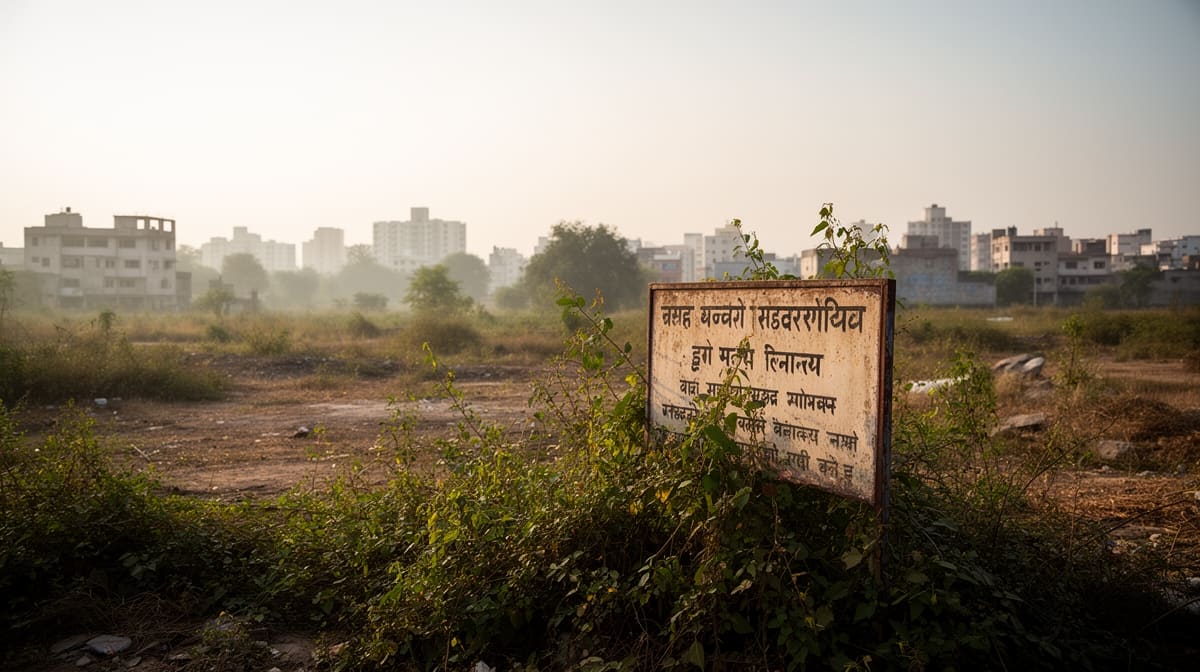
The petitioners, Shri Ivan Singh and Shri Shailesh Wankhede, are landowners in Village Chitki and Kurla, Tehsil Deoli, District Wardha. Their agricultural land, comprising Survey Nos. 40, 41, 42, 44, 45/2 and 45/3, lies within a 2000-yard clearance zone around the Central Ammunition Depot (CAD), Pulgaon. In 2002, the Union of India issued SRO No.85 under Section 3 of the Works of Defence Act, 1903, imposing restrictions on construction and land use in this zone. Despite the declaration, no steps were taken to assess or pay compensation to affected landowners.
Key Facts
- The declaration under Section 3 of the Works of Defence Act, 1903, was issued via SRO No.85 on 15/04/2002.
- A public notice dated 06/09/2001 preceded the declaration, informing the public of proposed restrictions.
- On 20/04/2023, the District Collector issued a notice reiterating the 2000-yard safety zone and prohibiting all construction activities within it.
- The petitioners made representations seeking either acquisition of their land or payment of compensation for the restrictions imposed, but received no response.
- The petitioners’ land remains subject to restrictions without any compensation, despite over two decades having passed since the declaration.
Procedural History
- 15/04/2002: Union of India issues SRO No.85 under Section 3 of the Works of Defence Act, 1903.
- 06/09/2001: Preliminary public notice issued regarding proposed restrictions.
- 20/04/2023: District Collector issues notice enforcing the 2000-yard clearance zone.
- 2025: Petitioners file Writ Petition No. 2190 of 2025 before the Bombay High Court, Nagpur Bench, seeking quashing of SRO No.85 and the 2023 notice.
- 23/03/2026: Oral judgment delivered by the Division Bench.
The Parties' Positions
For the Petitioners
The petitioners contended that the declaration under Section 3 had become legally ineffective due to the state’s failure to initiate the mandatory compensation process under Sections 9 and 12 of the Act. They relied on the Supreme Court’s judgment in M/s. Goya Resorts Pvt. Ltd. v. Union of India (Civil Appeal No. 6079 of 2017, decided on 18/12/2024), which held that failure to complete the compensation process within the statutory timeframe renders the declaration void.
For the Respondents
The Union of India and the General Officer Commanding did not dispute the non-completion of the compensation process. The Advocate General for Maharashtra conceded that no notice under Section 9 was issued within 18 months, nor was any extension granted by the Central Government under Section 9(b). The respondents acknowledged the lapse but sought time to re-initiate the process.
Relief Sought
The petitioners sought:
- Quashing of SRO No.85 dated 15/04/2002.
- Quashing of the District Collector’s communication dated 20/04/2023.
- Declaration that the 2000-yard safety zone is legally invalid due to non-compliance with the Act.
- Compensation for loss of land use rights, though no specific monetary claim was quantified.
The Legal Issue
The central question was whether a declaration under Section 3 of the Works of Defence Act, 1903, imposing land use restrictions, remains valid indefinitely in the absence of any action taken under Section 9 to initiate compensation proceedings within the statutory period of three years.
Arguments Presented
For the Petitioner
Shri Akshay Mohan Sudame argued that the scheme of the Act is sequential and interdependent: Section 3 declares restrictions, but Sections 9 and 12 mandate a time-bound process for inquiry and award of compensation. Failure to initiate this process within the prescribed period - either within 18 months or, at most, three years under Section 9(b) - renders the declaration legally inoperative. He cited M/s. Goya Resorts Pvt. Ltd. v. Union of India, where the Supreme Court held that perpetual restrictions without compensation are arbitrary and violate Article 14 and Article 300A of the Constitution. The petitioners emphasized that their land has been effectively rendered unusable for over 20 years without any compensation or acquisition.
For the Respondent
Shri C.J. Dhumane and Shri H.D. Marathe, A.G.P., did not contest the factual position that no notice under Section 9 was issued, nor was any extension granted. They acknowledged the lapse but requested the Court to suspend the quashing for six months to allow the government to initiate a fresh declaration under Section 3, ensuring continuity of defence security measures.
The Court's Analysis
The Court undertook a detailed textual and structural analysis of the Works of Defence Act, 1903, particularly Sections 3, 9, and 12. It observed that the Act is not a mere regulatory instrument but a statutory mechanism designed to balance national security with property rights. The Court emphasized that Section 3 is not self-executing; it is the trigger for a mandatory compensation process.
"The natural consequences, although not stated in the 1903 Act, would be of the lapsing of the declaration made under section 3 thereof. The same will have to be read in the context, as otherwise the Government could have continued with the declaration under Section 3 of the 1903 Act without suitably compensating the affected perpetually. This is impermissible in law. It would be arbitrary, unjust and unreasonable."
The Court held that the Supreme Court’s ruling in Goya Resorts is directly applicable. The Act requires the Collector to issue a notice to interested persons under Section 9 within 18 months of the declaration, or within a maximum extension of three years. In this case, no such notice was issued, nor was any extension notified in the Official Gazette. Consequently, the statutory machinery for determining compensation was never activated.
The Court rejected the notion that a declaration could remain in force indefinitely. It noted that such a reading would convert the Act into a tool for permanent deprivation of property rights without due process, which is constitutionally untenable. The Court further held that the communication dated 20/04/2023, which relied entirely on the lapsed SRO No.85, was legally unsustainable.
The Verdict
The petitioners succeeded. The Court quashed and set aside:
- SRO No.85 dated 15/04/2002 issued under Section 3 of the Works of Defence Act, 1903.
- The communication dated 20/04/2023 issued by the District Collector.
- The earlier public notice dated 06/09/2001.
The quashing is kept in abeyance until 22/09/2026 to allow the Central Government to initiate a fresh declaration under Section 3, provided it strictly follows the statutory procedure, including notice under Section 9 and award under Section 12, within the prescribed timelines. No costs were awarded.
What This Means For Similar Cases
Declaration Without Compensation Is Legally Void
- Practitioners must now challenge any defence-related land restrictions that have remained unaccompanied by compensation proceedings for more than three years.
- The lapse is automatic; no separate declaration of invalidity is required.
- Any subsequent notices or orders relying on such lapsed declarations are void ab initio.
Procedural Compliance Is Non-Negotiable
- The Works of Defence Act, 1903, is not a discretionary instrument. Compliance with Sections 9 and 12 is mandatory.
- Extensions under Section 9(b) must be published in the Official Gazette; mere internal orders or administrative notes are insufficient.
- Failure to comply with the timeline extinguishes the legal basis for restrictions, regardless of national security claims.
Remedies for Long-Term Landowners
- Landowners whose property has been restricted for over three years without compensation may now seek restoration of use rights.
- Future declarations must be accompanied by a clear timeline for compensation, with strict adherence to statutory deadlines.
- Claims for past deprivation may be pursued under Article 300A, even if no specific compensation was claimed in the writ petition.