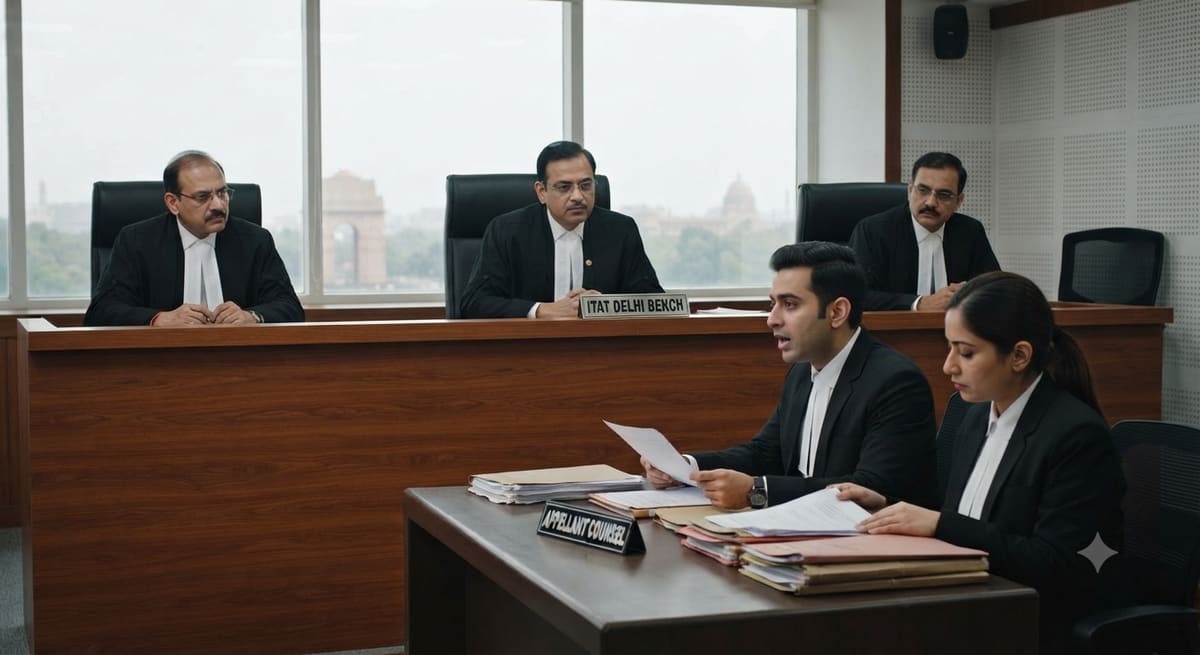
The Income Tax Appellate Tribunal, Mumbai, has reaffirmed that ex parte dismissal of an appeal under Section 250(6) of the Income Tax Act, without considering a bona fide request for adjournment or explaining the reasons for non-appearance, constitutes a violation of natural justice. This judgment restores procedural fairness as a non-negotiable pillar of appellate adjudication in tax matters.
Background & Facts
The Dispute
The appellant, Mustak Panirwala, an individual proprietor of "Techno Repair Construction", filed his income tax return for A.Y. 2020-21 on 15.02.2021 declaring income of Rs. 49,76,850. The case was selected for faceless scrutiny under the Faceless Assessment Scheme due to: (i) large investment in immovable property as per Form 26QB, (ii) purchase consideration significantly below stamp duty value, and (iii) high liabilities relative to declared income.
Key Facts
- The Assessing Officer (AO) observed a sharp increase in secured loans from nil in A.Y. 2019-20 to Rs. 6,93,14,917/- in A.Y. 2020-21.
- Sundry creditors increased from Rs. 83,17,101/- to Rs. 5,64,17,395/-.
- The AO accepted bank loans of Rs. 4,98,14,913/- but treated Rs. 1,95,00,000/- (from Building Guild India and Hiren Bharat Thakkar) as unexplained income under Section 68.
- The increase in sundry creditors of Rs. 4,81,00,294/- was also treated as unexplained income under Section 68.
- On 13.12.2019, the assessee purchased immovable property for Rs. 3,38,10,000/-, while stamp duty value was Rs. 6,47,21,500/-. The difference of Rs. 3,09,11,500/- was added under Section 56(2)(x).
- Turnover declared in GSTR-3B was Rs. 16,46,18,549/-, while return showed Rs. 13,59,42,221/-. The difference of Rs. 2,86,76,328/- was added under Section 37.
- The AO issued notices under Sections 143(2) and 142(1). Initial compliance was absent; partial compliance followed only after show cause notices.
Procedural History
- 27.09.2022: Assessment order passed under Section 143(3) read with Section 144B.
- 25.10.2025: CIT(A) passed ex parte order dismissing the appeal without adjudicating any issue on merits.
- 07.04.2026: Hearing before ITAT Mumbai.
- 07.05.2026: Judgment pronounced.
The Parties' Positions
For the Assessee
- Submitted that a request for adjournment was filed via e-proceedings portal due to the authorised representative being engaged in tax audit work.
- Filed an affidavit before the Tribunal explaining that the person handling tax affairs (his brother) was seriously ill and subsequently passed away, causing disruption in representation.
- Asserted no willful default; circumstances were beyond control.
- Highlighted that a co-ordinate bench in ITA No. 7242/Mum/2025 (Smt. Sophia Mushtaq Panirwala, co-owner of the same property) had restored the matter to the AO for de novo adjudication, citing failure to refer to District Valuation Officer and lack of appreciation of explanation regarding setback and encroachment.
For the Revenue
- Did not oppose restoration of the matter to the AO for fresh adjudication.
- Fairly conceded that the issues warranted reconsideration in light of the co-ordinate bench’s decision and procedural irregularities.
Relief Sought
The assessee sought: (i) setting aside of the ex parte order dated 25.10.2025; (ii) restoration of the appeal to the file of the Assessing Officer for de novo adjudication; (iii) consideration of all evidence and submissions already filed during assessment; and (iv) application of the co-ordinate bench’s decision in the co-owner’s case.
The Legal Issue
The central question was whether Section 250(6) of the Income Tax Act permits an appellate authority to dismiss an appeal ex parte without considering a request for adjournment and without evaluating whether the appellant was prevented by reasonable cause from appearing, thereby violating the principles of natural justice.
Arguments Presented
For the Appellant
The appellant relied on the mandate of Section 250(6), which requires the CIT(A) to pass a speaking order after considering the appeal on merits. It was argued that the CIT(A) failed to consider the e-proceedings acknowledgement of the adjournment request and ignored the affidavit explaining the death of the appellant’s brother, who managed his tax affairs. The appellant cited State of U.P. v. Mohammad Noor and K. S. Puttaswamy v. Union of India to underscore that natural justice is a constitutional imperative, even in statutory proceedings. The co-ordinate bench’s decision in the co-owner’s case was invoked to establish parity and consistency.
For the Respondent
The Revenue did not contest the appellant’s factual assertions. The Departmental Representative conceded that the ex parte dismissal was procedurally flawed and that the matter should be restored for fresh adjudication, particularly in light of the co-ordinate bench’s decision and the absence of any evidence of mala fide intent.
The Court's Analysis
The Tribunal emphasized that Section 250(6) mandates a reasoned, speaking order and prohibits mechanical or ex parte dismissals. The CIT(A)’s failure to consider the adjournment request and the affidavit explaining the appellant’s inability to appear was not merely procedural negligence - it was a substantive breach of natural justice.
"The explanation offered appears to be bona fide and remains uncontroverted."
The Tribunal noted that the appellant’s affidavit, detailing the death of his brother and resultant disruption, was not rebutted by the Revenue. The Tribunal further observed that the issue under Section 56(2)(x) involved a jointly owned property, and a co-ordinate bench had already restored a nearly identical case to the AO for de novo adjudication, including a direction to refer to the District Valuation Officer. To uphold judicial consistency and avoid contradictory outcomes, the Tribunal held that parity must be maintained.
The Tribunal rejected the notion that ex parte dismissal is a permissible shortcut for appellate authorities burdened with caseloads. It held that statutory forums must balance efficiency with fairness, and that the right to be heard is not contingent on the convenience of the forum.
The Verdict
The appeal was allowed for statistical purposes. The Tribunal set aside the order of the CIT(A) dated 25.10.2025 and restored the entire matter to the file of the Assessing Officer for de novo adjudication on merits. The Assessing Officer is directed to consider all evidence and submissions previously filed, including the affidavit and loan confirmations, and must take into account the decision in ITA No. 7242/Mum/2025. The assessee is directed to cooperate fully and furnish any additional details required. Reasonable opportunity of hearing shall be afforded.
What This Means For Similar Cases
Ex Parte Dismissals Are Not Permissible Without Due Inquiry
- Practitioners must now insist that appellate authorities record reasons for rejecting adjournment requests.
- Affidavits explaining personal hardship (e.g., death of a family member handling tax affairs) must be formally submitted and cannot be ignored.
- Failure to consider such affidavits renders the order voidable under Section 250(6).
Parity in Co-Owned Property Cases Is Mandatory
- Where identical issues arise in jointly owned properties, decisions in one case must inform the other.
- If a co-ordinate bench restores a case for de novo adjudication, the same must be done for co-owners unless a material distinction is established.
- Tax officers must be alert to cross-referencing related assessments involving common assets.
Natural Justice Trumps Procedural Technicalities
- The Tribunal reaffirmed that statutory compliance cannot override fundamental fairness.
- Even in faceless assessment regimes, the right to be heard remains inviolable.
- Practitioners should routinely file affidavits explaining non-appearance and cite Section 250(6) as a shield against arbitrary dismissal.