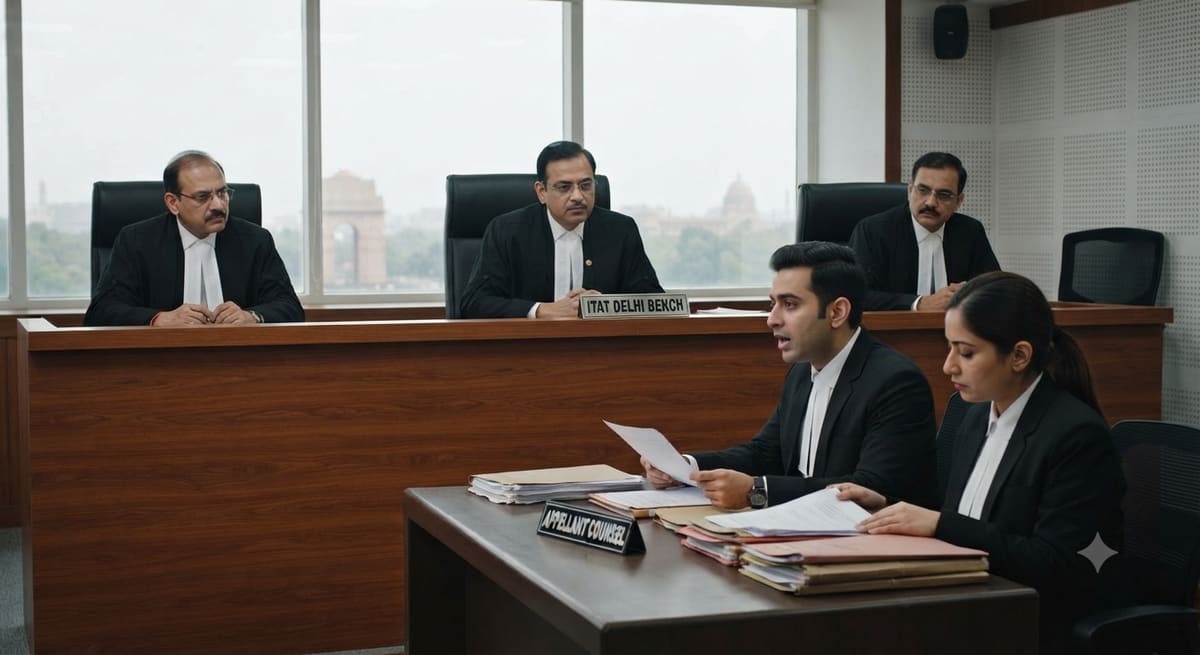
The Income Tax Appellate Tribunal, Guwahati Bench, has reaffirmed that the Commissioner of Income Tax (Appeals) cannot dispose of an appeal mechanically when the assessee remains non-responsive. The Tribunal emphasized that statutory obligations under Section 250(6) of the Income Tax Act require a reasoned, speaking order, irrespective of the assessee’s failure to appear.
Background & Facts
The Dispute
The appeal arises from the reassessment proceedings initiated against Ms. Joymati Gupta for Assessment Year 2015-16. The Assessing Officer received information that the assessee had deposited ₹1,11,89,900 in cash in Punjab National Bank during Financial Year 2014-15 without filing a return of income. Based on this, the Assessing Officer initiated reassessment proceedings under Section 147 of the Income Tax Act, 1961.
Key Facts
- The notice under Section 148 was issued on 31.03.2022
- The assessee did not file a return of income in response
- Notices under Section 142(1) and show-cause notices under Section 144 were issued but remained unacknowledged
- No explanation was furnished regarding the source of the cash deposits
- The Assessing Officer passed an ex-parte assessment order on 24.03.2023 under Section 147 read with Section 144 and Section 144B
- The entire cash deposit of ₹1,11,89,900 was treated as unexplained income under Section 69A
- The assessee filed an appeal before the Commissioner of Income Tax (Appeals) - NFAC, Delhi
Procedural History
- 31.03.2022: Notice under Section 148 issued
- 24.03.2023: Ex-parte assessment order passed by Assessing Officer
- 08.01.2026: Order of Commissioner of Income Tax (Appeals) - NFAC, Delhi, confirming the addition
- 15.05.2026: Hearing concluded before ITAT Guwahati Bench
- 05.06.2026: Judgment pronounced by ITAT
The Parties' Positions
The assessee, represented by no advocate, raised multiple grounds of appeal challenging the legality of the reassessment, the application of Section 69A, and the violation of natural justice. The Department, represented by I. Gyaneshori Devi, JCIT, supported the orders passed below.
Relief Sought
The assessee sought quashing of the assessment order, deletion of the addition of ₹1,11,89,900, and a direction to pass a lawful order after proper opportunity. The primary relief sought was not on the merits of the addition but on the procedural illegality of the CIT(A)'s order.
The Legal Issue
The central question was whether the Commissioner of Income Tax (Appeals) can discharge its statutory duty under Section 250(6) of the Income Tax Act by merely endorsing the Assessing Officer’s order without providing independent reasons, particularly when the assessee has not appeared.
Arguments Presented
For the Appellant
Although the assessee was unrepresented, the grounds of appeal raised before the Tribunal challenged the validity of the reassessment proceedings, the application of Section 69A, and the violation of natural justice. The Tribunal inferred that the appellant sought a fair hearing and a reasoned decision, not merely a mechanical confirmation of the lower order.
For the Respondent
The Department contended that the assessee had been given multiple opportunities to explain the source of cash deposits but remained non-responsive. It argued that the Assessing Officer’s order was self-explanatory and that the CIT(A) was justified in upholding it without elaboration.
The Court's Analysis
The Tribunal observed that Section 250(6) mandates that the CIT(A) must pass a speaking order that clearly states the points for determination, the decision, and the reasons for arriving at such decision. The Bench noted that the CIT(A)’s order merely stated that the assessee had not responded and that the AO’s order was therefore upheld, without addressing any of the grounds raised in the appeal.
"The law does not empower the CIT(A) to dismiss the appeal for non-prosecution as is evident from the provisions of the Act."
The Tribunal relied on Ajji Basha v. CIT (2019) and Commissioner of Income-tax (Central) Nagpur v. Premkumar Arjundas Luthra (HUF) [2016] to hold that the CIT(A) cannot abdicate its duty to adjudicate on merits merely because the assessee is absent. The absence of representation does not negate the obligation to provide reasoned findings.
The Bench further emphasized that the CIT(A)’s order was not a speaking order and failed to engage with the legal and factual contentions raised in the appeal. The Tribunal held that such a mechanical dismissal violates the principles of natural justice and statutory compliance.
The Verdict
The appeal was partly allowed for statistical purposes. The Tribunal set aside the order of the CIT(A) dated 08.01.2026 and restored the appeal to the Commissioner of Income Tax (Appeals) - NFAC, Delhi, for de novo adjudication. The CIT(A) was directed to afford the assessee a fresh opportunity to be heard and to provide the Assessing Officer an opportunity to be heard under Rule 46A of the Income Tax Rules, 1962, if necessary. The order was to be passed in accordance with law within a reasonable time.
What This Means For Similar Cases
Speaking Orders Are Non-Negotiable
- Practitioners must challenge any CIT(A) order that merely endorses the AO’s order without independent reasoning
- A non-appearance by the assessee does not absolve the CIT(A) of the duty to pass a speaking order under Section 250(6)
- Orders lacking reasons are liable to be set aside even if the outcome appears substantively correct
Procedural Fairness Trumps Technical Non-Compliance
- The Tribunal prioritized procedural justice over the assessee’s failure to respond
- Authorities cannot use non-appearance as a shield to avoid adjudication on merits
- This judgment reinforces that statutory compliance is not optional, even in ex-parte proceedings
Strategic Implications for Practitioners
- Always raise the absence of a speaking order as a ground of appeal, even if the assessee is unrepresented
- File writ petitions before High Courts if CIT(A) orders are passed without reasons
- Use Ajji Basha and Premkumar Luthra as binding precedents to challenge mechanical dismissals