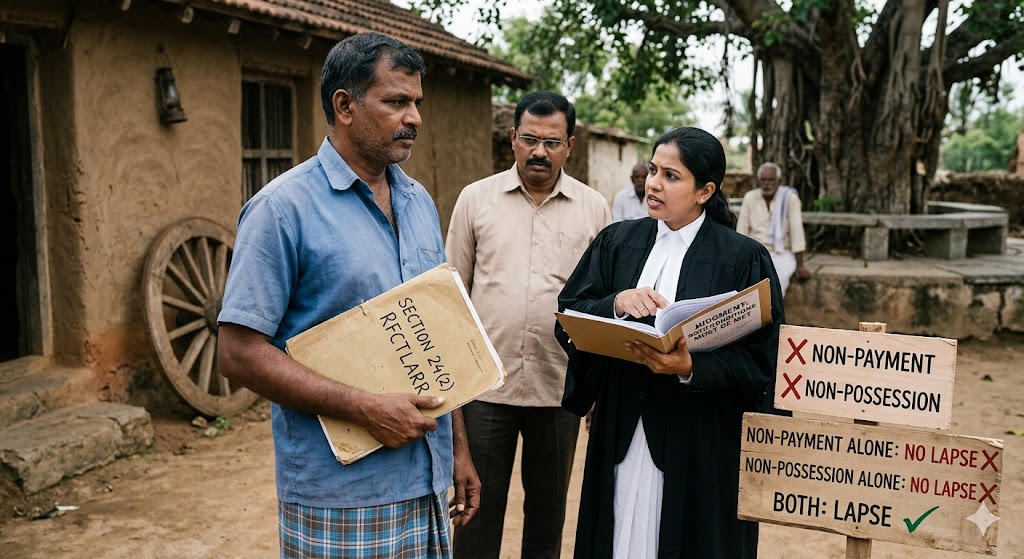
The Karnataka High Court has clarified the stringent twin conditions under Section 24(2) of the Right to Fair Compensation and Transparency in Land Acquisition, Rehabilitation and Resettlement Act, 2013 for declaring acquisition proceedings as lapsed. The Court held that mere deposit of compensation in treasury, without personal payment to landowners, does not satisfy the payment requirement if possession has already been lawfully taken. This judgment reinforces the absolute vesting principle under Section 16 of the Land Acquisition Act, 1894, where land vests in the State free from all encumbrances once possession is taken, barring subsequent divesting even if earlier acquisition proceedings lapse.
Background & Facts
The Dispute
The petitioners, Murugesh Mudaliar, Mohan Mudaliar, and late Sundarvelu Mudaliar (since abated), are legal heirs of Smt. Andalamma, who originally owned land measuring 3 acres 8 guntas in Survey No.20/1B, Madiwala Village, Begur Hobli, Bengaluru South Taluk. The dispute centers on two sets of acquisition proceedings:
Earlier Acquisition (1959-1965): Initiated by the State Government for the benefit of the City Improvement Trust Board (CITB), now Bangalore Development Authority (BDA), via:
Preliminary Notification dated 26.11.1959 under Section 4(1) of the Land Acquisition Act, 1894
Final Notification dated 28.09.1965 under Section 6(1)
Award passed on 02.09.1969, but approval granted only on 05.09.2000
This acquisition was challenged in W.P. No.30558/2000 on grounds of non-compliance with Section 11A of the LA Act, leading to a declaration of lapse by the High Court on 18.07.2002. The Division Bench upheld this in W.A. No.4899/2002 on 23.03.2005.
Subsequent Acquisition (1995-1996): Initiated during the pendency of the earlier proceedings for the benefit of the Indian Institute of Astrophysics, via:
Preliminary Notification dated 14.09.1995
Final Notification dated 27.09.1996
Award passed on 16.11.1997 (later corrected to 24.09.2002)
The petitioners challenged this acquisition in W.P. Nos.6522-6525/1998, contending lack of jurisdiction and public purpose. The High Court dismissed these petitions on 23.07.2002, and the Division Bench upheld the dismissal in W.A. Nos.4916-4918/2002 on 23.03.2005.
Key Facts
Land Details: Survey No.20/1B, Madiwala Village, measuring 3 acres 8 guntas (2 acres 35 guntas subject to subsequent acquisition)
Earlier Acquisition:
Preliminary Notification: 26.11.1959
Final Notification: 28.09.1965
Award: 02.09.1969 (approval: 05.09.2000)
Challenge: W.P. No.30558/2000 (lapse declared on 18.07.2002)
Appeal: W.A. No.4899/2002 (dismissed on 23.03.2005)
Subsequent Acquisition:
Preliminary Notification: 14.09.1995
Final Notification: 27.09.1996
Award: 16.11.1997 (corrected to 24.09.2002)
Possession Mahazar: 12.07.2005
Section 16(2) Notification: 15.07.2005
Possession Certificate: 11.08.2005
Sale Deed: 05.09.2005 (BDA to KSRP)
Compensation: Deposited in treasury as petitioners failed to receive it
Possession: Petitioners claim continued possession with houses, sheds, and nursery activities; respondents deny this, asserting physical possession by Indian Institute of Astrophysics and KSRP
Procedural History
18.07.2002: High Court declares earlier acquisition (1959-1965) lapsed in W.P. No.30558/2000
23.03.2005: Division Bench dismisses W.A. No.4899/2002, upholding lapse
23.07.2002: High Court dismisses W.P. Nos.6522-6525/1998 challenging subsequent acquisition (1995-1996)
23.03.2005: Division Bench dismisses W.A. Nos.4916-4918/2002, upholding subsequent acquisition
12.07.2005: Possession mahazar drawn
15.07.2005: Section 16(2) notification issued
11.08.2005: Possession certificate issued
05.09.2005: Sale deed executed by BDA in favor of KSRP
25.01.2016: Trial Court dismisses O.S. No.2864/2008 (injunction suit by petitioners), holding KSRP in lawful possession
2014: Petitioners file W.P. No.46212/2014 seeking declaration of lapse under Section 24(2) of the 2013 Act
2018: Petitioners file W.P. No.13080/2018 challenging sale deed and possession certificate
17.04.2026: Judgment reserved
12.06.2026: Present judgment delivered
The Parties' Positions
For the Petitioners
Lapse under Section 24(2): Contend that the subsequent acquisition proceedings (1995-1996) have lapsed because:
Compensation was not paid to them or deposited in court; mere treasury deposit is insufficient
Lawful physical possession was never taken; mahazar and Section 16(2) notification are inadequate
Invalidity of Subsequent Acquisition: Argue that the State could not initiate fresh acquisition proceedings in 1995 while the earlier proceedings (1959-1965) were subsisting
Continuing Possession: Assert they have remained in possession, with houses, sheds, and nursery activities on the land
Relief Sought: Declaration that acquisition proceedings have lapsed under Section 24(2) of the 2013 Act, quashing of sale deed and possession certificate
For the Respondents
No Lapse: Rely on Indore Development Authority v. Manoharlal ((2020) 8 SCC 129) to argue that lapse under Section 24(2) requires both non-payment and non-possession. Here, possession was taken, and compensation was deposited
Vesting under Section 16: Contend that once possession is taken under Section 16 of the LA Act, land vests absolutely in the State free from encumbrances, barring divesting
Finality of Proceedings: Argue that the subsequent acquisition proceedings were upheld in W.P. Nos.6522-6525/1998 and W.A. Nos.4916-4918/2002, attaining finality
Independent Source of Title: Assert that the subsequent acquisition proceedings constitute an independent source of title, unaffected by the lapse of earlier proceedings
Possession: Deny petitioners' continued possession, calling their photographs fabricated
Delay and Laches: Contend that W.P. No.46212/2014 was filed 17 years after the award, suffering from delay
Civil Remedy: Argue that validity of sale deed involves disputed questions of fact and title, requiring civil adjudication
The Legal Issue
The central questions before the Court were:
Whether the acquisition proceedings initiated pursuant to the Preliminary Notification dated 14.09.1995 and Final Notification dated 27.09.1996 have lapsed under Section 24(2) of the 2013 Act on grounds that:
Compensation was not paid, and
Lawful physical possession was not taken?
Whether the lapse of the earlier acquisition proceedings (1959-1965) automatically invalidates the subsequent acquisition proceedings (1995-1996)?
Whether the respondents established that pursuant to the subsequent acquisition proceedings:
Award was passed,
Possession was taken under Section 16 of the LA Act, and
Section 16(2) notification was issued, resulting in absolute vesting in the Government?
Whether the petitioners, after vesting under subsequent acquisition proceedings, can seek restoration of title or possession merely because the earlier acquisition proceedings lapsed?
Arguments Presented
For the Petitioners
Twin Conditions for Lapse: Invoked Section 24(2) of the 2013 Act, arguing that both conditions - non-payment of compensation and non-taking of possession - are satisfied:
Compensation: Though deposited in treasury, it was not paid to them or deposited in court, failing the statutory requirement
Possession: Contend that lawful physical possession was never taken; mahazar and Section 16(2) notification are insufficient
Invalidity of Subsequent Acquisition: Argued that the State lacked jurisdiction to initiate fresh acquisition proceedings in 1995 while the earlier proceedings (1959-1965) were subsisting
Continuing Possession: Asserted they have remained in possession, with structures and activities on the land
Res Judicata: Contended that the subsequent acquisition proceedings cannot be insulated from the lapse of the earlier proceedings
For the Respondents
No Lapse: Relied on Indore Development Authority to argue that lapse under Section 24(2) requires both non-payment and non-possession. Here, possession was taken, and compensation was deposited
Vesting under Section 16: Cited Sulochana Chandrakant Galande v. Pune Municipal Transport ((2010) 8 SCC 467) to argue that once possession is taken under Section 16, land vests absolutely in the State, barring divesting
Finality of Proceedings: Emphasized that the subsequent acquisition proceedings were upheld in earlier litigation, attaining finality
Independent Source of Title: Asserted that the subsequent acquisition proceedings constitute an independent source of title, unaffected by the lapse of earlier proceedings
Possession: Denied petitioners' continued possession, calling their evidence fabricated
Delay: Argued that W.P. No.46212/2014 was filed after 17 years, suffering from laches
Civil Remedy: Contended that validity of sale deed involves disputed questions of fact and title, requiring civil adjudication
The Court's Analysis
The Court conducted a meticulous analysis of Section 24(2) of the 2013 Act and the vesting principle under Section 16 of the LA Act, relying heavily on authoritative precedents:
Lapse under Section 24(2): Twin Conditions
The Court examined the Constitution Bench judgment in Indore Development Authority v. Manoharlal, which held:
"366.3. The word 'or' used in Section 24(2) between possession and compensation has to be read as 'nor' or as 'and'. The deemed lapse of land acquisition proceedings under Section 24(2) of the 2013 Act takes place where due to inaction of authorities for five years or more prior to commencement of the said Act, the possession of land has not been taken nor compensation has been paid."
The Court emphasized that both conditions must coexist for lapse. Here, while compensation was deposited in treasury (not personally paid), possession was lawfully taken via:
Possession Mahazar dated 12.07.2005
Section 16(2) Notification dated 15.07.2005
Possession Certificate dated 11.08.2005
Sale Deed dated 05.09.2005 (BDA to KSRP)
The Court rejected the petitioners' contention that treasury deposit does not constitute payment, citing Indore Development Authority:
"366.5. In case a person has been tendered the compensation as provided under Section 31(1) of the 1894 Act, it is not open to him to claim that acquisition has lapsed under Section 24(2) due to non-payment or non-deposit of compensation in court. The obligation to pay is complete by tendering the amount under Section 31(1)."
Vesting under Section 16: Absolute and Unencumbered
The Court relied on Sulochana Chandrakant Galande to elucidate the absolute vesting principle under Section 16 of the LA Act:
"13. ... the property acquired becomes the property of Government without any conditions or limitations either as to title or possession. The legislature has made it clear that the vesting of the property is not for any limited purpose or limited duration."
Key holdings from Sulochana Chandrakant Galande applied:
Once land vests in the State under Section 16, it is free from all encumbrances, and the original owner ceases to have enforceable rights except compensation
No divesting is permissible under Section 24(2) of the 2013 Act once possession is taken
Change of user or transfer between governmental authorities does not invalidate acquisition
The original owner becomes persona non grata post-vesting, with no right to restoration
Independent Validity of Subsequent Acquisition
The Court held that the subsequent acquisition proceedings (1995-1996) constituted an independent source of title, unaffected by the lapse of the earlier proceedings (1959-1965). Key points:
The subsequent acquisition was initiated during the pendency of the earlier proceedings but for a different public purpose (Indian Institute of Astrophysics)
The petitioners independently challenged the subsequent acquisition in W.P. Nos.6522-6525/1998, which were dismissed on 23.07.2002
The Division Bench upheld the subsequent acquisition in W.A. Nos.4916-4918/2002 on 23.03.2005, attaining finality
The sale deed executed by BDA (relying on the lapsed earlier acquisition) is of lesser consequence because the real source of title is the subsequent acquisition proceedings
Possession: Official Records vs. Petitioners' Claims
The Court noted that the petitioners' claim of continuing possession was supported only by photographs and assertions, while the respondents produced:
Possession Mahazar dated 12.07.2005
Section 16(2) Notification dated 15.07.2005
Possession Certificate dated 11.08.2005
Sale Deed dated 05.09.2005
The Court also relied on the civil suit O.S. No.2864/2008, where the Trial Court held:
"43. ... evidence on record clearly shows that defendant no.2 [KSRP] is in lawful possession and enjoyment of the suit schedule property by paying tax to the Bruhat Bengaluru Mahanagara Palike. Hence, on perusal of the entire evidence on record it is much clear that, plaintiffs are not at all in possession and enjoyment of the suit schedule property."
Res Judicata and Finality
The Court emphasized that the subsequent acquisition proceedings were upheld in earlier litigation, attaining finality. The petitioners cannot reopen concluded proceedings under the guise of Section 24(2).
Civil Remedy for Disputed Questions
The Court noted that adjudication of the validity of the sale deed, source of title, and inter se rights between governmental authorities involves disputed questions of fact and title, which are inappropriate for writ jurisdiction. The petitioners' remedy, if any, lies before the civil court.
The Verdict
The Court dismissed both writ petitions, holding:
The acquisition proceedings initiated pursuant to the Preliminary Notification dated 14.09.1995 and Final Notification dated 27.09.1996 have not lapsed under Section 24(2) of the 2013 Act because:
Compensation was deposited (even if not personally paid), and
Lawful possession was taken (evidenced by mahazar, Section 16(2) notification, and possession certificate)
The land vested absolutely in the Government under Section 16 of the LA Act free from all encumbrances, and the petitioners ceased to have enforceable proprietary rights except the right to compensation
The subsequent acquisition proceedings (1995-1996) constitute an independent source of title, unaffected by the lapse of the earlier proceedings (1959-1965)
The petitioners cannot seek restoration of title or possession merely because the earlier acquisition lapsed
The sale deed executed by BDA (relying on the lapsed earlier acquisition) is of lesser consequence compared to the subsequent acquisition proceedings
What This Means For Similar Cases
Section 24(2) Lapse: Strict Twin Conditions
Both non-payment AND non-possession required: Practitioners must note that Section 24(2) lapse is attracted only if both conditions coexist. Mere treasury deposit of compensation, without personal payment, does not suffice if possession is taken
Possession mahazar and Section 16(2) notification critical: Official records evidencing lawful possession (mahazar, Section 16(2) notification, possession certificate) will defeat lapse claims
No divesting post-vesting: Once possession is taken under Section 16, land vests absolutely in the State, and Section 24(2) cannot divest the Government
Vesting under Section 16: Absolute and Unassailable
No encumbrances post-vesting: Land vests in the State free from all encumbrances, including easements, mortgages, or claims by original owners
Change of user or transfer permissible: Government can change the user of acquired land or transfer it between authorities without invalidating acquisition
No restoration right: Original owners cannot seek restoration even if land is used for a different public purpose or transferred
Compensation is sole remedy: Post-vesting, original owners' only right is compensation; no proprietary claims survive
Subsequent Acquisition: Independent Validity
Independent source of title: Subsequent acquisition proceedings constitute an independent source of title, even if earlier proceedings lapse
Finality of proceedings: If subsequent acquisition proceedings are upheld in earlier litigation, they attain finality and cannot be reopened under Section 24(2)
Civil remedy for disputed questions: Validity of sale deeds, source of title, and inter se rights between authorities involve disputed questions of fact, requiring civil adjudication
Delay and Laches: Procedural Hurdles
Unexplained delay fatal: Petitions filed after significant delay (e.g., 17 years post-award) may be dismissed on grounds of laches
Res judicata: Parties cannot reopen concluded proceedings under the guise of Section 24(2) if earlier litigation upheld the acquisition