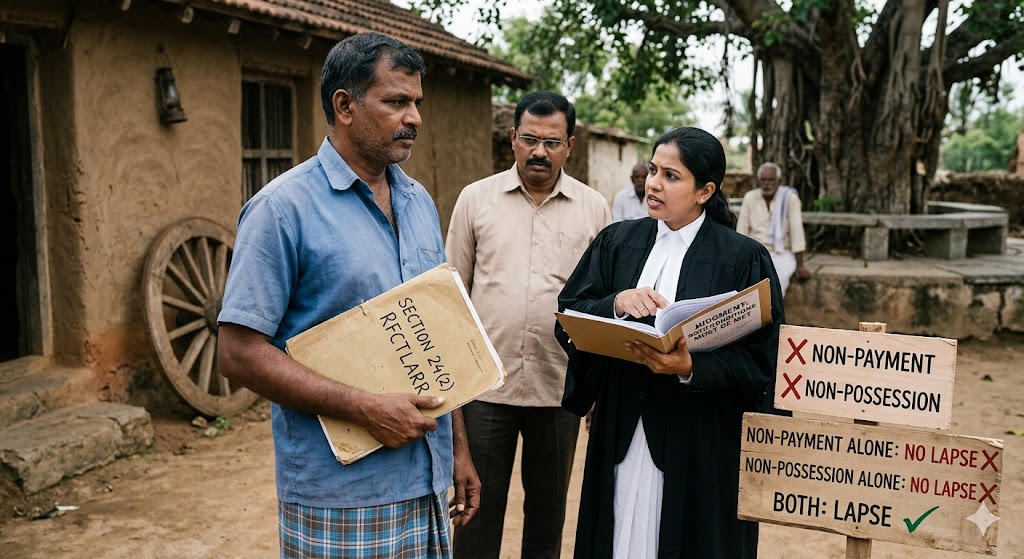
The Rajasthan High Court has reaffirmed that land acquisition proceedings lapse under Section 24(2) of the Right to Fair Compensation and Transparency in Land Acquisition, Rehabilitation and Resettlement Act, 2013, where neither possession has been taken nor compensation paid within five years prior to the Act’s enforcement. This ruling restores the rights of landowners whose property was subject to decades of inaction by the acquiring authority.
Background & Facts
The Dispute
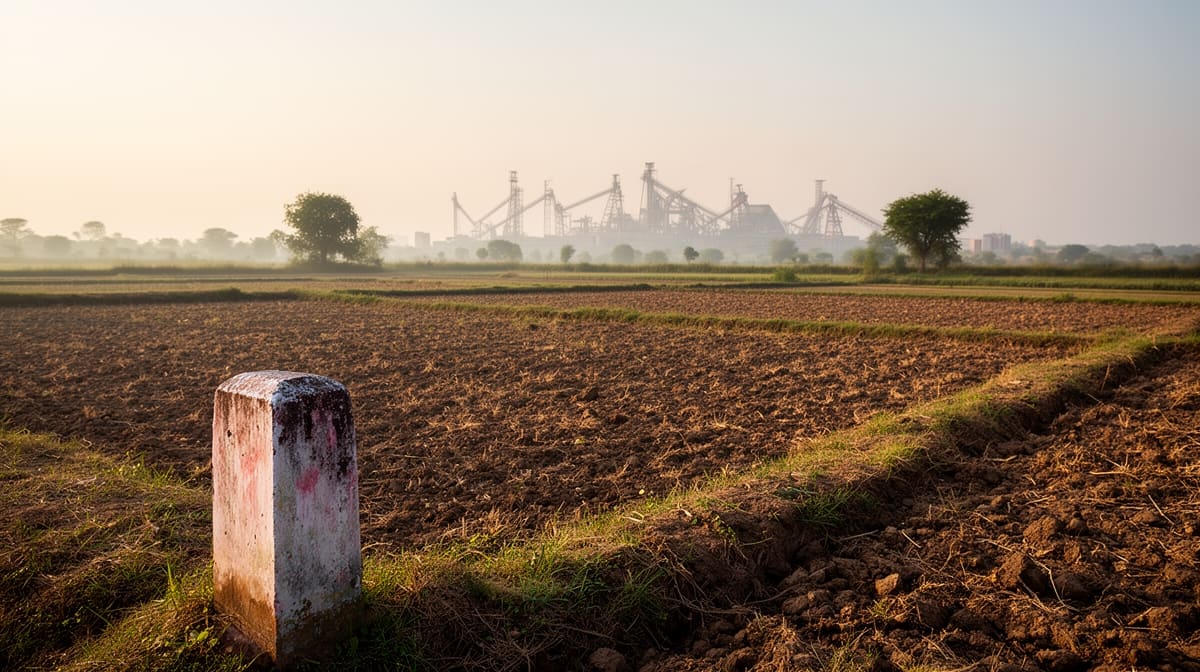
The dispute centers on land bearing Khasra No. 194, measuring 23 bighas and 8 biswas, located in Village Beed Khatipura, Jaipur. The land was purchased by Jhutharam S/o Rampratap and Shaitan Singh S/o Ramdas on 10.11.1975. Subsequent proceedings under the Urban Land (Ceiling and Regulation) Act, 1976 and the Land Acquisition Act, 1894 were initiated, but neither possession nor compensation was ever lawfully completed.
Key Facts
- The land was purchased on 10.11.1975 and registered with mutation entry on 03.01.1976
- Proceedings under the Urban Land (Ceiling and Regulation) Act, 1976 were initiated in 1991
- An interim order dated 06.04.1993 restrained dispossession, later confirmed by the High Court on 26.04.1997
- A notification under Section 4 of the Land Acquisition Act, 1894 was issued on 23.10.1991
- An award under the Land Acquisition Act, 1894 was passed on 27.05.1995
- No memorandum of possession was ever prepared or produced
- Compensation was not paid, tendered, or deposited in the treasury or before the reference court
- A cheque for compensation issued on 19.01.2002 was returned by the Land Acquisition Officer due to subsisting court orders
- The Supreme Court granted an interim stay on 12.01.2001, maintaining possession with the landowners
- The land remained in the physical possession of the original owners and their heirs throughout
- In 2014, registered sale deeds were executed in favor of the legal heirs of Shaitan Singh (Appellants Nos. 3 to 7)
Procedural History
- 10.11.1975: Purchase of land by Jhutharam and Shaitan Singh
- 03.01.1976: Mutation recorded in favor of purchasers
- 1991: Proceedings initiated under ULC Act, 1976 and Land Acquisition Act, 1894
- 06.04.1993: High Court interim order restraining dispossession
- 26.04.1997: High Court dismissed writ petition challenging ULC proceedings, but possession remained with landowners
- 27.05.1995: Award passed under Land Acquisition Act, 1894
- 04.09.1995: High Court stayed dispossession under Land Acquisition proceedings
- 1997: Appeal against award dismissed as belated
- 12.01.2001: Supreme Court granted interim stay in SLP No. 21538/2000
- 10.04.2002: Settlement Committee of JDA directed regularization upon deposit of 25% of reserved price (Rs. 1,650/sq.m)
- 08.05.2002: Petitioners withdrew SLP and deposited Rs. 1,45,05,000 (partial payment)
- 15.09.2004: Settlement Committee dissolved
- 08.09.2003: Legal opinion issued advising non-implementation of Settlement Committee order
- 21.08.2007: State Government directed implementation of Settlement Committee order
- 16.11.2007: State Government stayed implementation
- 16.08.2012: PIL No. 2658/2003 decided, Settlement Committee order remained unimplemented
- 13.08.2013: Petitioners made fresh representation for implementation
- 01.01.2014: Right to Fair Compensation and Transparency in Land Acquisition, Rehabilitation and Resettlement Act, 2013 came into force
- 2442/2015: Writ petition filed before Single Judge of Rajasthan High Court
- 15.10.2015: Single Judge held acquisition proceedings lapsed under Section 24(2) of the 2013 Act but declared subsequent sale deeds void and upheld notices under Section 72 of JDA Act
- 1208/2015: Appeal filed by Jhutharam and heirs challenging adverse findings
- 19/2016: Appeal filed by JDA challenging finding of lapse
- 30.03.2026: Arguments concluded
- 27.05.2026: Judgment pronounced
The Parties' Positions
Appellants (Jhutharam and Legal Heirs): Argued that acquisition proceedings lapsed under Section 24(2) of the 2013 Act due to non-taking of possession and non-payment of compensation. Contended that the Settlement Committee’s order was not implemented due to state inaction, and that subsequent sale deeds were valid. Asserted entitlement to regularization under Section 90-A of the Rajasthan Land Revenue Act.
Respondents (JDA and State): Argued that the award of 1995 and the Settlement Committee’s 2002 order constituted conclusive vesting and surrender of rights. Claimed that tendering of compensation (even if returned) satisfied the requirement of payment under Section 24(2). Asserted that the petitioners were trespassers due to unauthorized construction and that sale deeds were void.
Relief Sought
The appellants sought: (1) declaration that acquisition proceedings lapsed under Section 24(2) of the 2013 Act; (2) setting aside of the Single Judge’s order declaring sale deeds void; (3) direction to decide pending applications under Section 90-A of the Rajasthan Land Revenue Act; (4) refund of Rs. 1,45,05,000 deposited under the Settlement Committee with interest.
The JDA sought: (1) setting aside of the finding of lapse under Section 24(2); (2) upholding of notices under Section 72 of the JDA Act; (3) declaration that land vested in the State.
The Legal Issue
The central question was whether Section 24(2) of the Right to Fair Compensation and Transparency in Land Acquisition, Rehabilitation and Resettlement Act, 2013 applies to render acquisition proceedings lapsed where neither possession has been taken nor compensation paid within five years prior to its enforcement, and whether the conduct of landowners in participating in a settlement process constitutes waiver or estoppel.
Arguments Presented
For the Appellant/Petitioner
Counsel for Jhutharam and heirs relied on Indore Development Authority v. Manoharlal (2020) 8 SCC 129 to argue that lapse under Section 24(2) requires both non-possession and non-payment. They emphasized that no memorandum of possession was ever prepared, and compensation was never tendered or deposited. They contended that the Settlement Committee’s order was never implemented due to state inaction, and that partial deposit under the scheme did not amount to surrender of title. They further argued that Section 90-A of the Rajasthan Land Revenue Act permits regularization for both original owners and transferees, and that the Single Judge erred in adjudicating beyond pleadings by declaring sale deeds void.
For the Respondent/State
Counsel for JDA argued that the award of 1995 and the Settlement Committee’s 2002 order amounted to constructive possession and implied surrender of rights. They relied on Indore Development Authority to assert that tendering compensation - even if returned due to litigation - satisfies the requirement of payment. They contended that the petitioners’ withdrawal of SLP and partial payment constituted an election and waiver of rights under the Land Acquisition Act. They further argued that unauthorized construction rendered the petitioners trespassers under Section 90-A(5), and that sale deeds were void ab initio.
The Court's Analysis
The Court undertook a detailed review of the factual and legal position under Section 24(2) of the 2013 Act, referencing the Constitution Bench judgment in Indore Development Authority v. Manoharlal. The Court observed that the word "or" in Section 24(2) must be read as "nor" or "and", meaning lapse occurs only if both possession and compensation remain unfulfilled for five years prior to 01.01.2014.
"The word ‘or’ used in Section 24(2) between possession and compensation has to be read as ‘nor’ or as ‘and’. The deemed lapse of land acquisition proceedings under Section 24(2) of the 2013 Act takes place where due to inaction of authorities for five years or more prior to commencement of the said Act, the possession of land has not been taken nor compensation has been paid."
The Court noted that the award was passed in 1995, but no memorandum of possession was ever drawn, and the State admitted that possession was never taken. The compensation cheque issued in 2002 was returned due to court orders, and no deposit was made in court or treasury. The Supreme Court’s stay order from 2001 remained in force until 2014, and the period of judicial stay was to be excluded from the five-year computation under Indore Development Authority.
The Court rejected the JDA’s argument that the Settlement Committee’s order amounted to vesting or surrender. It held that Section 83-A of the JDA Act made the Committee’s decision binding only if implemented, and the State itself delayed implementation for over a decade. The partial deposit of Rs. 1,45,05,000 was not a payment of compensation under the Land Acquisition Act, but a condition for regularization under a policy scheme.
"The conduct of the petitioners in withdrawing litigation and depositing part of the amount cannot be construed as waiver of statutory rights under the Land Acquisition Act, particularly when the State itself refused to implement its own decision."
The Court further held that the Single Judge erred in declaring the sale deeds void. The validity of these deeds was not pleaded by the respondents, and the Court’s jurisdiction under Articles 226 and 227 cannot be used to adjudicate rights beyond the pleadings. The Court emphasized that the land remained agricultural and could only be converted under Section 90-A of the Rajasthan Land Revenue Act, which applies to both original owners and transferees.
The Court also rejected the JDA’s reliance on Chhotu Ram, distinguishing it on the ground that possession had been taken in that case, whereas here, no possession was ever taken.
The Verdict
The appellants succeeded. The Court held that the acquisition proceedings under the Land Acquisition Act, 1894 stood lapsed under Section 24(2) of the Right to Fair Compensation and Transparency in Land Acquisition, Rehabilitation and Resettlement Act, 2013, due to non-taking of possession and non-payment of compensation. The Single Judge’s order declaring sale deeds void was set aside. The Court directed the Jaipur Development Authority to return the amount of Rs. 1,45,05,000 deposited by the petitioners under the Settlement Committee with interest at 12% per annum from 08.05.2002 until realization. The land is to be treated as agricultural, and the petitioners may apply for regularization under Section 90-A of the Rajasthan Land Revenue Act, with the deposited amount deductible from any conversion charges. The appeal filed by the JDA was dismissed.
What This Means For Similar Cases
Acquisition Proceedings Cannot Be Revived by Settlement Committee Orders
- A settlement committee’s order, even if binding on the authority, does not substitute for lawful possession or compensation under the Land Acquisition Act
- Non-implementation of such orders by the State cannot be used to claim vesting or estoppel against landowners
- Partial payments made under settlement schemes do not constitute payment of compensation under Section 24(2)
Sale Deeds Cannot Be Declared Void Without Pleading
- Courts cannot declare third-party transactions void under writ jurisdiction if such relief was not sought by the respondent
- Validity of sale deeds must be adjudicated in a separate suit, not through Article 226
- Transferees are entitled to claim regularization under Section 90-A if the original owner had lawful possession
Landowners Retain Title Until Lawful Vesting
- Mere non-payment of settlement amount does not transfer title to the State
- Unauthorized construction may warrant demolition, but not forfeiture of ownership
- The State cannot act as a private land dealer; deprivation of property requires strict compliance with statutory procedure
- Landowners may claim interest on amounts deposited under settlement schemes if the State fails to implement its own orders