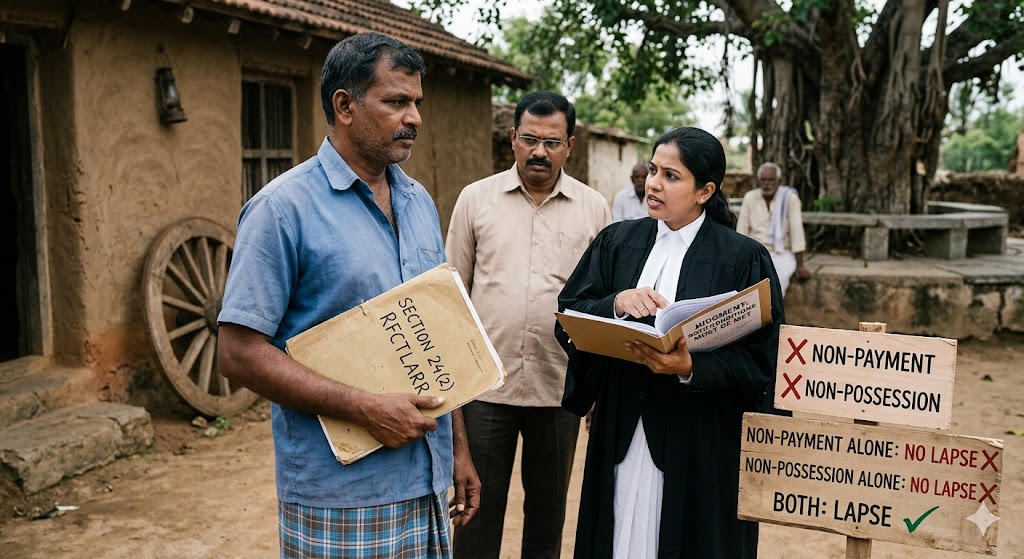
In a significant ruling on lapsed land acquisition proceedings, the Telangana High Court has directed the competent authority to refer a matter under Section 64 of the Right to Fair Compensation and Transparency in Land Acquisition, Rehabilitation and Resettlement Act, 2013 for fresh adjudication. The judgment underscores the importance of procedural compliance and natural justice in land acquisition disputes, particularly where notifications under the old Land Acquisition Act, 1894 have lapsed under Section 24(2) of the 2013 Act.
Background & Facts
The Dispute
The petitioner, Smt. Rangu Sathavva, challenged the land acquisition proceedings initiated by the State of Telangana for the submergence of the Mid-Manair Reservoir Project. The dispute centered around the acquisition of her land bearing GP door No. 7-9, situated at Cheerlavancha Village, Thangallapalli Mandal, Rajanna Sircilla District, where a poultry farm structure was allegedly demolished on 08.06.2012.
Key Facts
- Draft Notification and Declaration: The State issued Draft Notification No. D3/2876/2007-1 dated 19.09.2007 and Draft Declaration No. D3/2876/2007-2 dated 20.09.2007 under the Land Acquisition Act, 1894.
- Construction and Demolition: The petitioner constructed a poultry farm structure on the land in 2006, which was demolished on 08.06.2012.
- Award Passed: The respondents passed Award No. 17/2017-18, File No. A/1/8/1/2017-VII-Abadi, dated 15.07.2017 under the Right to Fair Compensation and Transparency in Land Acquisition, Rehabilitation and Resettlement Act, 2013.
- Compensation Received Under Protest: The petitioner received compensation under protest on 23.08.2017.
- Representation: The petitioner submitted a representation before the Revenue Divisional Officer, Sircilla, on 04.10.2017.
Procedural History
- 19.09.2007: Draft Notification No. D3/2876/2007-1 issued.
- 20.09.2007: Draft Declaration No. D3/2876/2007-2 issued.
- 08.06.2012: Demolition of the poultry farm structure.
- 15.07.2017: Award No. 17/2017-18 passed.
- 23.08.2017: Petitioner received compensation under protest.
- 04.10.2017: Petitioner submitted a representation to the Revenue Divisional Officer.
- 2017: Writ Petition No. 28475 of 2017 filed before the Telangana High Court.
- 24.08.2017: Interim order granted in WPMP No. 35419 of 2017.
- 01.04.2026: Final order passed by the High Court.
The Parties' Positions
For the Petitioner
The petitioner argued that the acquisition proceedings were illegal and void as they had lapsed under Section 24(2) of the Right to Fair Compensation Act, 2013. She contended that the award passed on 15.07.2017 was arbitrary, violated principles of natural justice, and was barred by limitation under Section 11-A of the Land Acquisition Act, 1894. The petitioner sought compensation of Rs. 13,82,000 for the illegal demolition of her poultry farm structure.
For the Respondents
The respondents, represented by the Assistant Government Pleader for Land Acquisition, resisted the petitioner's claim. They contended that the petitioner had limited her relief to seeking a reference under Section 64 of the 2013 Act and had already received compensation under protest. The respondents argued that the petitioner's representation before the Revenue Divisional Officer was duly considered.
Relief Sought
The petitioner sought:
- A declaration that the impugned award and acquisition proceedings were illegal, void, and lapsed under Section 24(2) of the 2013 Act.
- Setting aside of Award No. 17/2017-18 dated 15.07.2017.
- Direction to the respondents to initiate fresh acquisition proceedings and pay compensation under the 2013 Act.
- Compensation of Rs. 13,82,000 for the illegal demolition of the poultry farm structure.
The Legal Issue
The central question before the Court was whether the land acquisition proceedings initiated under the Land Acquisition Act, 1894, had lapsed under Section 24(2) of the Right to Fair Compensation and Transparency in Land Acquisition, Rehabilitation and Resettlement Act, 2013, and if so, whether the petitioner was entitled to a reference under Section 64 of the 2013 Act for fresh adjudication of compensation.
Arguments Presented
For the Petitioner
The petitioner's counsel argued that:
- The acquisition proceedings had lapsed under Section 24(2) of the 2013 Act as the award was not passed within the stipulated time.
- The impugned award was passed in violation of Section 17(3-A), 17(3)(a)(b), and Section 5-A of the Land Acquisition Act, 1894, and was barred by limitation under Section 11-A.
- The proceedings violated principles of natural justice and were arbitrary, warranting intervention under Article 226 of the Constitution of India.
For the Respondents
The respondents contended that:
- The petitioner had already received compensation under protest and had limited her relief to seeking a reference under Section 64 of the 2013 Act.
- The petitioner's representation before the Revenue Divisional Officer was duly considered, and no further relief was warranted.
- The acquisition proceedings were valid and compliant with the statutory provisions.
The Court's Analysis
The Court observed that the petitioner had initially challenged the Draft Notification and Declaration dated 19.09.2007 and 20.09.2007, respectively, as illegal and lapsed under Section 24(2) of the 2013 Act. The Court noted that the petitioner had subsequently amended her prayer to challenge Award No. 17/2017-18 dated 15.07.2017, which was passed under the 2013 Act.
The Court recorded the submissions of the learned counsel for the petitioner and the Assistant Government Pleader. It noted that the petitioner had received compensation under protest and had submitted a representation before the Revenue Divisional Officer on 04.10.2017. The Court refrained from expressing any opinion on the merits of the case but deemed it appropriate to direct a reference under Section 64 of the 2013 Act.
"In view of the aforesaid discussion, and upon recording the submission of the learned counsel appearing on behalf of the petitioner, this Court, without expressing any opinion on merits of the case, deems it appropriate to direct respondent No.7 to refer the matter to the competent authority under Section 64 of the Act within a period of four (04) weeks from the date of receipt of copy of the order."
The Court further directed that upon such reference, the competent authority should dispose of the matter expeditiously, preferably within six months, after issuing notice to all concerned parties and affording them an opportunity of hearing. The petitioner was granted liberty to raise all permissible claims and objections before the competent authority.
The Verdict
The Telangana High Court disposed of the writ petition with the following directions:
- Respondent No. 7 was directed to refer the matter to the competent authority under Section 64 of the Right to Fair Compensation and Transparency in Land Acquisition, Rehabilitation and Resettlement Act, 2013 within four weeks from the date of receipt of the order.
- The competent authority was directed to dispose of the reference within six months from the date of reference, after issuing notice to all concerned parties and affording them an opportunity of hearing.
- The petitioner was granted liberty to raise all permissible claims and objections before the competent authority.
- The writ petition was disposed of without costs.
What This Means For Similar Cases
Lapse Under Section 24(2) Triggers Fresh Adjudication
- Section 24(2) of the 2013 Act provides that acquisition proceedings under the old Land Acquisition Act, 1894 lapse if the award is not passed within five years from the date of the declaration. This judgment reinforces that lapsed proceedings must be referred for fresh adjudication under Section 64 of the 2013 Act.
- Practitioners should argue for a reference under Section 64 where acquisition proceedings have lapsed, ensuring that affected parties are not left without remedy.
Natural Justice and Procedural Compliance Are Non-Negotiable
- The Court emphasized the importance of affording affected parties an opportunity of hearing before passing an award. This judgment serves as a reminder that procedural compliance and natural justice are critical in land acquisition disputes.
- Where awards are passed without due process, courts are likely to intervene and direct fresh adjudication.
Compensation Under Protest Does Not Preclude Further Relief
- The fact that the petitioner received compensation under protest did not bar her from seeking further relief. This judgment clarifies that receiving compensation under protest preserves the right to challenge the award and seek a reference under Section 64.
- Affected parties should ensure that protests are duly recorded when receiving compensation to safeguard their rights for future adjudication.