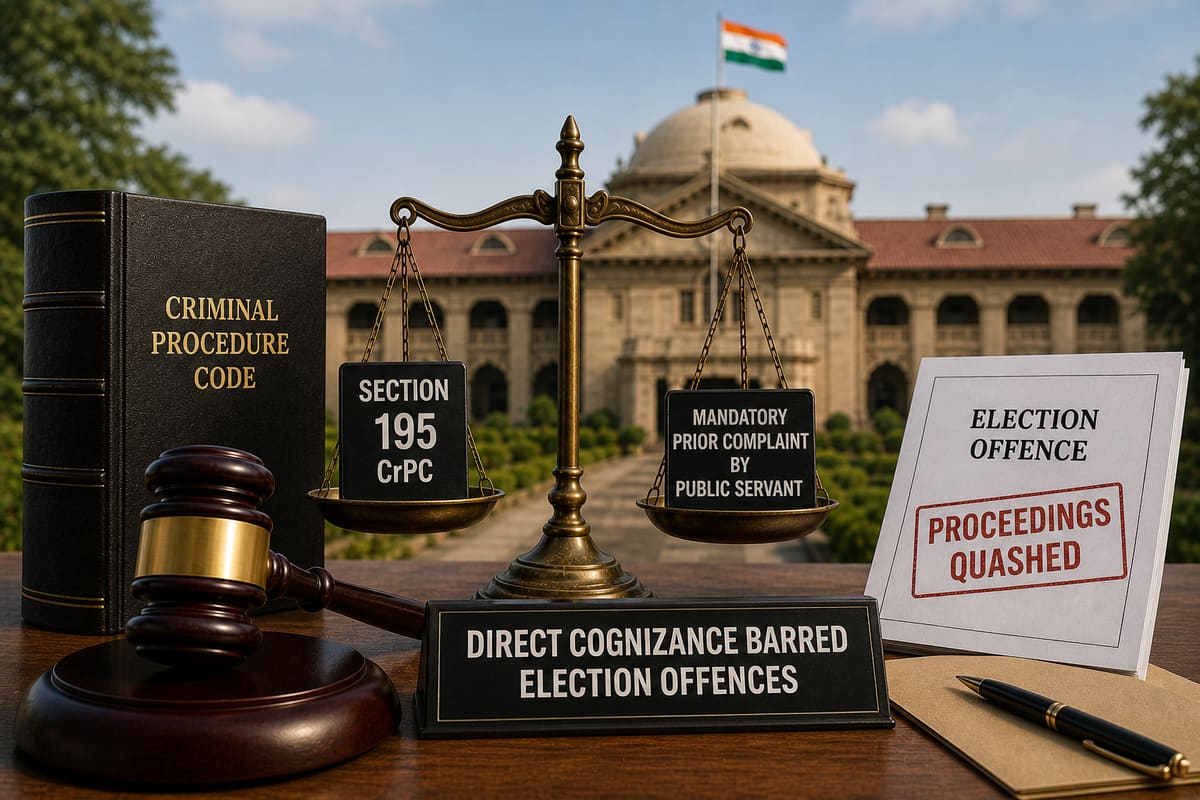
The Allahabad High Court has set aside a cognizance order passed in a non-cognizable offence case, emphasizing the mandatory compliance with Section 2(d) of the Code of Criminal Procedure, 1973 (CrPC). The Court held that proceedings initiated as a 'State case' for non-cognizable offences violate statutory provisions, necessitating remand for fresh consideration. This judgment underscores the procedural safeguards embedded in criminal jurisprudence to prevent abuse of process.
Background & Facts
The Genesis
The applicants, Lalman and three others, were summoned in Criminal Case No. 603 of 2025, arising from N.C.R. No. 45 of 2024 registered at Police Station Chunar, District Mirzapur. The case pertained to allegations under Sections 323 and 504 of the Indian Penal Code, 1860 (IPC), which are non-cognizable offences.
Key Facts
- The offence alleged was punishable under Sections 323 (voluntarily causing hurt) and 504 (intentional insult with intent to provoke breach of peace) IPC, both classified as non-cognizable offences.
- The cognizance order dated 25.06.2025 was passed by the Additional Chief Judicial Magistrate, Court No. 1, Mirzapur, treating the case as a 'State case' under Section 2(d) CrPC.
- The applicants challenged the order, arguing that cognizance could not be taken in a non-cognizable offence as a 'State case' without compliance with statutory definitions.
Procedural History
- N.C.R. No. 45 of 2024: Registered at Police Station Chunar, District Mirzapur, alleging offences under Sections 323 and 504 IPC.
- 25.06.2025: Cognizance order passed by the Additional Chief Judicial Magistrate, Court No. 1, Mirzapur, summoning the applicants.
- Application under Section 528 BNSS: Filed before the Allahabad High Court to quash the cognizance order and related proceedings.
The Parties' Positions
Applicants' Stand
The applicants, represented by Sri Vikas Kumar Chaubey, contended that:
- The cognizance order was passed in violation of Section 2(d) CrPC, as the offence was non-cognizable.
- The Magistrate erroneously treated the case as a 'State case', which is impermissible for non-cognizable offences.
- The proceedings amounted to an abuse of the process of law.
Respondent's Stand
The State, represented by Sri A.K. Rai (A.G.A.), did not file any substantive counter-affidavit or oppose the application. The Court proceeded ex parte in the absence of opposition.
Relief Sought
The applicants sought:
- Quashing of the cognizance order dated 25.06.2025 and all subsequent proceedings in Criminal Case No. 603 of 2025.
- Remand of the matter to the Magistrate for fresh consideration in accordance with law.
The Legal Issue
The central question was whether a Magistrate could take cognizance of a non-cognizable offence as a 'State case' under Section 2(d) CrPC, thereby bypassing the statutory safeguards for such offences.
Arguments Presented
For the Applicant(s)
Learned counsel for the applicants, Sri Vikas Kumar Chaubey, argued:
- The cognizance order dated 25.06.2025 was passed in violation of Section 2(d) CrPC, as the offence was non-cognizable.
- The Magistrate erroneously proceeded as a 'State case', which is impermissible for non-cognizable offences.
- The proceedings were an abuse of the process of law, warranting intervention under Section 528 of the Bhartiya Nagrik Suraksha Sanhita, 2023 (BNSS).
For the Respondent(s)
No substantive arguments were advanced by the State, as the learned A.G.A. did not oppose the application. The Court proceeded ex parte.
The Court's Analysis
The Court examined the definition of 'complaint' under Section 2(d) CrPC, which excludes a police report but includes a report made by a police officer in a case that, after investigation, discloses a non-cognizable offence. The Court observed:
"A bare perusal of explanation added to Section 2(d) shows that this explanation speaks about cases where police has investigated a cognizable case but investigation made discloses a non-cognizable offence."
The Court held that the Magistrate had erroneously treated the case as a 'State case' for a non-cognizable offence, thereby violating the statutory scheme. The Court emphasized that cognizance of non-cognizable offences must be taken only on a complaint, not on a police report or suo motu.
The Court further noted that the impugned order was passed without applying the judicial mind to the nature of the offence, leading to procedural impropriety.
The Verdict
The Allahabad High Court allowed the application under Section 528 BNSS and:
- Quashed the cognizance order dated 25.06.2025 passed by the Additional Chief Judicial Magistrate, Court No. 1, Mirzapur.
- Remanded the matter back to the Magistrate for fresh consideration after applying judicial mind to the nature of the offence.
- Directed the Magistrate to pass a fresh order in accordance with law.
What This Means For Similar Cases
Non-Cognizable Offences Require Complaint-Based Cognizance
- Section 2(d) CrPC mandates that cognizance of non-cognizable offences can only be taken on a complaint, not on a police report or suo motu.
- Magistrates must verify the nature of the offence before taking cognizance to avoid procedural violations.
Quashing Is Mandatory for Statutory Violations
- Proceedings initiated in violation of Section 2(d) CrPC are liable to be quashed.
- Courts must intervene to prevent abuse of process, even in the absence of opposition from the State.
Fresh Consideration Is Required
- Remand for fresh consideration ensures compliance with statutory safeguards.
- Magistrates must apply judicial mind to the nature of the offence and the mode of cognizance.