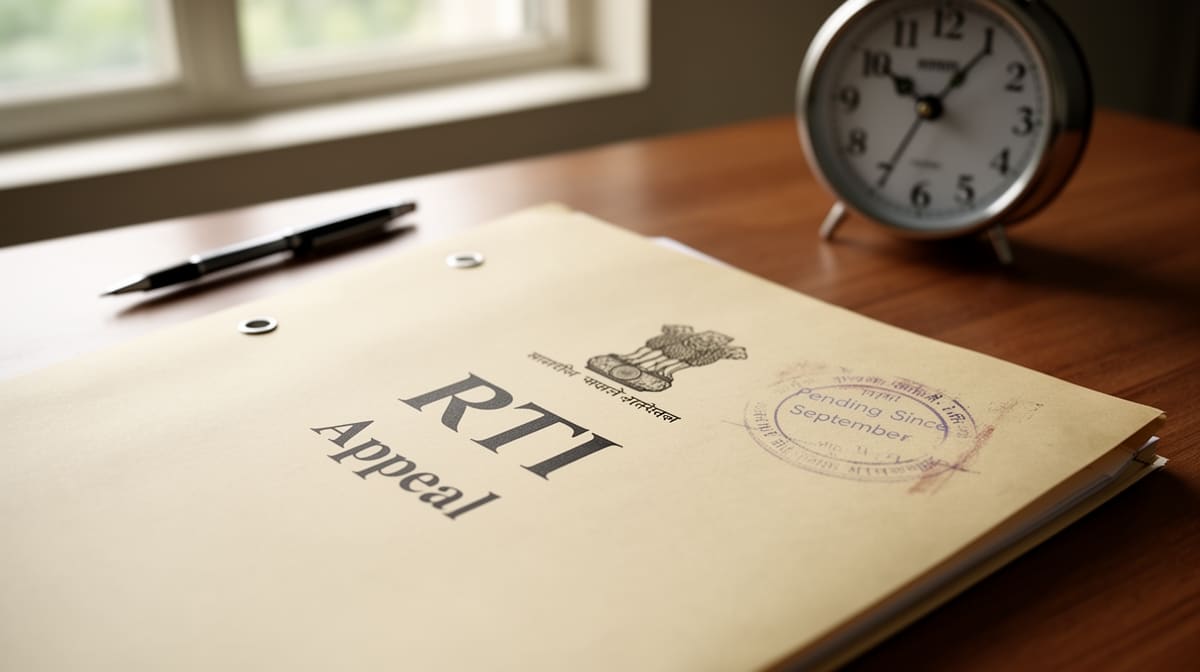
The Rajasthan High Court has reinforced the statutory obligation of Appellate Authorities under the Right to Information Act, 2005 to dispose of appeals within a reasonable timeframe, setting a clear precedent for timely adjudication in public transparency matters.
Background & Facts
The Dispute
The petitioner, Veesa Ram Meghwal, filed an RTI application on 28 August 2025 seeking information regarding development works and fund utilization by Gram Panchayat Siwna in Jalore district. The Public Information Officer failed to respond within the mandated 30-day period. The petitioner then filed a first appeal under Section 19(1) of the RTI Act on 9 September 2025, which remained pending for over five months without any decision.
Procedural History
- 28 August 2025: RTI application submitted to Gram Panchayat Siwna
- 28 September 2025: Deadline for response expired without reply
- 9 September 2025: First appeal filed before the Appellate Authority under Section 19(1)
- January 2026: No order issued on appeal; petitioner approached High Court
- 10 March 2026: Writ petition filed seeking mandamus for disposal of appeal
Relief Sought
The petitioner sought a writ of mandamus directing the Appellate Authority to decide the pending appeal, declaring the delay arbitrary, and demanding compliance with statutory obligations under the RTI Act and Rajasthan RTI Rules, 2005.
The Legal Issue
The central question was whether the Appellate Authority under Section 19(1) of the Right to Information Act, 2005 is bound by a reasonable time limit to decide first appeals, and whether prolonged inaction constitutes a violation of the statutory framework and the right to information.
Arguments Presented
For the Petitioner
Learned counsel for the petitioner relied on Central Information Commission v. State of Bihar and Smt. Sunita Devi v. State of Haryana to argue that delay in deciding RTI appeals undermines the very purpose of the Act, which is to promote transparency and accountability. He emphasized that Section 19(1) mandates the Appellate Authority to decide appeals "as expeditiously as possible," and that a delay of over five months without reason violates the principle of audi alteram partem and the petitioner’s fundamental right to information under Article 19(1)(a).
For the Respondent
No appearance or written submissions were filed by the respondents. The Court noted the absence of any justification for the delay, which amounted to a de facto admission of non-compliance with statutory duties.
The Court's Analysis
The Court examined the statutory scheme under the RTI Act, particularly Section 19(1), which requires the Appellate Authority to decide appeals "as expeditiously as possible." The Court observed that while the Act does not prescribe a fixed deadline for appellate decisions, the legislative intent is clear: delays defeat the purpose of transparency. The Court distinguished this from mere administrative backlog, noting that the petitioner had exhausted all remedies under the Act before approaching the Court.
"The Right to Information Act is not a mere procedural statute; it is a tool for empowering citizens and ensuring public accountability. Delay in deciding appeals is not a technical lapse but a substantive denial of rights."
The Court further referenced the Central Information Commission’s guidelines recommending disposal of appeals within 30 days, and held that a period of over five months without any order is indefensible. The Court rejected the notion that judicial intervention should be avoided merely because the Act provides an internal appellate mechanism. It affirmed that courts have the power to enforce statutory timelines when public authorities fail to act.
The Verdict
The petitioner succeeded. The Court held that Section 19(1) of the RTI Act imposes a binding obligation on Appellate Authorities to decide appeals expeditiously, and directed the Appellate Authority to dispose of the pending appeal within four weeks from the date of judgment. The writ petition was disposed of accordingly.
What This Means For Similar Cases
Appellate Deadlines Are Enforceable
- Practitioners may now cite this judgment to seek judicial intervention when RTI appeals remain pending beyond 60 days without reason
- Courts are likely to treat prolonged inaction as a violation of statutory duty, not mere administrative delay
- Writ petitions under Article 226 are maintainable even before the CIC if the delay is unreasonable
Transparency Requires Timeliness
- Public authorities must treat RTI appeals as time-sensitive matters, not low-priority tasks
- Failure to decide within four to six weeks may now be grounds for contempt or mandatory directions
- This ruling strengthens the position of citizens and NGOs filing RTI appeals in rural and decentralized governance structures
Documentation of Delay Is Critical
- Petitioners must maintain records of filing dates, follow-up letters, and non-responses
- Courts will expect evidence of exhaustion of remedies before entertaining writ petitions
- Advocates should include a prayer for specific timelines in RTI-related writs, not just generic directions