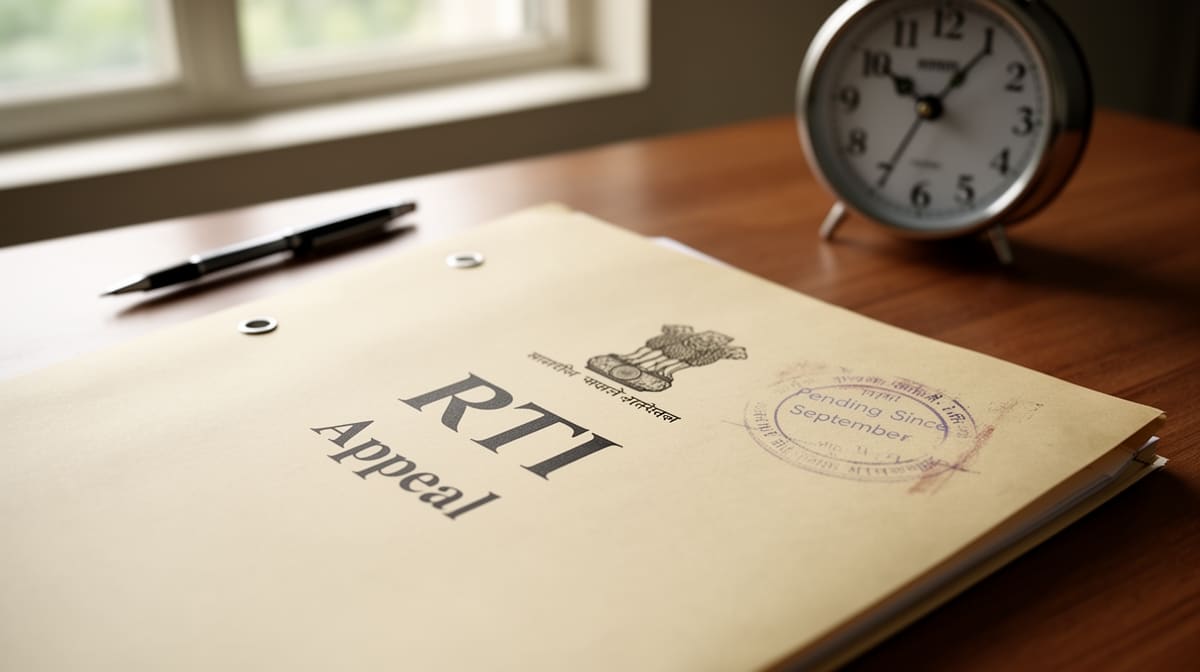
The Madhya Pradesh High Court has reinforced the statutory obligation under the Right to Information Act to ensure timely disposal of second appeals, issuing a clear directive for expeditious adjudication where delay undermines the very purpose of transparency. This judgment underscores the judiciary’s role in enforcing procedural compliance by information authorities.
Background & Facts
The Dispute
The petitioner, Manthan Dixit, filed five Right to Information (RTI) applications dated 30.07.2025 seeking information from public authorities. Upon receiving incomplete or unsatisfactory responses, he filed first appeals before the respective First Appellate Authorities as mandated under Section 19(1) of the RTI Act, 2005. These first appeals were not decided within the statutory period of 30 days, as required under Section 19(2), prompting the petitioner to file second appeals before the State Information Commissioner.
Key Facts
- The petitioner submitted five RTI applications on 30.07.2025
- First appeals were filed against the responses received, as per Section 19(1)
- First Appellate Authorities failed to decide the appeals within 30 days, constituting statutory default
- Five second appeals were filed before the State Information Commissioner on 09.12.2025
- The appeals were formally registered by the State Information Commissioner on 09.01.2026
- As of the filing of the writ petition, no decision had been rendered on any of the five appeals
- The petitioner made no request for interim relief or disclosure of information pending appeal disposal
Procedural History
- 30.07.2025: Five RTI applications submitted to public authorities
- Within 30 days of 30.07.2025: First appeals filed due to non-response or inadequate response
- 09.12.2025: Five second appeals filed before the State Information Commissioner
- 09.01.2026: Appeals formally registered by the State Information Commissioner
- 13.05.2026: Writ Petition No. 14824 of 2026 filed before the High Court of Madhya Pradesh at Jabalpur
- 13.05.2026: Court reviewed status via ERP system, confirming five appeals remained pending
The Parties' Positions
For the Petitioner
The petitioner contended that the prolonged inaction by the State Information Commissioner violated the mandatory timelines under the RTI Act and deprived him of his statutory right to information. He emphasized that the appeals had been pending for over four months without any indication of hearing or decision, rendering the remedy under the Act illusory.
For the Respondents
The State Information Commissioner, through the Government Advocate, acknowledged the pendency of the five appeals and confirmed via the ERP system that no orders had been passed. No objection was raised to the prayer for expeditious disposal.
Relief Sought
The petitioner sought:
- A writ of mandamus directing the State Information Commissioner to dispose of the five pending second appeals expeditiously
- A direction to provide the information sought in the original RTI applications within a time-bound manner
- Any other relief deemed appropriate by the Court
The Legal Issue
The central question was whether the High Court can issue a writ of mandamus under Article 226 of the Constitution to compel the State Information Commissioner to decide pending second appeals under the RTI Act when there is undue and unexplained delay beyond the statutory framework.
Arguments Presented
For the Petitioner
The petitioner’s counsel relied on the principle that the RTI Act is a social legislation designed to promote transparency and accountability. Delay in disposing of appeals defeats the object of the Act. Citing Central Information Commission v. Sai Kiran and State of U.P. v. Rajesh Kumar, it was argued that the Information Commission is under a statutory duty to decide appeals within 30 days under Section 19(6), and failure to do so renders the remedy ineffective. The petitioner’s right to information under Article 19(1)(a) was infringed by the inaction.
For the Respondent
The State Information Commissioner did not contest the petitioner’s claim. The Government Advocate confirmed the pendency and submitted that the appeals were under consideration. No legal objection was raised to the prayer for direction.
The Court's Analysis
The Court observed that the RTI Act is a comprehensive statutory regime intended to ensure timely access to information. Section 19(6) mandates that the Information Commission shall decide second appeals within 30 days of receipt, extendable only for reasons to be recorded in writing. The five appeals filed on 09.12.2025 had remained pending for over four months without any order or explanation.
"The right to information is meaningless if the machinery created to enforce it remains dormant. The Commission cannot treat statutory obligations as discretionary or subject to administrative convenience."
The Court noted that the petitioner had exhausted all remedies under the RTI Act and had no alternative forum to seek redressal. The delay was neither explained nor justified. The Court emphasized that mandamus is an appropriate remedy where a public authority fails to perform a statutory duty, especially when the right involved is fundamental under Article 19(1)(a).
The Court further held that while it cannot direct the outcome of the appeals, it can and must ensure their timely adjudication. The ERP status confirmation by the Commission itself validated the pendency and absence of progress.
The Verdict
The writ petition was disposed of with the direction that the State Information Commissioner shall decide all five pending second appeals filed on 09.12.2025 within 90 days from the date of production of the certified copy of this order. The Court directed the Commission to provide a copy of the orders to the petitioner immediately upon disposal. No costs were awarded.
What This Means For Similar Cases
Timeliness Is Non-Negotiable Under RTI Act
- Practitioners may now cite this judgment to seek mandamus when second appeals remain pending beyond 60 days without reason
- Courts will treat prolonged inaction by Information Commissions as a violation of statutory duty, not mere administrative delay
- The 90-day deadline set here establishes a practical benchmark for judicial intervention
Mandamus Is a Viable Remedy Against Information Commissions
- The High Court’s willingness to intervene confirms that Information Commissions are not immune from writ jurisdiction
- Petitioners need not wait indefinitely; a delay of over four months without progress is sufficient to trigger judicial review
- This judgment empowers litigants to move courts when the RTI machinery stalls, reinforcing the Act’s enforceability
Procedural Compliance Must Be Documented
- Information Commissions must record reasons for any extension beyond 30 days under Section 19(6)
- Failure to do so renders the delay legally unsustainable and invites writ petitions
- Courts will rely on official records (like ERP status) to verify pendency, reducing the burden on petitioners to prove delay