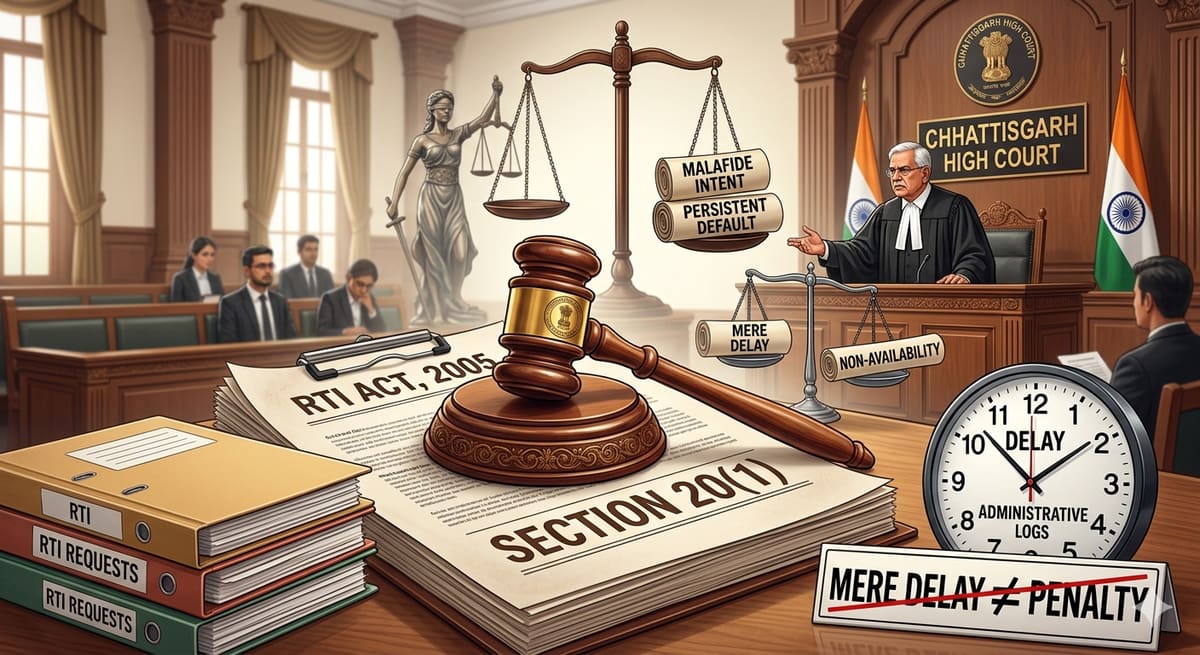
The Karnataka High Court recently quashed a penalty of ₹5,000 imposed on a Senior Motor Vehicle Inspector under the Right to Information Act, 2005 for delayed furnishing of voluminous registration data. The judgment underscores that penalties for administrative delays must account for practical difficulties in data compilation, particularly when the process is manual and the information sought is broad in scope.
Background & Facts
The Dispute
The petitioner, N.G. Hittalmakki, a Senior Motor Vehicle Inspector in the Office of the Deputy Commissioner, Transport and Senior Regional Transport Office, Belagavi, was penalized by the Karnataka State Information Commission for failing to furnish information sought under the Right to Information Act, 2005 within the statutory period. The complainant had requested details regarding the number of two-wheelers, three-wheelers, and four-wheelers registered in Kodani Village.
Key Facts
- The complaint was lodged alleging delay in furnishing information under the RTI Act
- The information sought pertained to vehicle registrations in Kodani Village, requiring compilation of voluminous data
- The petitioner was serving as Senior Motor Vehicle Inspector at the relevant time
- The process of data retrieval and verification was largely manual in 2016
- The respondent-imposed penalty of ₹5,000 under Section 20(1) of the RTI Act via order dated 22.03.2016 (Annexure-G)
Procedural History
- 2014: Complaint filed before the Karnataka State Information Commission (Case No. KMA 8455 APL 2014)
- 22.03.2016: Respondent imposed penalty of ₹5,000 on the petitioner
- 2016: Writ Petition (WP No. 104688 of 2016) filed before the Karnataka High Court challenging the penalty
- 29.06.2026: Present judgment delivered by the High Court
Relief Sought
The petitioner sought quashing of the order dated 22.03.2016 (Annexure-G) imposing the penalty of ₹5,000 under Article 226 of the Constitution of India.
The Legal Issue
The central question was whether Section 20(1) of the Right to Information Act, 2005 permits imposition of a penalty for delayed furnishing of information when the delay is attributable to practical difficulties in compiling voluminous data, particularly in the absence of urgency or specific purpose for the request.
Arguments Presented
For the Petitioner
- Contended that the information sought was broad and required compilation of voluminous data from manual records
- Argued that the delay was not willful but due to administrative constraints
- Highlighted that the penalty would adversely affect the petitioner’s service prospects, including promotions
- Emphasized that the information was eventually furnished, and no mala fide intent was established
For the Respondent
- Relied on Section 20(1) of the RTI Act, which mandates imposition of penalty for delay in furnishing information
- Contended that the petitioner failed to comply with the statutory timeline, warranting penal action
- Argued that the nature of the information sought did not absolve the petitioner of the obligation to furnish it within the prescribed period
The Court's Analysis
The Court examined the scope and object of the Right to Information Act, 2005, noting that while the Act aims to promote transparency and accountability, the imposition of penalties must be contextual. The Court observed:
"There can be no dispute that the object of the Right to Information Act, 2005 is to promote transparency and accountability by ensuring that citizens have timely access to information held by public authorities. However, the records reveal that the information sought by the complainant pertained to the number of two-wheelers, three-wheelers and four-wheelers registered in respect of Kodani Village."
The Court further emphasized that the information sought was broad and required compilation of voluminous data, which, given the manual process in 2016, could not reasonably be furnished within the statutory period. The Court noted:
"Having regard to the nature of the information sought, this Court is of the considered view that, although there may have been some delay on the part of the petitioner in furnishing the information, the request itself was broad in its scope and required compilation of voluminous data. The petitioner, who was serving as the Senior Motor Vehicles Inspector at the relevant point of time, was required to collect and collate information from various records before furnishing the same."
The Court also highlighted the lack of urgency or specific purpose behind the complainant’s request, which weighed against the imposition of a penalty. It held that the respondent-authority had failed to appreciate the practical difficulties involved in compiling the data, particularly when the penalty could have adverse civil consequences for the petitioner’s service prospects.
The Verdict
The Karnataka High Court allowed the writ petition and quashed the order dated 22.03.2016 passed by the Karnataka State Information Commission in Case No. KMA 8455 APL 2014. The Court set aside the penalty of ₹5,000 imposed on the petitioner, holding that the delay did not warrant penal action in the peculiar facts and circumstances of the case.
What This Means For Similar Cases
Penalty Under RTI Act Must Account for Practical Difficulties
- Contextual Assessment: Public authorities and Information Commissions must assess the practical difficulties in compiling information before imposing penalties under Section 20(1) of the RTI Act. Delays attributable to manual processes, voluminous data, or administrative constraints may not warrant penal action.
- Urgency and Purpose: The absence of urgency or specific purpose behind an RTI request should be a relevant factor in determining whether a penalty is justified. Broad or generic requests may not carry the same weight as those seeking time-sensitive or critical information.
Implications for Public Servants
- Service Prospects: Penalties under the RTI Act can have adverse civil consequences for public servants, including impacts on promotions and career progression. Courts may intervene where the imposition of a penalty appears disproportionate to the delay.
- Manual Processes: In cases where data compilation is manual, public authorities should document the efforts made to furnish information within the statutory period. This documentation can serve as evidence to justify delays in legal proceedings.
Burden on Information Commissions
- Balanced Approach: Information Commissions must adopt a balanced approach while imposing penalties, ensuring that the object of the RTI Act - transparency and accountability - is not undermined by rigid adherence to timelines without considering practical challenges.
- Record Appreciation: Commissions should adequately appreciate the records and factual matrix before concluding that a delay is willful or unjustified. Failure to do so may render the penalty vulnerable to judicial review.