Topic

RTI Act

The RTI Act enables Indian citizens to request information from public authorities, with defined limits on exemptions and obligations for disclosure under Sections 2, 7, and 19.

24 articlesLatest July 2026
Retaliatory Transfer for Union Leadership Violates Natural Justice | MP HC Orders Stay Pending Representation : MP HC Indore
Case Law Analysis
|Madhya Pradesh High Court

Retaliatory Transfer for Union Leadership Violates Natural Justice | MP HC Orders Stay Pending Representation : MP HC Indore

The Madhya Pradesh High Court has directed authorities to decide a government employee's representation against a retaliatory transfer, linking it to his role as union president. The stay on transfer until decision reinforces that administrative actions targeting union activity must be scrutinized under natural justice, setting a critical precedent for public sector labor rights.

Section 20(2) RTI Act | Commission Cannot Order Disciplinary Action Against Non-PIOs or Demand Action Taken Reports : Karnataka HC
Case Law Analysis
|Karnataka High Court

Section 20(2) RTI Act | Commission Cannot Order Disciplinary Action Against Non-PIOs or Demand Action Taken Reports : Karnataka HC

The Karnataka High Court has ruled that the Information Commission lacks power under Section 20(2) of the RTI Act to direct disciplinary action against senior bureaucrats who are not Public Information Officers, or to compel submission of Action Taken Reports. This clarifies the statutory limits of the Commission’s authority, protecting non-PIO officials from overreach and reinforcing that remedial powers under the RTI Act are confined to PIOs alone.

RTI Act Section 19(3) | Second Appeal Must Be Decided Within Statutory Timeline; MP HC Directs Expedited Disposal : MPHC Gwalior
Case Law Analysis
|Madhya Pradesh High Court

RTI Act Section 19(3) | Second Appeal Must Be Decided Within Statutory Timeline; MP HC Directs Expedited Disposal : MPHC Gwalior

Madhya Pradesh High Court reinforces that second appeals under the RTI Act must be decided within the prescribed statutory timeline, directing the appellate authority to dispose of the pending appeal within two weeks. The ruling underscores that writ jurisdiction cannot be invoked for factual disputes where statutory remedies remain available, ensuring compliance with the RTI Act’s mandate for timely information access.

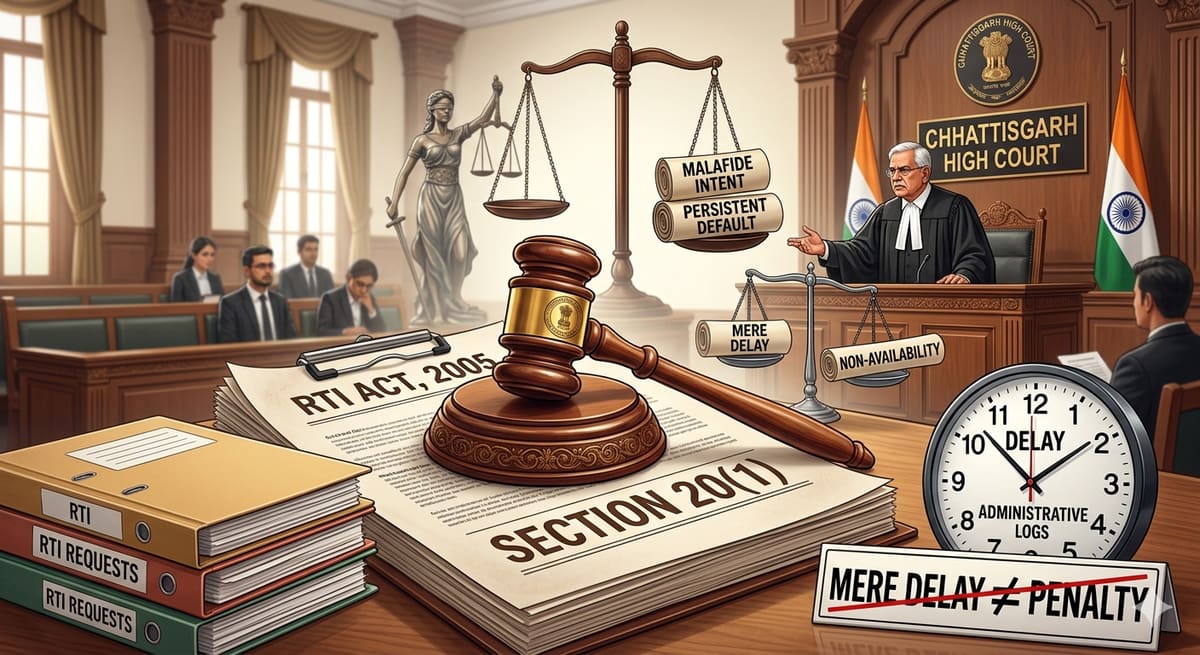
Section 20(1) RTI Act | Penalty Requires Proven Malafide Intent or Persistent Default, Not Mere Delay or Non-Availability : Chhattisgarh HC
Case Law Analysis
|Chhattisgarh High Court

Section 20(1) RTI Act | Penalty Requires Proven Malafide Intent or Persistent Default, Not Mere Delay or Non-Availability : Chhattisgarh HC

The Chhattisgarh High Court has ruled that Public Information Officers cannot be penalized under Section 20(1) of the RTI Act for mere delay or incomplete information unless there is a clear finding of malafide intent or persistent, unreasonable default. This sets a vital safeguard for PIOs acting in good faith and reinforces that procedural lapses alone do not justify financial penalties under the law.

CPC Order 13 Rule 10 | Original Revenue Records Mandatory When RTI Copies Are Disputed as Manipulated : MP HC Jabalpur
Case Law Analysis
|Madhya Pradesh High Court

CPC Order 13 Rule 10 | Original Revenue Records Mandatory When RTI Copies Are Disputed as Manipulated : MP HC Jabalpur

MP High Court rules that trial courts must summon original mutation records from revenue authorities if RTI-obtained copies are challenged as manipulated, ensuring evidentiary integrity. The ruling reinforces that uncertified RTI documents cannot substitute for original records in civil proceedings, impacting litigants relying on such evidence.

RTI Act | Insured Can Access LIC Policy Details Without Policy Number If Key Identifiers Provided : Delhi HC
Case Law Analysis
|Delhi High Court

RTI Act | Insured Can Access LIC Policy Details Without Policy Number If Key Identifiers Provided : Delhi HC

Delhi High Court rules that insured individuals can obtain LIC policy details under the RTI Act even without a policy number, provided they furnish identifying details like name, DOB, and NEFT. The judgment underscores that public authorities must facilitate information access when sufficient alternative identifiers are available, reinforcing the RTI Act's purpose of transparency.

RTI Act Section 6(5) | SPIOs Must Obtain & Provide Information Even If Not Record Custodian; Unilateral Corrigenda Void : Calcutta HC
Case Law Analysis
|Calcutta High Court

RTI Act Section 6(5) | SPIOs Must Obtain & Provide Information Even If Not Record Custodian; Unilateral Corrigenda Void : Calcutta HC

Public Information Officers cannot evade their duty under the RTI Act by claiming they are not custodians of records-they must actively seek and furnish information. The Calcutta High Court has ruled that attempting to terminate proceedings via unilateral corrigenda violates natural justice and undermines the fundamental right to information under Article 19(1)(a), setting a binding precedent for all SPIOs across India.

Section 19(3) RTI Act | Second Appellate Authority Cannot Order Criminal Prosecution - Powers Limited to Disclosure and Penalties : Bombay HC
Case Law Analysis
|Bombay High Court

Section 19(3) RTI Act | Second Appellate Authority Cannot Order Criminal Prosecution - Powers Limited to Disclosure and Penalties : Bombay HC

The Bombay High Court has held that the Second Appellate Authority under the RTI Act lacks the statutory power to direct criminal prosecution, reinforcing that its role is confined to ordering information disclosure and imposing penalties under Section 20. This ruling protects public authorities from overreach by appellate bodies and clarifies the boundaries between administrative accountability and criminal liability under the Act.

Section 19(5) RTI Act | Monetary Costs Require Proof of Deliberate Fault or Mala Fide Delay, Not Merely Procedural Delay : Bombay HC
Case Law Analysis
|Bombay High Court

Section 19(5) RTI Act | Monetary Costs Require Proof of Deliberate Fault or Mala Fide Delay, Not Merely Procedural Delay : Bombay HC

The Bombay High Court has ruled that public authorities cannot be penalized with monetary costs under Section 19(5) of the RTI Act solely for procedural delays; the imposition of costs demands clear evidence of intentional obstruction or mala fide conduct. This sets a critical precedent for accountability, ensuring that public bodies are not unduly punished for administrative bottlenecks absent bad faith.

RTI Act Section 2(f) | Private Trusts Not Public Authorities Without Ownership, Control or Substantial State Financing : Bombay HC
Case Law Analysis
|Bombay High Court

RTI Act Section 2(f) | Private Trusts Not Public Authorities Without Ownership, Control or Substantial State Financing : Bombay HC

The Bombay High Court holds that receipt of state grants alone does not transform a private trust into a public authority under the RTI Act, reinforcing that only entities under substantial state control or financing are subject to disclosure obligations. This clarifies the legal boundary for thousands of trusts and NGOs receiving government funds, ensuring RTI applies only where public accountability is truly embedded.

RTI Act | Right to Immediate Answer Sheet Inspection Post-Result Declaration : Uttarakhand HC Strikes Down Delay Until Recruitment Completion
Case Law Analysis
|Uttarakhand High Court

RTI Act | Right to Immediate Answer Sheet Inspection Post-Result Declaration : Uttarakhand HC Strikes Down Delay Until Recruitment Completion

Uttarakhand High Court ruled that unsuccessful candidates in public recruitment exams have an enforceable right under the RTI Act to inspect their evaluated answer sheets immediately after results are declared, rejecting rules that deferred access until the entire selection process concluded. The judgment reinforces transparency and prevents irreparable prejudice to candidates.

Section 19(1) RTI Act | Appellate Authorities Must Decide Appeals Within Four Weeks: Rajasthan HC
Case Law Analysis
|Rajasthan High Court

Section 19(1) RTI Act | Appellate Authorities Must Decide Appeals Within Four Weeks: Rajasthan HC

The Rajasthan High Court has mandated that appellate authorities under the RTI Act must dispose of first appeals within four weeks, enforcing statutory deadlines to prevent indefinite delays in public information disclosure. This ruling directly impacts gram panchayats and district-level officials, transforming procedural timelines into enforceable rights for citizens seeking transparency.