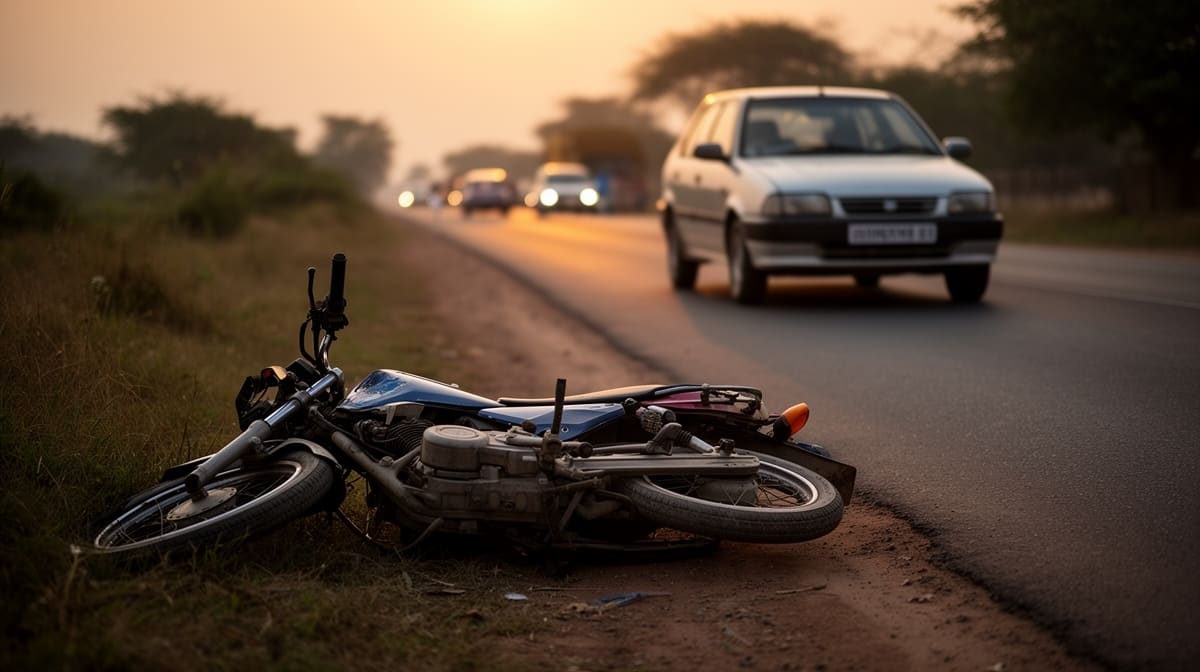
The Madhya Pradesh High Court has clarified that the mere suspicion or allegation of alcohol consumption by a motorcyclist or pillion rider does not extinguish the insurer’s liability under the Motor Vehicles Act, absent concrete proof of statutory violation. This ruling reinforces the principle that compensation claims must be adjudicated on established facts, not speculative assumptions.
Background & Facts
The Dispute
The dispute arose from a road accident on 08.10.2023 at approximately 7:30 - 7:45 PM near Pardi Dhaba on the Kurwai-Mehlua public road in District Vidisha. Ramsingh, respondent No.1 in Civil Revision No.982/2025, was driving a motorcycle bearing registration number MP 67 MG 0726, with Sirnam Singh Ahirwar as the pillion rider. The motorcycle was allegedly struck by a car bearing registration number MP04 ZD 4691, driven by Vikas Yadav, who was operating the vehicle on the wrong side. As a result, Sirnam Singh sustained fatal head injuries and died at the scene, while Ramsingh suffered grievous injuries.
Key Facts
- The accident occurred on 08.10.2023 at approximately 7:30 - 7:45 PM
- An FIR bearing Crime No.423/2023 was registered at Police Station Kurwai on 28.10.2023
- A Marg inquiry (No.83/2023) was initiated on 11.10.2023 after the hospital at Hamidia, Bhopal, reported Sirnam Singh’s death
- The FIR was filed only after completion of the Marg inquiry
- The motorcycle was owned by an unjoined party; neither the owner nor its insurer were made parties to the claim petitions
- The driver of the offending car, Vikas Yadav, did not possess a valid driving license
- The insurance company alleged both the driver and pillion rider were under the influence of alcohol
- No blood alcohol test results or breath analyzer reports were produced on record
Procedural History
- 08.10.2023: Accident occurred
- 11.10.2023: Hospital reported death; Marg inquiry initiated
- 28.10.2023: FIR registered
- 2023: Claim petitions filed before Motor Accident Claims Tribunal (MACT), Ganjbosoda
- MACC No.134/2023: Filed by legal representatives of deceased Sirnam Singh
- MACC No.135/2023: Filed by injured rider Ramsingh
- 07.05.2025: MACT awarded compensation
- Rs.15,63,562/- with 6% interest to legal heirs of Sirnam Singh
- Rs.18,000/- with 6% interest to Ramsingh
- Insurance Company held jointly and severally liable
- 2025: Appellant filed M.A. No.7444/2025 and Civil Revision No.982/2025 challenging the award
- 16.03.2026: High Court heard both matters together
The Parties' Positions
For the Insurance Company (Appellant)
- Alleged that the offending vehicle was falsely implicated in the accident
- Claimed the driver (Ramsingh) and pillion rider (Sirnam Singh) were under the influence of alcohol
- Argued that the absence of the motorcycle owner and insurer as parties rendered the claim petitions non-maintainable
- Contended that the delay in filing the FIR (20 days) indicated fabrication
- Asserted that Section 185 of the Motor Vehicles Act was violated, thereby barring compensation
For the Claimants (Respondents)
- Maintained that the accident was caused solely by the rash and negligent driving of the car driver
- Denied any evidence of alcohol consumption by either rider or driver
- Argued that the delay in FIR was explained by the Marg inquiry process
- Stated that joinder of the motorcycle owner/insurer was not mandatory under the law
- Emphasized that the burden of proving negligence or statutory violation lay with the insurer
Relief Sought
The appellant sought:
- Setting aside of the MACT award dated 07.05.2025
- Dismissal of both claim petitions on grounds of false implication, non-joinder, and contributory negligence
- Declaration that the insurer is not liable for compensation
The respondents sought:
- Affirmation of the MACT award
- Enforcement of the compensation amounts with interest
The Legal Issue
The central question was whether the insurer can avoid liability under the Motor Vehicles Act merely on the allegation that the motorcyclist or pillion rider consumed alcohol, without proving violation of Section 185 of the Motor Vehicles Act, and whether non-joinder of the motorcycle owner and insurer automatically renders the claim petition non-maintainable.
Arguments Presented
For the Appellant/Petitioner
Counsel for the Insurance Company argued that the accident was caused by the negligence of the motorcycle driver, who was allegedly under the influence of alcohol. He relied on the timing of the FIR and the absence of the motorcycle owner as parties to contend that the claim was fabricated or defective. He cited general principles of contributory negligence and asserted that the insurer should not be liable where the victim’s own conduct contributed to the accident. He further claimed that the delay in FIR registration indicated malafide intent.
For the Respondent/State
Counsel for the claimants countered that the insurer had not pleaded false implication in its written statement, and therefore could not raise it for the first time in appeal. He emphasized that no breathalyzer or blood test results were produced to establish alcohol levels exceeding the statutory limit under Section 185. He argued that the pillion rider, being a passive occupant, could not be held contributorily negligent without proof of his conduct causing the accident. He further contended that the Marg inquiry explained the delay in FIR, and that joinder of the motorcycle owner was not mandatory under Section 166 of the Motor Vehicles Act.
The Court's Analysis
The Court undertook a rigorous analysis of the insurer’s contentions, applying statutory interpretation and established precedents. It first addressed the claim of false implication. The Court noted that the insurer had not pleaded this ground in its written statement before the Claims Tribunal. The Court held that raising such a serious allegation for the first time in appeal, without any prior notice or pleading, was impermissible. The Court further observed that the delay in filing the FIR was fully explained by the procedural requirement of a Marg inquiry, which was initiated on 11.10.2023 and concluded before the FIR was lodged on 28.10.2023. The Court cited well-established principles that delay in FIR registration cannot be a ground to dismiss a claim petition unless it is shown to be inordinate and unexplained.
"It is a well-established principle of law that claim petitions cannot be dismissed solely on the ground of delay in lodging the FIR."
Regarding the allegation of alcohol consumption, the Court examined Section 185 of the Motor Vehicles Act, which prescribes the exact threshold for intoxication: alcohol exceeding 30 mg per 100 ml of blood. The Court held that mere suspicion or unsubstantiated assertion is insufficient to establish a violation. The insurer produced no evidence - no breathalyzer report, no blood test, no medical opinion - to prove that the driver’s blood alcohol content exceeded the statutory limit. The Court emphasized that without satisfying all ingredients of Section 185, no finding of negligence under the Act can be made.
"Unless and until all the ingredients of Section 185 of Motor Vehicles Act are satisfied, it cannot be said that the driver of the motor vehicle is negligent."
On the issue of the pillion rider, the Court held that a pillion rider cannot be presumed negligent merely for consuming alcohol, as there is no provision prohibiting such conduct. The Court further clarified that the doctrine of composite negligence applies only when both vehicles are found to be negligent. Since the insurer failed to prove the motorcycle driver’s negligence under Section 185, the principle of composite negligence did not arise. The Court held that the claimants were entitled to seek compensation from the insurer of the offending vehicle, even without impleading the motorcycle owner or insurer, as the liability of the offending vehicle’s insurer was primary and independent.
The Court concluded that the insurer had not discharged its burden of proof, and the Claims Tribunal’s findings were fully supported by evidence and law.
The Verdict
The appellant’s appeal and civil revision were dismissed. The award dated 07.05.2025 passed by the Second Additional Member, MACT Ganjbosoda, was affirmed. The insurer is liable to pay:
- Rs.15,63,562/- with 6% interest from the date of the claim petition to the date of payment to the legal representatives of Sirnam Singh
- Rs.18,000/- with 6% interest from the date of the claim petition to the date of payment to Ramsingh
The liability is joint and several. No costs were awarded.
What This Means For Similar Cases
Alcohol Allegations Require Concrete Proof
- Practitioners must now insist on production of breathalyzer or blood test reports to invoke Section 185 as a defense
- Mere oral assertions or speculative claims of intoxication will not suffice to deny compensation
- Insurers must plead and prove statutory violation, not rely on general assumptions
Non-Joinder Does Not Defeat Claims Against Offending Vehicle
- Claimants are not required to implead the owner or insurer of the victim’s vehicle to pursue a claim against the offending vehicle’s insurer
- The liability of the offending vehicle’s insurer is primary and independent under Section 140 and Section 166
- Tribunals and courts must not dismiss claims on technical grounds of non-joinder unless the claimant is barred by law
Delay in FIR Is Not Fatal if Explained
- Delays caused by procedural requirements such as Marg inquiries or post-mortem formalities are not inordinate
- Courts must examine the reason for delay, not merely its duration
- The burden shifts to the insurer to prove that the delay prejudiced the investigation or led to fabrication