The Punjab and Haryana High Court has clarified that the mere presence of alcohol in a deceased motorist’s system cannot justify a finding of contributory negligence in a motor accident claim unless there is cogent evidence linking such consumption to the occurrence of the accident. This ruling reinforces the principle that fault must be proven, not presumed, in compensation proceedings under the Motor Vehicles Act.
Background & Facts
The Dispute
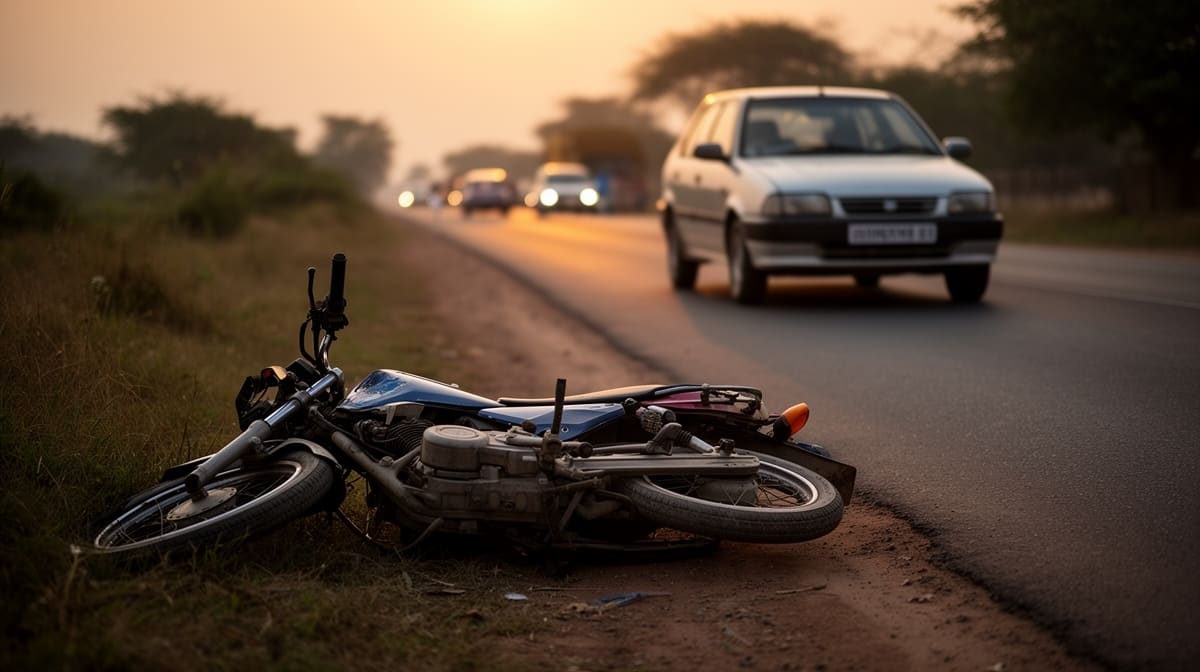
The dispute arose from a fatal road accident on 19.04.1998 at approximately 2:45 PM in Patiala, Punjab. Raj Krishan Prashar, the deceased, was driving a scooter bearing registration No. PB-11A-8308 on the correct side of the road when a Maruti car, bearing registration No. PB-11C-8118 and driven by respondent No. 1, came from the opposite direction on the wrong side and collided head-on with the scooter. The impact caused multiple grievous injuries to the deceased, who was admitted to hospital and later died on 23.04.1998. The Post-Mortem Report (Ex. A-7) confirmed death due to injuries sustained in a road traffic accident.
Key Facts
- The deceased was 51 years old at the time of death
- He was employed as a Senior Assistant in the Office of the Commissioner, Excise and Taxation, Patiala, drawing a monthly salary of ₹8,203/-
- He was also receiving a monthly pension of ₹1,275/- from prior Army service
- The Medico-Legal Report (Ex. R-7) noted alcohol consumption by the deceased but did not quantify blood alcohol content
- No blood sample was taken to determine the level of intoxication
- No evidence was presented to show impaired driving, erratic behavior, or loss of vehicle control
- The sole eyewitness, AW-5 Ujjagar Singh, testified that the deceased was driving lawfully on the correct side and had no opportunity to avoid the collision
- The respondents did not allege in their written statement that the deceased was intoxicated or lying on the road prior to impact
Procedural History
- 19.04.1998: Fatal accident occurred
- 23.04.1998: Deceased succumbed to injuries
- 2000: Claim petition filed before Motor Accident Claims Tribunal, Patiala
- 22.09.2001: Tribunal awarded compensation of ₹5,13,120/-
- 05.01.2002: Appeal filed by driver and owner of Maruti car (F.A.O. No. 5 of 2002)
- 07.01.2002: Cross-objection filed by claimants (XOBJC-70-CII-2002)
- 23.03.2026: Arguments concluded
- 30.03.2026: Judgment pronounced
Relief Sought
The appellants sought reduction of compensation on grounds of contributory negligence due to alcohol consumption. The claimants sought enhancement of compensation, arguing that the Tribunal erred in deducting GPA and GIS contributions from salary and failed to apply correct multiplier and future prospects.
The Legal Issue
The central question was whether alcohol consumption by a deceased motorist, in the absence of evidence showing impaired driving or a causal connection to the accident, can justify a finding of contributory negligence under the Motor Vehicles Act.
Arguments Presented
For the Appellant
Learned counsel contended that the deceased’s consumption of alcohol, as noted in the Medico-Legal Report, rendered him negligent per se. It was argued that driving under the influence constitutes a breach of duty of care, and even without proof of erratic driving, the mere presence of alcohol should lead to reduction in compensation. Reliance was placed on general principles of negligence and public policy against drunk driving.
For the Respondent
Learned counsel for the claimants submitted that the burden of proving contributory negligence lies squarely on the party alleging it. Mere mention of alcohol in the MLR, without a blood test, expert opinion, or evidence of impaired control, cannot establish a causal link to the accident. The uncontroverted eyewitness testimony and medical evidence showed the offending vehicle was on the wrong side, making the deceased’s conduct irrelevant. Further, the Tribunal’s calculation of income was flawed and required correction.
The Court's Analysis
The Court undertook a detailed review of the evidence and legal principles governing contributory negligence in motor accident claims. It emphasized that contributory negligence cannot be presumed and must be affirmatively established with cogent evidence.
"The law relating to contributory negligence is well settled that the same cannot be presumed and must be established on the basis of cogent evidence. It is required to be shown that the victim failed to take reasonable care for his own safety and that such failure had a direct nexus with the occurrence of the accident."
The Court cited Sudhir Kumar Rana v. Surinder Singh (2008) to affirm that contributory negligence arises only when both parties are negligent and the victim’s act or omission materially contributed to the accident. It further relied on its own coordinate bench decision in United India Insurance Co. Ltd. v. Rani (2025) to hold that the mere presence of alcohol in the body, without evidence of its impact on driving, cannot ground a finding of negligence.
The Court found that the deceased was driving on the correct side of the road, as corroborated by the eyewitness and medical evidence. There was no indication of swerving, speeding, or loss of control. The appellants produced no evidence to show that alcohol consumption affected the deceased’s ability to drive or contributed to the collision. The Court held that even a sober driver in the deceased’s position would have been unable to avoid the impact caused by a vehicle coming from the wrong side at high speed.
Regarding compensation, the Court found the Tribunal erred in deducting GPA and GIS contributions from the deceased’s salary. These were savings deductions, not expenses, and did not reduce the deceased’s real earning capacity. The Court recalculated monthly income as ₹9,478/- (₹8,203/- salary + ₹1,275/- pension), applied a 15% future prospects addition, deducted one-third for personal expenses, and used a multiplier of 11 (for age 51) as per National Insurance Co. Ltd. v. Pranay Sethi and Sarla Verma v. DTC.
The Verdict
The appeal filed by the appellants was dismissed. The cross-objection by the claimants was allowed. The compensation was enhanced from ₹5,13,120/- to ₹10,69,244/-. The Court directed payment of interest at 7% per annum from the date of filing the claim petition (2000) until realization. Any amount already deposited by the respondents shall be adjusted against the enhanced award. The Tribunal’s award was modified accordingly.
What This Means For Similar Cases
Alcohol Consumption Does Not Automatically Imply Negligence
- Practitioners must now argue that contributory negligence requires proof of impaired driving, not mere alcohol presence
- Medical reports noting alcohol without blood test results are insufficient to shift blame
- Courts will not infer negligence from circumstantial evidence alone
Income Calculation Must Reflect Real Earning Capacity
- Deductions like GPA and GIS are savings and must be added back to gross salary for compensation calculation
- Pension income from prior service must be included in total monthly income
- Future prospects at 15% must be applied to the full income, not the net after savings
Causal Nexus Is Non-Negotiable
- The burden remains on the defendant to prove that the victim’s conduct materially contributed to the accident
- Eyewitness testimony and accident reconstruction evidence take precedence over speculative allegations
- Courts will not reduce compensation based on moral judgments about lifestyle choices without factual linkage to causation