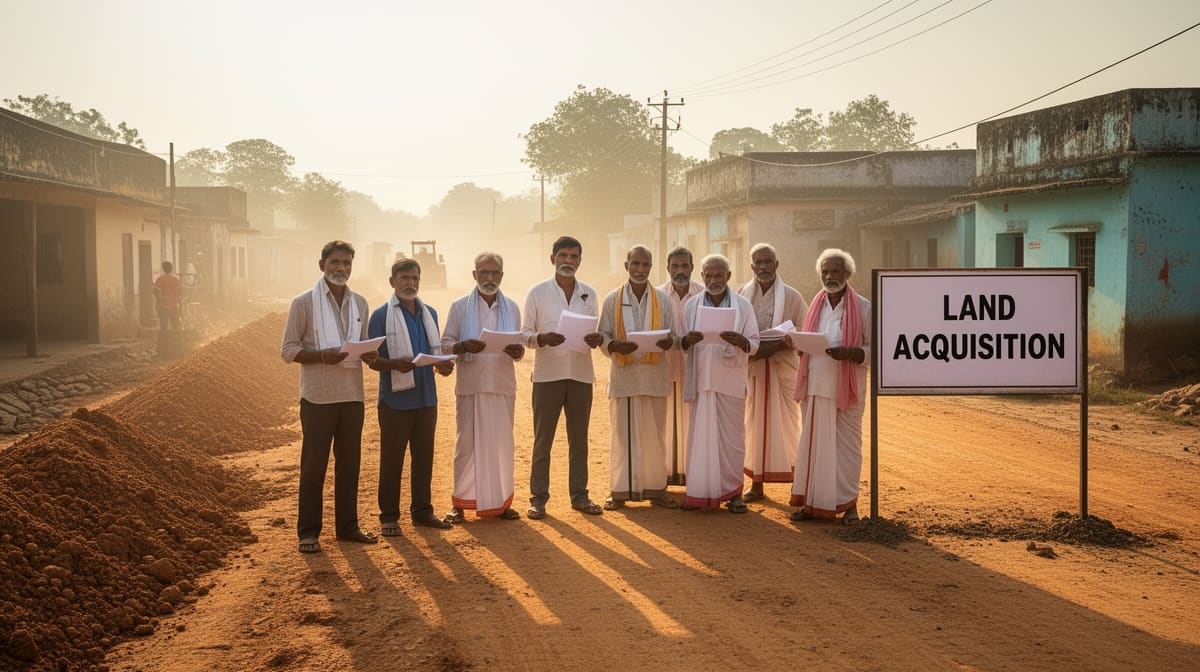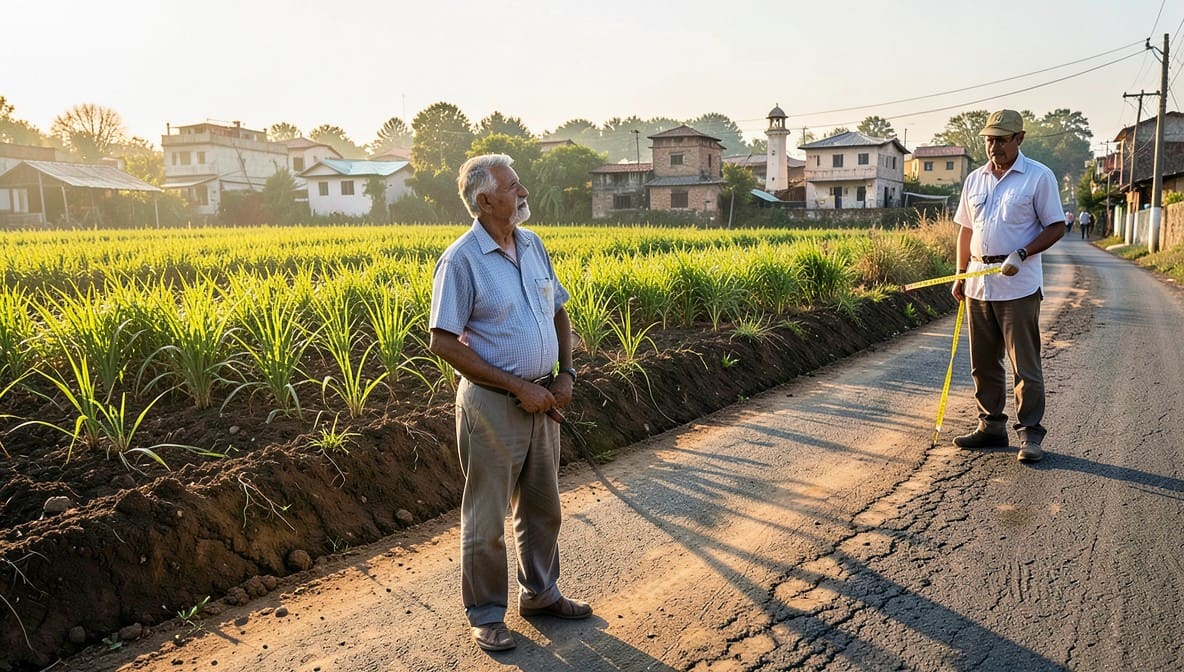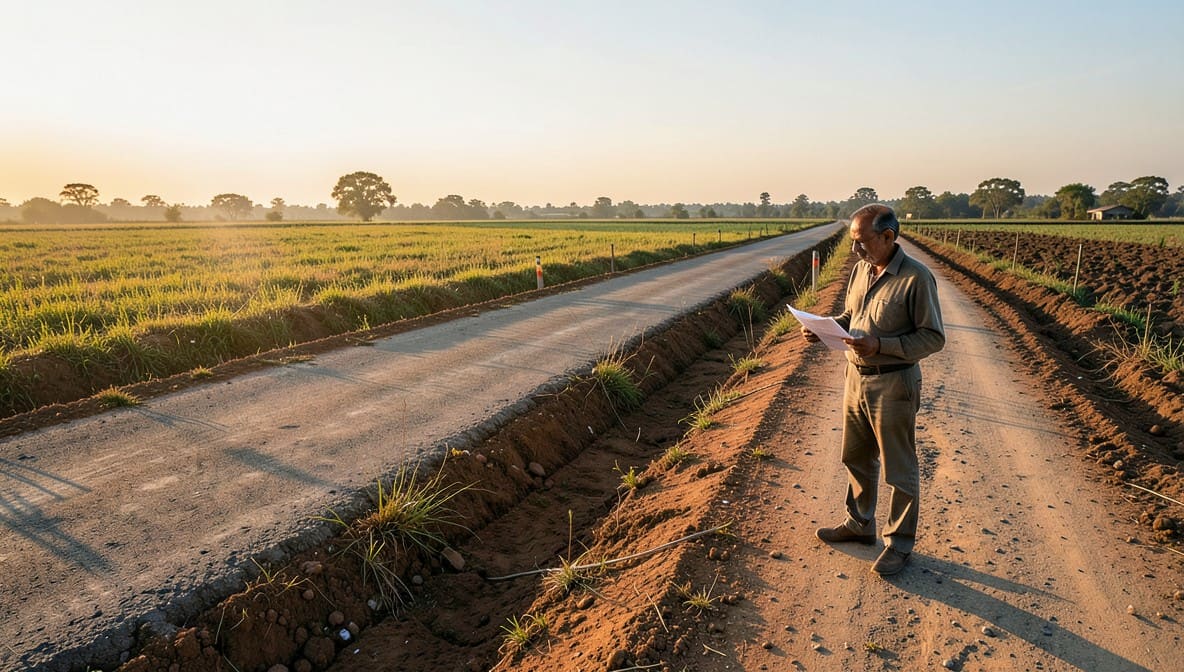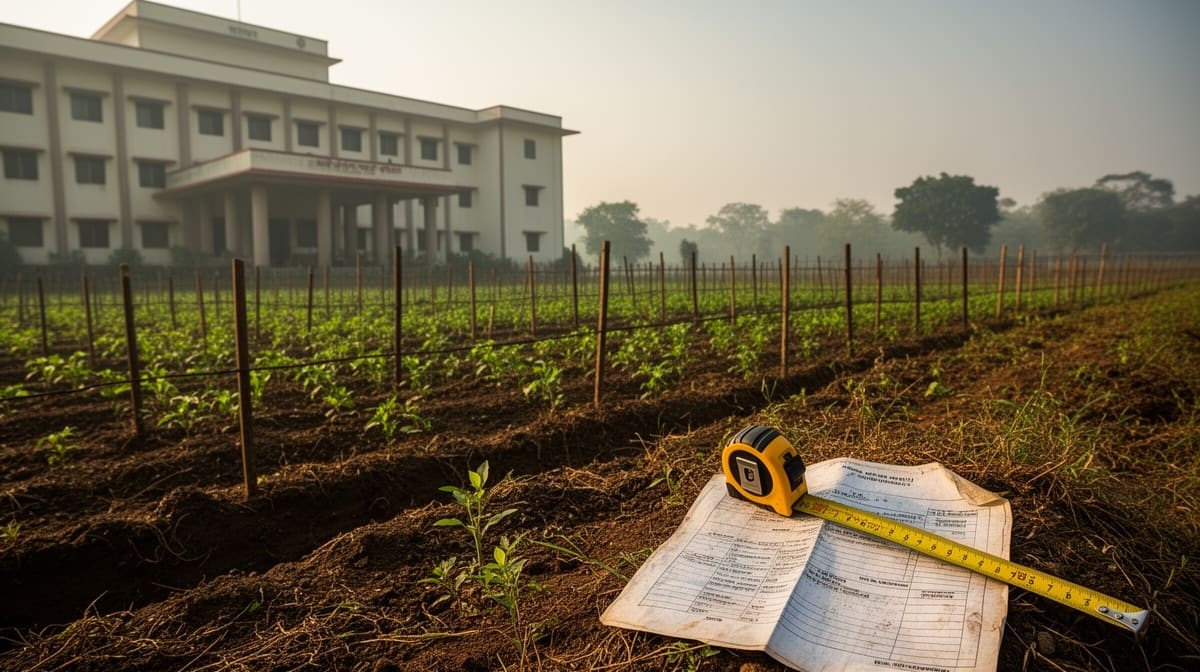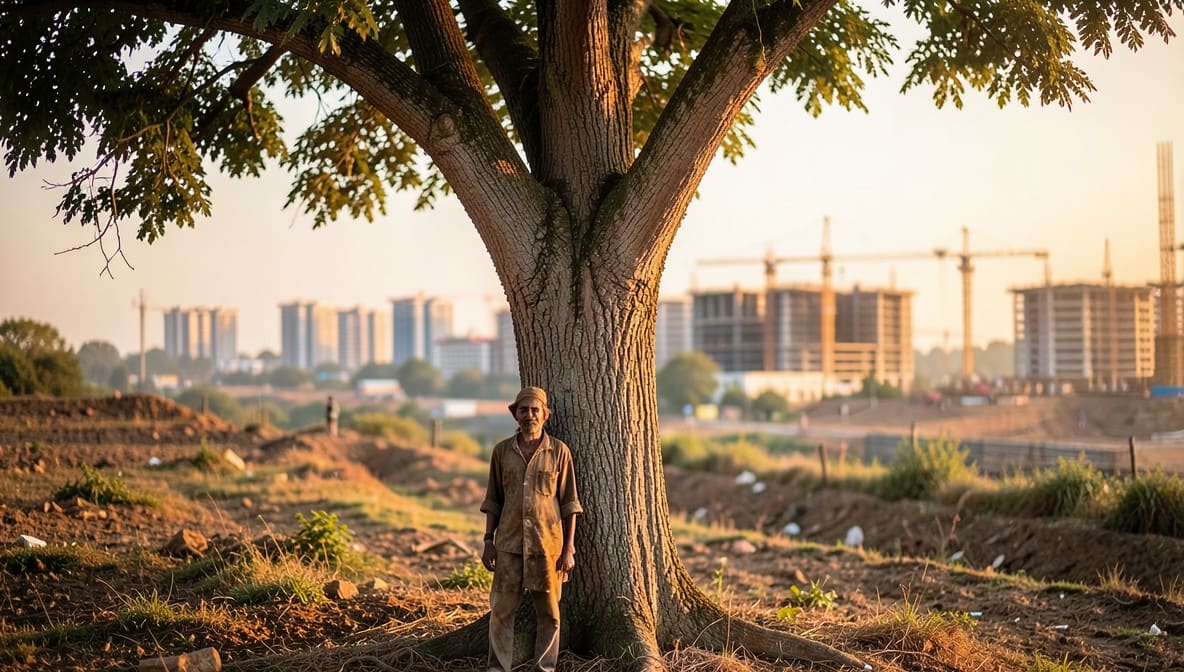
The Chhattisgarh High Court has delivered a significant ruling affirming that the invocation of the urgency clause under Section 17 of the Land Acquisition Act, 1894, cannot be a mechanical or routine exercise, especially for planned urban development projects. The Court held that such invocation must be justified by real, demonstrable urgency and cannot override the statutory right to be heard under Section 5A, even when the acquisition is for a public purpose.
Background & Facts
The Dispute
The petitioner, Kamal Chand Jain, is the owner and long-term cultivating possessor of two parcels of land bearing Khasra Nos. 105 (1.12 hectares) and 388 (1.42 hectares) in Village Chhatauna, Raipur District, Chhattisgarh. He has held peaceful, continuous possession of this land for over 20 years and has developed a farm house and dense plantation, including trees exceeding 15 feet in height, with prior approval from the Gram Panchayat. The land falls within the Naya Raipur Development Authority (NRDA) planning area under the Naya Raipur Development Plan 2031.
In March 2011, NRDA proposed the acquisition of 52 khasras, including the petitioner’s land, for the development of New Raipur as the State capital. The proposal invoked the urgency clause under Section 17(1) of the Land Acquisition Act, 1894, to bypass the mandatory objection and inquiry process under Section 5A.
Key Facts
- The petitioner has been in cultivating possession of the land since at least 1994.
- On 14.03.2011, NRDA requested the Collector and SDO to initiate acquisition proceedings under Section 4(1) read with Section 17(1) of the Act of 1894.
- On 29.07.2011, the Collector submitted a proposal to the Commissioner, Department of Revenue.
- On 30.07.2011, the Commissioner granted approval for invoking urgency, citing the need for rapid development of the new capital.
- Notification under Section 4(1) read with Section 17(1) was published in Chhattisgarh Rajpatra on 26.08.2011 (issued 09.08.2011).
- Declaration under Section 6 was issued on 14.08.2012 and published on 24.08.2012 - over one year after the Section 4 notification.
- The petitioner submitted representations on 29.11.2012 and 20.11.2013 requesting exclusion of his land, citing his long possession, environmental concerns, and prior voluntary surrender of 9 acres for a cargo hub.
- The NRDA issued a non-responsive rejection letter dated 13.12.2013 (Annexure P-1), without addressing the petitioner’s submissions.
- On 08.01.2014, the petitioner filed an RTI application seeking documents; it was denied on 15.16.01.2014 on the ground that proceedings were with the Divisional Commissioner.
- On 22.01.2014, the petitioner made a further representation, which remained unanswered.
- An award under the Act of 1894 was passed on 25.11.2013, fixing compensation at Rs. 1,01,04,120/- with 12% interest and a 10% incentive.
- A second award under the Right to Fair Compensation and Transparency in Land Acquisition, Rehabilitation and Resettlement Act, 2013, was passed on 03.07.2014 for the same land, without reference to the earlier award.
- No physical possession of the land was taken before the filing of the writ petition on 19.02.2014.
- A possession certificate dated 16.06.2015 (Annexure R-2) was later produced by the State, but lacked the petitioner’s signature or evidence of actual physical handover.
Procedural History
- 14.03.2011: NRDA initiates proposal for land acquisition.
- 29.07.2011: Collector submits proposal to Commissioner.
- 30.07.2011: Commissioner approves invocation of urgency clause.
- 09.08.2011: Section 4(1) + Section 17(1) notification issued.
- 26.08.2011: Notification published in Chhattisgarh Rajpatra.
- 14.08.2012: Section 6 declaration issued.
- 24.08.2012: Section 6 notification published.
- 29.11.2012: Petitioner’s first representation seeking exclusion of land.
- 25.11.2013: First award passed under the Act of 1894.
- 20.11.2013: Petitioner’s second representation.
- 13.12.2013: NRDA issues rejection letter (Annexure P-1).
- 08.01.2014: RTI application filed.
- 15.16.01.2014: RTI denied.
- 22.01.2014: Third representation by petitioner.
- 03.07.2014: Second award passed under the Act of 2013.
- 19.02.2014: Writ Petition filed before Chhattisgarh High Court.
- 14.12.2023: Amended petition filed, challenging both awards.
- 30.04.2026: Judgment pronounced.
The Parties' Positions
Petitioner: Argued that the invocation of Section 17 was arbitrary, mala fide, and violative of Section 5A, Articles 14, 19, and 300A of the Constitution. He contended that the long delay between notification and award, absence of evidence of real urgency, and failure to respond to representations rendered the proceedings illegal. He also challenged the dual awards as legally impermissible.
Respondents (State & NRDA): Contended that the acquisition was for a vital public purpose - development of the new capital - and that the urgency clause was validly invoked with government approval. They argued that the petitioner’s representations were duly considered, the dual awards were necessitated by the enactment of the 2013 Act, and possession had been taken. They further claimed delay and laches barred the petition.
Relief Sought
The petitioner sought:
- Quashing of the rejection letter dated 13.12.2013.
- Quashing of the Section 4 and Section 6 notifications dated 09.08.2011 and 14.08.2012.
- Prohibition against acquisition of his land.
- Quashing of the awards dated 25.11.2013 and 03.07.2014.
- Declaration that the acquisition proceedings are illegal and inoperative.
The Legal Issue
The central question was whether the State could lawfully invoke the urgency clause under Section 17(1) of the Land Acquisition Act, 1894 to bypass the mandatory hearing and objection process under Section 5A for a planned, non-emergency urban development project, and whether the failure to pay compensation or take physical possession rendered the acquisition proceedings liable to lapse under Section 24(2) of the Right to Fair Compensation and Transparency in Land Acquisition, Rehabilitation and Resettlement Act, 2013.
Arguments Presented
For the Petitioner
The petitioner’s counsel relied on multiple Supreme Court precedents including Darshan Lal Nagpal v. NCT of Delhi, Ram Dhari Jindal Memorial Trust v. Union of India, Bharat Sevak Samaj v. Lt. Governor, and Indore Development Authority v. Manoharlal. He argued that:
- The development of a planned capital city does not constitute real urgency justifying the exclusion of Section 5A.
- The one-year gap between Section 4 and Section 6 notifications, coupled with the delay in passing awards, negated any claim of urgency.
- The State failed to produce any material demonstrating that the project could not have waited for the Section 5A inquiry.
- The dual awards for the same land were legally impermissible and indicated procedural arbitrariness.
- No compensation had been paid to the petitioner; mere deposit of cheques without proof of actual payment or tendering to the landowner did not satisfy Section 31 of the 1894 Act.
- The possession certificate dated 16.06.2015 was a paper exercise lacking physical evidence and was filed after the petition.
- The petitioner’s representations were ignored, violating the rule of audi alteram partem.
For the Respondent/State
The State counsel contended that:
- The acquisition was for a critical public purpose - establishing the new State capital - and the urgency clause was validly invoked with the Commissioner’s approval.
- The Naya Raipur Development Plan 2031 classified the land as Layer-1, necessitating rapid acquisition.
- The petitioner had no sanctioned building plan, so the urban design provisions under Chapter 18 did not apply.
- The second award under the 2013 Act was legally required due to the enactment of the new law.
- Compensation had been deposited, and the petitioner’s failure to collect it did not invalidate the proceedings.
- Possession had been taken on 16.06.2015, and the petition was barred by delay.
- The Supreme Court decisions cited by the petitioner were distinguishable.
The Court's Analysis
The Court undertook a meticulous review of the statutory framework, judicial precedents, and factual timeline. It emphasized that Section 5A is not a mere procedural formality but the statutory embodiment of the fundamental principle of audi alteram partem. The Court held that the burden lies squarely on the State to prove real, compelling urgency when invoking Section 17(1).
"The State has not been in a position to demonstrate that it was the dire urgency which became an impelling factor to move ahead with the acquisition proceedings in hot haste."
The Court noted that the one-year gap between the Section 4 and Section 6 notifications, coupled with the passage of over two years before the first award, conclusively demonstrated the absence of urgency. The Court cited Darshan Lal Nagpal and Ram Dhari Jindal Memorial Trust to affirm that planned urban development, including capital city projects, cannot be treated as an emergency justifying the denial of a hearing.
"Invoking urgency provisions by the State in this case... seems to be not only ex facie illegal but wholly arbitrary and unjustified."
The Court further held that the State’s reliance on the Commissioner’s approval was insufficient. The approval must reflect a conscious, reasoned application of mind to the necessity of dispensing with Section 5A - not a mechanical endorsement. The record contained no such reasoning.
Regarding the dual awards, the Court observed that while the enactment of the 2013 Act may necessitate a recalculated award, the failure to mention the earlier award or explain its supersession rendered the second award procedurally defective and arbitrary.
On compensation, the Court relied on Aligarh Development Authority v. Megh Singh and Vijay Lakra v. State of Haryana to hold that the State’s obligation is to "go and give," not to expect the landowner to "come and get." The mere deposit of cheques without proof of tendering to the petitioner or deposit in court did not satisfy the legal requirement. The Court noted that no evidence established that the petitioner received the compensation.
On possession, the Court rejected the 16.06.2015 certificate as a non-substantive document lacking signatures of independent witnesses or evidence of physical handover. The Court held that possession under Section 16 of the 1894 Act requires actual physical control, not a paper record.
The Court also dismissed the State’s plea of delay and laches, noting the petitioner’s persistent representations and RTI applications, and emphasized that fundamental rights cannot be defeated by technicalities when the State has acted illegally.
The Verdict
The writ petition was allowed. The Court set aside:
- The rejection letter dated 13.12.2013.
- The Section 4 and Section 6 notifications dated 09.08.2011 and 14.08.2012, insofar as they relate to the petitioner’s land.
- The award dated 25.11.2013.
- The award dated 03.07.2014.
The Court held that the acquisition proceedings against the petitioner’s land are quashed. However, the State is at liberty to initiate fresh acquisition proceedings in accordance with law, including compliance with Section 5A and payment of compensation under the 2013 Act. No costs were awarded.
What This Means For Similar Cases
Urgency Must Be Proven, Not Assumed
- Practitioners must challenge any invocation of Section 17 where the project is planned, non-emergency, or involves urban development.
- The State must produce contemporaneous records showing a conscious, reasoned decision to dispense with Section 5A - mere approval letters are insufficient.
- Courts will examine the timeline between proposal, notification, and award to determine if urgency was genuine.
Dual Awards Are Permissible Only With Transparency
- If a new Act necessitates a fresh award, the later award must explicitly reference and explain the supersession of the prior award.
- Failure to do so renders the second award arbitrary and liable to be set aside.
Compensation Must Be Actually Paid, Not Just Deposited
- Mere deposit of funds in an account or issuance of cheques does not satisfy the legal obligation under Section 31 of the 1894 Act.
- Compensation must be tendered to the landowner or deposited in court.
- The State cannot shift the burden to the landowner to collect payment.
Possession Requires Physical Handover
- A possession certificate without independent witnesses, landowner’s signature, or physical evidence of handover is legally inadequate.
- Courts will scrutinize the actual circumstances of possession, not just documentary claims.
Representation Cannot Be Ignored
- Repeated representations by landowners must be addressed substantively.
- Silence or non-response constitutes a violation of natural justice and may invalidate proceedings.