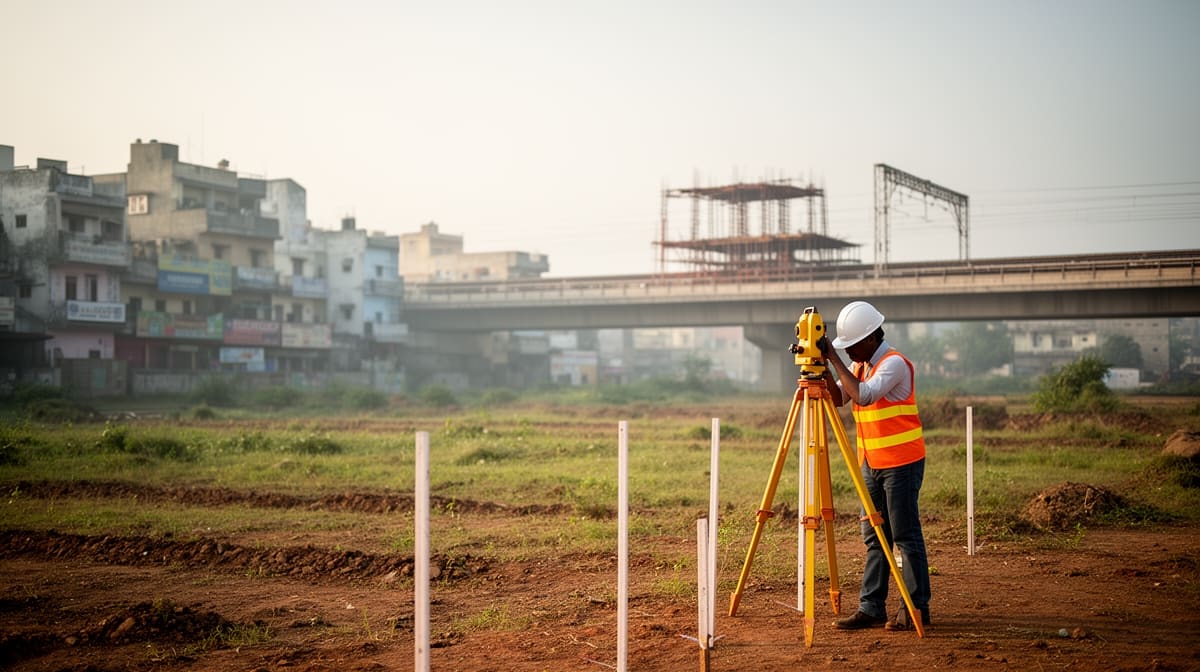
The Karnataka High Court has reaffirmed that land acquisition authorities cannot rely on prior awards to determine compensation without conducting a proper hearing or evaluating site-specific factors under the Right to Fair Compensation and Transparency in Land Acquisition, Rehabilitation and Resettlement Act, 2013. This judgment reinforces procedural fairness as a non-negotiable requirement in compensation adjudication.
Background & Facts
The Dispute
The dispute arises from the acquisition of agricultural land in Kavaloor Village, Koppal district, for the Singatalur Lift Irrigation Project. The respondent, Paramma (deceased), was the owner of the land. The Special Land Acquisition Officer (SLAO) initially fixed the market value at Rs. 72,000 per acre based on sales data from 25.09.2011 to 25.09.2014. The claimant filed a claim petition challenging this valuation, leading to the matter being referred to the Land Acquisition, Rehabilitation and Resettlement Authority (Authority) under Section 64 of the Act.
Key Facts
- The acquired land was agricultural, located in Kavaloor Village, Koppal district
- SLAO determined market value at Rs. 72,000 per acre using sales statistics method for a three-year period ending 25.09.2014
- Claimant filed claim petition (LAC No. 182/2022) seeking enhanced compensation
- Authority rejected claimant’s request to lead evidence, as noted in Paragraph 4 of the impugned award
- Authority enhanced compensation to Rs. 3,80,000 per acre solely by relying on its earlier award in LAC No. 83/2020 and connected cases (LAC Nos. 79, 80, 87, 89, 93, 187, 190 of 2020)
- No independent assessment was made of the land’s nature, fertility, proximity to roads, potential for non-agricultural use, or other factors under Section 26 of the Act
- No evidence was recorded, no witnesses examined, and no documents were admitted on record
Procedural History
- 25.09.2011 to 25.09.2014: Period of sales data used by SLAO for market value determination
- Date unspecified (prior to 19.12.2024): SLAO issued notification and fixed compensation at Rs. 72,000 per acre
- Date unspecified: Claim petition filed by respondent before SLAO
- Date unspecified: Reference made to the Land Acquisition Authority under Section 64 of the Act
- 19.12.2024: Authority passed award enhancing compensation to Rs. 3,80,000 per acre without recording evidence or hearing parties
- 29.04.2025: Miscellaneous First Appeal No. 101464 of 2025 filed before the High Court of Karnataka at Dharwad
- 29.04.2026: Judgment delivered by Division Bench
The Parties' Positions
For the Appellants (State)
- Argued that the Authority’s award of Rs. 3,80,000 per acre was justified by parity with prior awards
- Contended that the earlier award in LAC No. 83/2020 was a reliable precedent
- Did not dispute the absence of evidence or hearing, but sought to justify the enhancement on grounds of uniformity
- Relied on Manoj Kumar v. State of Haryana to argue that prior judgments may be used only as last resort, yet failed to demonstrate compliance with this principle
For the Respondent (Claimant)
- Did not dispute that the Authority rejected the request to lead evidence
- Did not argue the quantum of compensation but emphasized the procedural illegality
- Maintained that the award was arbitrary and violated the principles of natural justice
Relief Sought
The appellants sought to set aside the award dated 19.12.2024 and remand the matter to the Authority for fresh adjudication with proper opportunity to lead evidence and compliance with Section 26 of the Act.
The Legal Issue
The central question was whether the Land Acquisition Authority can enhance compensation solely by relying on a prior award without affording parties an opportunity to lead evidence or independently assessing the land’s characteristics under Section 26 of the LARR Act, 2013.
Arguments Presented
For the Appellant
The appellants contended that the Authority’s reliance on its earlier award in LAC No. 83/2020 was legally permissible under the doctrine of parity. They argued that the enhancement from Rs. 72,000 to Rs. 3,80,000 per acre was reasonable and aligned with prevailing rates in the region. They cited Manoj Kumar v. State of Haryana to assert that prior judgments may be used when no other evidence is available, but failed to demonstrate that the land in the present case was materially similar to the land in the earlier case. They did not contest the absence of a hearing or evidence recording.
For the Respondent
The respondent did not dispute the factual concession that the Authority denied the opportunity to lead evidence. However, the respondent’s counsel emphasized that the Authority’s failure to conduct a hearing and to evaluate the land under Section 26 rendered the award void ab initio. The respondent argued that the Authority’s reliance on a prior award without verifying the similarity of land characteristics violated the mandate of Section 60(4) of the Act, which requires a fair hearing and adjudication based on evidence.
The Court's Analysis
The Court conducted a rigorous analysis of Section 60 of the LARR Act, 2013, which governs the powers and procedure of the Authority. The Court emphasized that while the Authority is not bound by the strict procedural rules of the Code of Civil Procedure, it is bound by the principles of natural justice under Section 60(3). The Court held that the right to be heard and the right to present evidence are fundamental components of natural justice.
"The authority has rejected the prayer of the claimant to adduce evidence... and has passed the judgment without any evidence on record and only placing reliance on the judgment and awards passed in LAC No.83/2020 and connected matters."
The Court observed that the Authority did not examine whether the land in the earlier case was comparable in terms of soil quality, irrigation access, proximity to infrastructure, or potential for non-agricultural use - all factors explicitly required under Section 26 of the Act. The Court noted that Section 26 mandates a comprehensive assessment of the land’s market value, including recent sales, potential for development, and other relevant factors.
The Court distinguished Manoj Kumar v. State of Haryana, clarifying that even if prior awards may be considered, they cannot substitute for an independent, evidence-based determination. The Court held that the Authority’s action amounted to a mechanical application of precedent without any factual or legal justification, rendering the award arbitrary and violative of statutory mandates.
The Court further noted that Section 60(4) requires the Authority to dispose of the reference within six months after giving notice and affording a hearing to all parties. The failure to do so rendered the award legally unsustainable.
The Verdict
The appeal was allowed. The Court set aside the impugned award dated 19.12.2024 passed in LAC No. 182/2022. The matter was remanded to the Principal District and Sessions Judge and Land Acquisition, Rehabilitation and Resettlement Authority, Koppal, with directions to afford the parties a full opportunity to lead evidence and to determine the market value of the land strictly in accordance with Section 26 of the LARR Act, 2013. The parties are directed to appear before the Authority on 02.06.2026. The appellants are entitled to a full refund of the court fee paid on the memorandum of appeal under Section 64 of the Karnataka Court Fee and Suit Valuation Act, 1958.
What This Means For Similar Cases
Hearing Is Mandatory, Not Discretionary
- Practitioners must now insist on formal recording of evidence in all land acquisition references, even if the Authority claims to rely on precedent
- Any award passed without affording an opportunity to lead evidence is voidable under Section 60(4) and principles of natural justice
- Applications to record evidence must be formally recorded and addressed in writing by the Authority
Section 26 Requires Individualized Assessment
- Compensation cannot be determined by blanket application of rates from other cases
- Each parcel must be assessed for its unique characteristics: soil type, irrigation, accessibility, proximity to urban centers, and potential for conversion
- Authorities must document their reasoning for each factor considered under Section 26
Parity Cannot Override Statutory Procedure
- Prior awards may be referenced for guidance, but never as a substitute for independent adjudication
- The doctrine of parity is subordinate to statutory compliance and procedural fairness
- Courts will not uphold awards that bypass evidence recording, even if the quantum appears "reasonable"