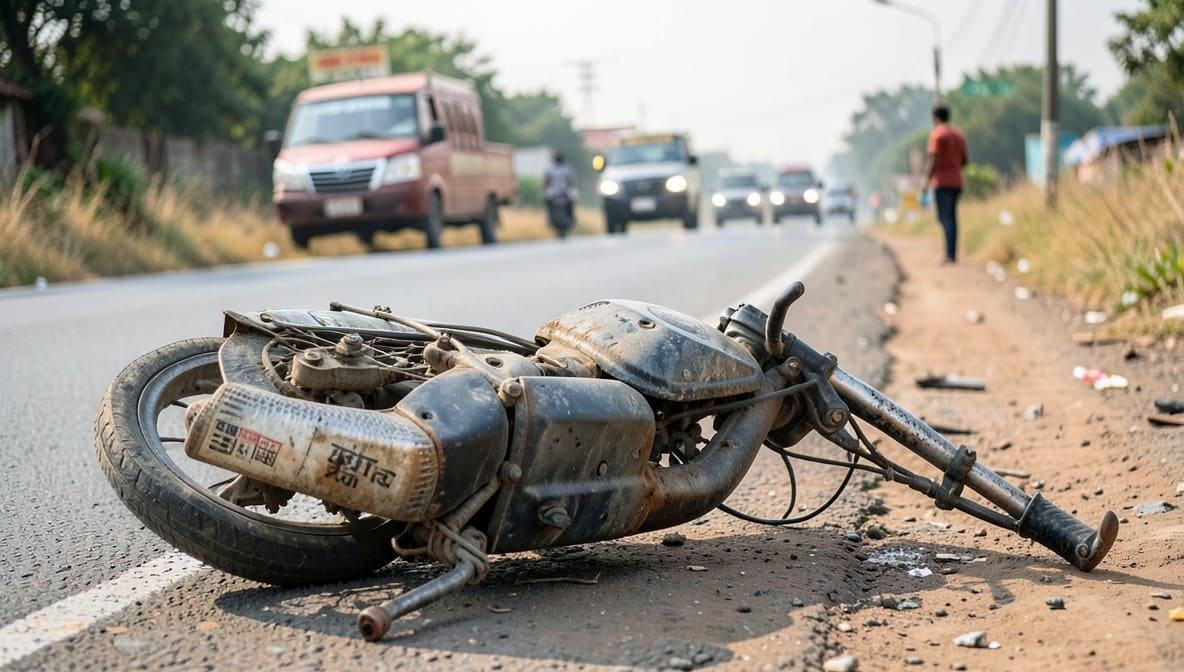
The Chhattisgarh High Court has reaffirmed that in motor accident claims, credible eyewitness testimony corroborated by an FIR is sufficient to establish negligence and liability, even in the absence of direct documentary proof of the driver’s license validity. The judgment underscores the tribunal’s duty to evaluate evidence holistically and not to reject claims based on speculative defenses raised without evidence.
Background & Facts
The Dispute
The appellant, Ram Kumar Sharma, filed a claim petition before the Claims Tribunal seeking compensation for grievous injuries sustained in a road accident on 15.08.2017. He alleged that the driver of a motor vehicle, respondent No.1, Gyan Singh Chandra, was driving rashly and negligently, resulting in the vehicle striking him while he was on his way to perform pooja. The vehicle was owned by respondent No.2, Smt. Asa Singh, and insured with respondent No.3, United India Insurance Company Limited.
Key Facts
- The accident occurred on 15.08.2017 at Korba, Chhattisgarh.
- The appellant was struck while walking on the roadside.
- He suffered multiple injuries requiring hospitalization and prolonged treatment.
- The appellant filed an FIR (Ex.P/02) on 16.08.2017 against the driver under Sections 279 (rash driving) and 337 (causing hurt by act endangering life or personal safety) of the IPC.
- The driver was charge-sheeted on 10.11.2017.
- The appellant submitted medical bills (Ex.P/14 to Ex.P/58) totaling Rs.32,201/-.
- The appellant was employed informally and earned Rs.6,206 per month, as per minimum wage norms.
- No evidence was produced by the insurer to challenge the validity of the driver’s license at the time of the accident.
Procedural History
- 15.08.2017: Accident occurred.
- 16.08.2017: FIR registered against driver under Sections 279 & 337 IPC.
- 10.11.2017: Charge-sheet filed by police.
- 12.06.2018: Claim petition filed before Claims Tribunal, Korba.
- 12.12.2018: Claims Tribunal dismissed the claim, holding that the appellant’s testimony was unreliable and no independent corroboration existed.
- 23.01.2019: Appeal filed before the High Court under Section 173 of the Motor Vehicles Act, 1988.
- 01.04.2026: Judgment delivered by the High Court.
Relief Sought
The appellant sought compensation for:
- Loss of income during 5 months of treatment
- Medical expenses
- Pain and suffering
- Special diet and attendant care
- Interest on the awarded amount Total claimed: Rs.1,25,000/-
The Legal Issue
The central question was whether the Claims Tribunal was justified in rejecting a compensation claim solely on the ground of perceived unreliability of the claimant’s testimony, when such testimony was corroborated by an eyewitness and supported by an FIR and charge-sheet establishing negligence.
Arguments Presented
For the Appellant
Counsel for the appellant argued that the testimony of the claimant (Witness No.1) and the eyewitness Ashok Kumar Yadav (Witness No.2) was consistent, unimpeached during cross-examination, and corroborated by the FIR and charge-sheet. He relied on National Insurance Co. Ltd. v. Pranay Sethi and Sarla Verma v. Delhi Transport Corporation to assert that compensation must be awarded based on the totality of evidence, not on technical objections raised without proof. He emphasized that the insurer’s failure to lead evidence regarding the driver’s license invalidity rendered the defense untenable.
For the Respondent
Counsel for the insurance company contended that the claimant’s testimony was self-serving and lacked independent corroboration. They argued that the absence of a police report or accident reconstruction report undermined the claim. They also raised a preliminary objection that the driver lacked a valid license at the time of the accident, thereby absolving the insurer of liability under Section 149(2)(a) of the Motor Vehicles Act. However, no documentary or testimonial evidence was produced to substantiate this claim.
The Court's Analysis
The Court conducted a meticulous review of the evidence recorded before the Claims Tribunal. It noted that the claimant’s testimony, as Witness No.1, was detailed, consistent, and remained unchallenged during cross-examination. The eyewitness, Ashok Kumar Yadav, corroborated the sequence of events, stating he was behind the offending vehicle and witnessed the collision. The Court emphasized that the presence of an FIR registered under Sections 279 and 337 IPC, followed by a charge-sheet, constituted strong circumstantial evidence of negligence.
"The claimant’s version, supported by an independent eyewitness and the FIR, cannot be dismissed merely because the Tribunal found it "self-serving". The burden to disprove negligence lies with the insurer, not the claimant."
The Court further held that the insurer’s plea regarding the driver’s invalid license was not substantiated by any evidence. Under Section 149 of the Motor Vehicles Act, the insurer’s liability is primary and cannot be avoided by raising unproven defenses. The Court cited Magma General Insurance Co. Ltd. v. Nanu Ram to affirm that the insurer must prove the existence of a statutory defense; mere assertion is insufficient.
The Court rejected the tribunal’s approach of requiring absolute corroboration beyond eyewitness testimony, noting that such a standard would render victims of road accidents perpetually remediless. The tribunal’s findings were held to be perverse and contrary to the record.
The Verdict
The appeal was allowed. The impugned order dated 12.12.2018 was set aside. The appellant is entitled to compensation of Rs.1,03,231/-, comprising:
- Loss of income: Rs.31,030/-
- Medical expenses: Rs.32,201/-
- Pain and suffering: Rs.20,000/-
- Special diet: Rs.10,000/-
- Attendant care: Rs.10,000/-
The compensation shall carry interest at 6% per annum from the date of filing the claim petition before the Tribunal until realization. The insurer, respondent No.3, is directed to deposit the amount with the Claims Tribunal within 45 days of receipt of this order. The Tribunal shall then handle apportionment, investment, and disbursement.
What This Means For Similar Cases
Witness Testimony Alone Can Establish Negligence
- Practitioners must argue that consistent, unimpeached testimony of the claimant and an eyewitness, even without video or forensic evidence, suffices to prove negligence under the Motor Vehicles Act.
- Tribunals cannot demand corroboration beyond what is reasonably available in accident scenarios.
Insurance Defenses Require Evidence, Not Allegations
- Insurers cannot rely on speculative defenses such as invalid license, unregistered vehicle, or driver’s intoxication without leading evidence.
- The burden of proof for statutory exceptions under Section 149 lies squarely on the insurer.
Compensation Calculations Must Reflect Realistic Income Norms
-
Where claimants are unorganized sector workers, courts may use minimum wage as a proxy for income, as done here with Rs.6,206/month.
-
Medical bills must be accepted if properly documented (Exhibits P/14 - P/58), even if not itemized in detail.
-
Always file and rely on the FIR and charge-sheet as critical corroborative documents in accident claims.
-
Advocate for interest from the date of filing, not from the date of judgment, as per Sarla Verma.