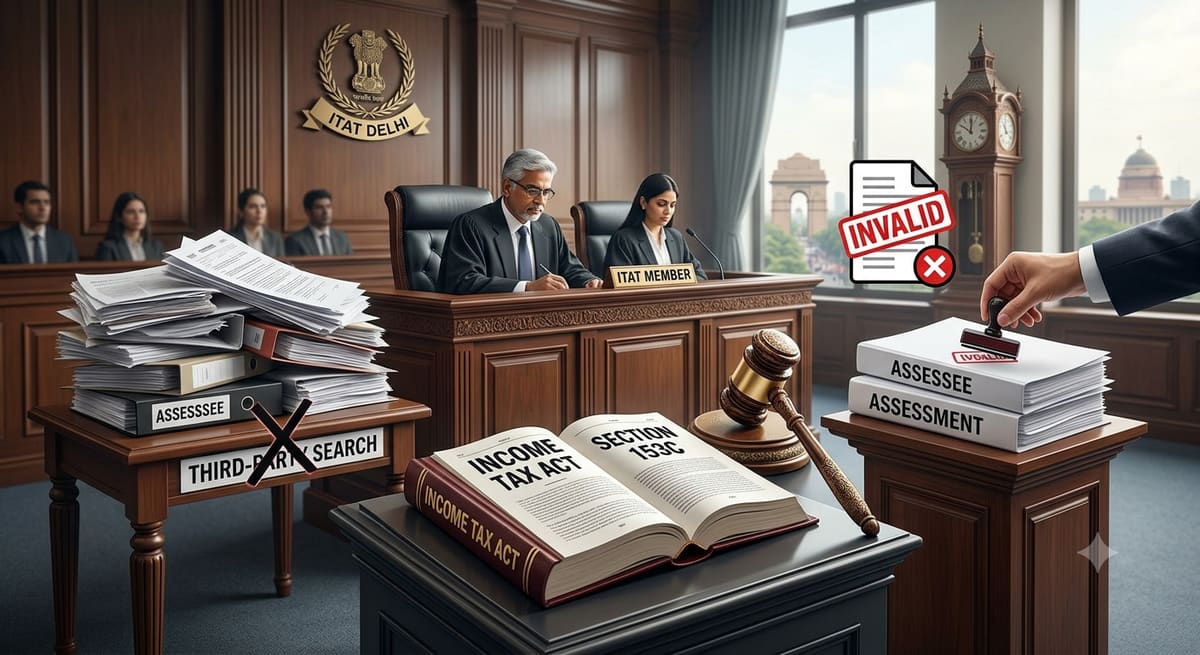
The Income Tax Appellate Tribunal, Delhi, has delivered a significant ruling clarifying the limits of assessment powers under Section 153C of the Income Tax Act, 1961. The Tribunal held that additions based exclusively on the valuation reports of Departmental Valuation Officers, without any incriminating material linking the assessee to unexplained income, are legally unsustainable. This decision reinforces the requirement of substantive evidence established in PCIT v. Abhisar Buildwell Pvt. Ltd. and provides critical guidance for taxpayers and revenue authorities alike.
Background & Facts
The Dispute
The instant batch of eight appeals involves three assessees - Shri Subhanshu Gupta, Shri Rishabh Gupta, and Shri Girish Kumar Gupta - each challenged assessments framed under Sections 153A, 153C, and 143(3) of the Income Tax Act, 1961. The assessments arose from a search operation conducted on 04.01.2018 at M/s SSGR Hospital and Research Centre Private Limited. The Assessing Officer initiated proceedings against the assessees under Section 153C, alleging unexplained investments based on a Departmental Valuation Officer (DVO) report, without producing any incriminating documents or statements directly linking them to the income.
Key Facts
- Search conducted on 04.01.2018 at M/s SSGR Hospital and Research Centre Private Limited
- Assessments framed against the three assessees under Sections 153A, 153C, and 143(3) for Assessment Years 2012-13 to 2018-19
- Additions made solely on the basis of DVO valuation reports, with no incriminating material recovered from the searched premises
- The DVO reports estimated unexplained investments in the form of cash, jewellery, and other assets, but did not establish ownership or source attribution to the assessees
- For Shri Girish Kumar Gupta (AY 2018-19), an addition of Rs. 19,00,00,000 was made under Section 69B based on alleged surrender, and Rs. 43,75,461 under Section 69A for unexplained jewellery
Procedural History
- 04.01.2018: Search conducted at M/s SSGR Hospital and Research Centre Private Limited
- 14.12.2020: Assessing Officer initiated proceedings under Section 153C against the assessees
- 28.12.2019: Order passed by CIT(A) for AY 2018-19
- 30.10.2025: CIT(A) order dated for AYs 2014-15, 2015-16, 2016-17
- 12.11.2025: CIT(A) order for AYs 2015-16, 2016-17, 2014-15
- 19.11.2025: CIT(A) order for AY 2012-13
- 29.05.2026: Hearing before ITAT Delhi; no appearance by assessees; proceedings held ex-parte
- 03.06.2026: Judgment pronounced by ITAT Delhi
Relief Sought
The assessees sought deletion of additions made under Sections 69A, 69B, and 153C, arguing that the assessments were based solely on DVO reports without incriminating material, and that the surrender claim for Rs. 19,00,00,000 lacked legal validity under CBDT Circular No. 10 of 2003.
The Legal Issue
The central question was whether an assessment under Section 153C can be sustained when the addition of unexplained investment is based exclusively on a Departmental Valuation Officer’s report, without any incriminating material recovered during the search that directly connects the assessee to the income.
Arguments Presented
For the Appellant
Although the assessees did not appear, the Tribunal inferred their position from the nature of the appeals and the absence of any rebuttal. The underlying contention, supported by precedent, was that Section 153C requires the Assessing Officer to establish a direct nexus between the unexplained investment and the assessee through incriminating material recovered during the search. Mere reliance on DVO valuation, without such material, violates the mandate of PCIT v. Abhisar Buildwell Pvt. Ltd. (2023) 454 ITR 212 (SC).
For the Respondent
The Revenue, represented by Ms. Poonam Sharma, CIT DR, argued that the DVO reports were sufficient to quantify unexplained investments and that the search date of 04.01.2018 validated the assessment years under Section 153C. It was contended that the valuation reports, even without incriminating material, could form the basis of addition under Section 153C.
The Court's Analysis
The Tribunal undertook a detailed analysis of Section 153C(1) and its first proviso, which governs the initiation of assessment against non-searched persons based on documents seized during a search. The Court emphasized that the proviso requires the Assessing Officer to record satisfaction that the documents seized are attributable to the assessee. The Tribunal relied on PCIT v. Ojjus Medicare Private Limited (2024) 465 ITR 101 (Del.), which held that the date of initiation of proceedings under Section 153C is not the date of search, but the date of recording satisfaction or handing over documents to the jurisdictional Assessing Officer.
"The addition made in the hands of the assessees is based on the DVO’s valuation report(s) only; involving varying sums, than any specific incriminating material as held mandatory in PCIT vs Abhisar Buildwell Pvt. Ltd. (2023) 454 ITR 212 (SC)."
The Tribunal found that the Assessing Officer had failed to establish any link between the seized documents and the assessees. The DVO reports merely estimated the value of assets, but did not prove ownership, source, or connection to the assessees. The Tribunal held that such additions are legally invalid.
Regarding Shri Girish Kumar Gupta’s case, the Tribunal examined the addition of Rs. 19,00,00,000 under Section 69B based on alleged surrender. It relied on CBDT Circular No. 10 of 2003, which states that mere admission or surrender during search proceedings, without corroboration, cannot form the basis of an addition. The Tribunal held this addition unsustainable. However, the addition of Rs. 43,75,461 under Section 69A for unexplained jewellery was upheld, as the assessee failed to explain the source of the jewellery, satisfying the requirements of that provision.
The Verdict
The appeals of Shri Subhanshu Gupta and Shri Rishabh Gupta (seven appeals collectively) are allowed. The additions based on DVO reports under Section 153C for AYs 2012-13 to 2016-17 are deleted. The appeal of Shri Girish Kumar Gupta (AY 2018-19) is partly allowed: the addition of Rs. 19,00,00,000 under Section 69B is deleted, but the addition of Rs. 43,75,461 under Section 69A for unexplained jewellery is confirmed. A copy of this order is to be placed in each case file.
What This Means For Similar Cases
DVO Reports Alone Cannot Sustain Section 153C Additions
- Practitioners must challenge any assessment under Section 153C that relies solely on DVO valuation without incriminating material
- The burden shifts to the Revenue to prove direct attribution of seized documents to the assessee
- Mere possession of assets valued by DVO, without evidence of ownership or source, is insufficient
Surrender Claims Require Corroboration
- Admissions or surrenders during search proceedings, without independent corroboration, cannot be the basis of additions under Section 69B
- Practitioners should invoke CBDT Circular No. 10 of 2003 to contest uncorroborated surrender claims
- The Tribunal’s reliance on this circular reaffirms its binding nature in assessment proceedings
Jurisdictional Timing Under Section 153C Is Critical
- The date of initiation under Section 153C is not the search date but the date of recording satisfaction or handing over documents
- Assessments for years beyond the period of search may be invalid if the procedural trigger under the proviso is not met
- Practitioners must scrutinize the date of satisfaction recording in every Section 153C case