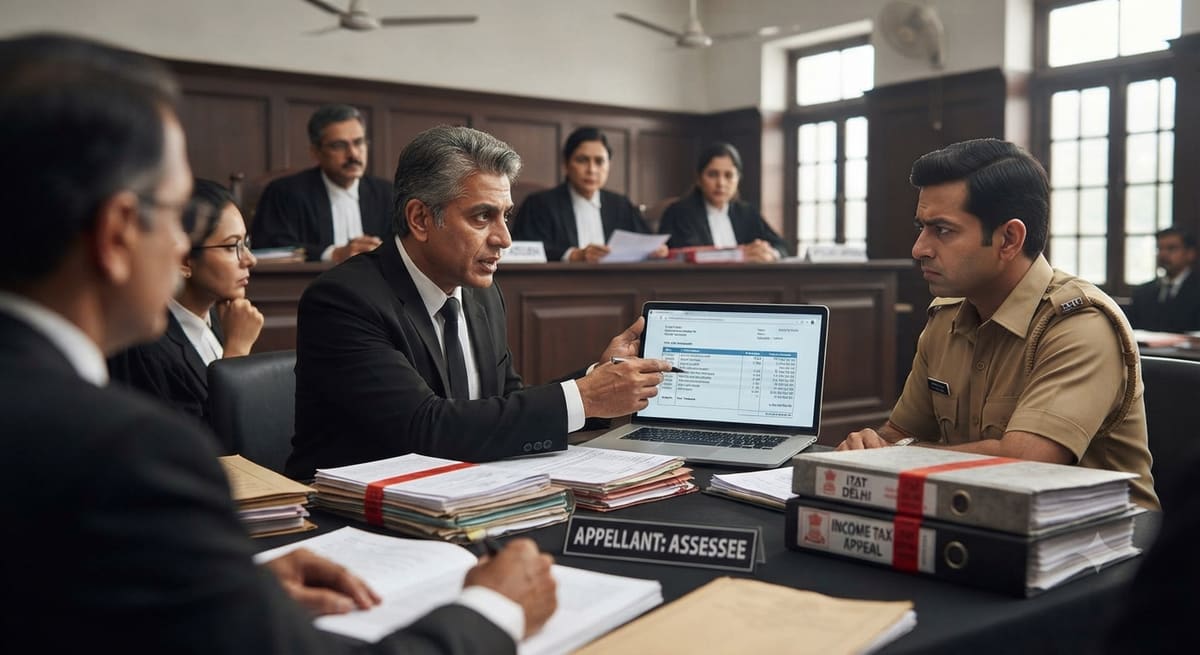
The Income Tax Appellate Tribunal, Delhi Bench, has clarified that additions under Section 153C of the Income-tax Act, 1961, cannot be sustained unless the incriminating documents seized during search operations specifically mention the assessee. This ruling underscores the necessity of direct evidence linking the assessee to alleged unexplained expenditures, setting a critical precedent for search assessments.
Background & Facts
The Dispute
The appellant, Fahim Ahmed Abbasi, challenged an addition of Rs. 15,37,500 made by the Assessing Officer (AO) under Section 69C of the Income-tax Act, 1961. The addition was based on alleged on-money payments made during a land purchase transaction. The dispute arose from a search operation conducted on 06.02.2019 in the case of Sh. Sanjay Jain (Kochar Group), during which documents purportedly relating to the appellant were seized.
Key Facts
- The appellant filed his Income Tax Return (ITR) for A.Y. 2018-19 on 21.08.2018, declaring an income of Rs. 6,77,400.
- A search under Section 132 was conducted on 06.02.2019 in the case of Sh. Sanjay Jain, leading to the initiation of Section 153C proceedings against the appellant.
- Notice under Section 153C was issued to the appellant on 31.03.2022.
- The AO completed the assessment on 30.03.2023, assessing the appellant’s income at Rs. 22,14,900 after adding Rs. 15,37,500 as unexplained expenditure under Section 69C.
- The alleged incriminating document was an agreement to sell dated 05.10.2017 for a land purchase, where the appellant was one of five buyers. The total consideration was Rs. 1,34,37,500, of which Rs. 57,50,000 was paid through banking channels, and Rs. 76,87,500 was allegedly paid in cash. The appellant’s share of the cash payment was calculated at Rs. 15,37,500.
- The appellant denied making any cash payment, contending that the agreement was not executed due to Uttarakhand government policies on land transfer.
Procedural History
- 10.07.2025: The Commissioner of Income Tax (Appeals)-29, Delhi (CIT(A)), upheld the AO’s addition in an order dated 04.03.2024 (DIN & case nos. 12568/2017-18).
- 09.04.2026: The appellant filed an appeal before the Income Tax Appellate Tribunal (ITAT), Delhi Bench.
Relief Sought
The appellant sought the deletion of the addition of Rs. 15,37,500, arguing that the seized documents did not specifically mention him and that no cash payment was made.
The Legal Issue
The central question was whether an addition under Section 153C of the Income-tax Act can be sustained when the incriminating documents seized during a search operation do not specifically mention the assessee’s name, thereby failing to establish a direct link between the seized material and the alleged unexplained expenditure.
Arguments Presented
For the Appellant
- The appellant contended that the agreement to sell dated 05.10.2017 was not executed due to Uttarakhand government policies, and no cash payment was made.
- The appellant argued that the seized documents did not specifically mention his name, rendering them insufficient to form the basis of an addition under Section 153C.
- Reliance was placed on the Supreme Court’s decision in PCIT vs Abhisar Buildwell Pvt. Ltd. (2023) 454 ITR 212 (SC), which held that additions in unabated assessments under Section 153C can only be made based on specific seized material.
For the Respondent
- The AO and CIT(A) relied on the seized documents, which allegedly reflected details of payments made through banking channels and in cash.
- The respondent argued that the appellant’s share of the cash payment (Rs. 15,37,500) was clearly identifiable from the seized material, and the appellant failed to provide evidence of the return of the amount paid through banking channels.
- The respondent submitted that the absence of the appellant’s name in the seized documents was not fatal, as the documents collectively established the transaction.
The Court's Analysis
The ITAT examined the legal principles governing Section 153C assessments, particularly the requirement that incriminating documents must specifically relate to the assessee. The Tribunal observed:
"A perusal thereof suggests that the assessee's name does not even find a mention therein so as to treat the same as an incriminating documents in his case which could held as forming basis of as many addition made herein."
The Tribunal relied on the Supreme Court’s decision in PCIT vs Abhisar Buildwell Pvt. Ltd., which established that for an assessment to be valid under Section 153C, the seized material must directly implicate the assessee. The Tribunal noted that the AO’s assessment order merely extracted the seized material without demonstrating how it specifically related to the appellant. The absence of the appellant’s name in the seized documents was held to be a critical deficiency, rendering the addition unsustainable in law.
The Tribunal further emphasized that Section 153C proceedings are not a fishing expedition. The AO must establish a direct nexus between the seized material and the assessee’s alleged unexplained expenditure. In this case, the Tribunal found that the AO failed to discharge this burden, as the seized documents did not specifically mention the appellant.
The Verdict
The ITAT allowed the appellant’s appeal and deleted the addition of Rs. 15,37,500. The Tribunal held that the addition under Section 69C was not sustainable in law or on facts, as the incriminating documents seized during the search did not specifically mention the appellant. The assessment order dated 30.03.2023 and the CIT(A)’s order dated 04.03.2024 were set aside.
What This Means For Similar Cases
Incriminating Documents Must Specifically Mention the Assessee
- The judgment reinforces that additions under Section 153C require incriminating documents to directly implicate the assessee. Generic or collective references in seized material are insufficient to sustain an addition.
- Practitioners should scrutinize seized documents to ensure they specifically mention the assessee’s name or role in the transaction. If the documents lack this specificity, the addition may be challenged on this ground alone.
Evidentiary Burden in Section 153C Proceedings
- The AO must establish a clear nexus between the seized material and the assessee’s alleged unexplained expenditure. Mere inferences or assumptions based on collective documents are not enough.
- Assessees should demand that the AO demonstrate how the seized material directly relates to them. If the AO fails to do so, the addition may be vulnerable to challenge.
Unabated Assessments Under Section 153C
- The ruling aligns with the Supreme Court’s decision in PCIT vs Abhisar Buildwell Pvt. Ltd., which held that additions in unabated assessments under Section 153C can only be made based on specific seized material.
- This principle applies retroactively, meaning that assessments completed without adhering to this standard may be reopened or challenged in appellate proceedings.