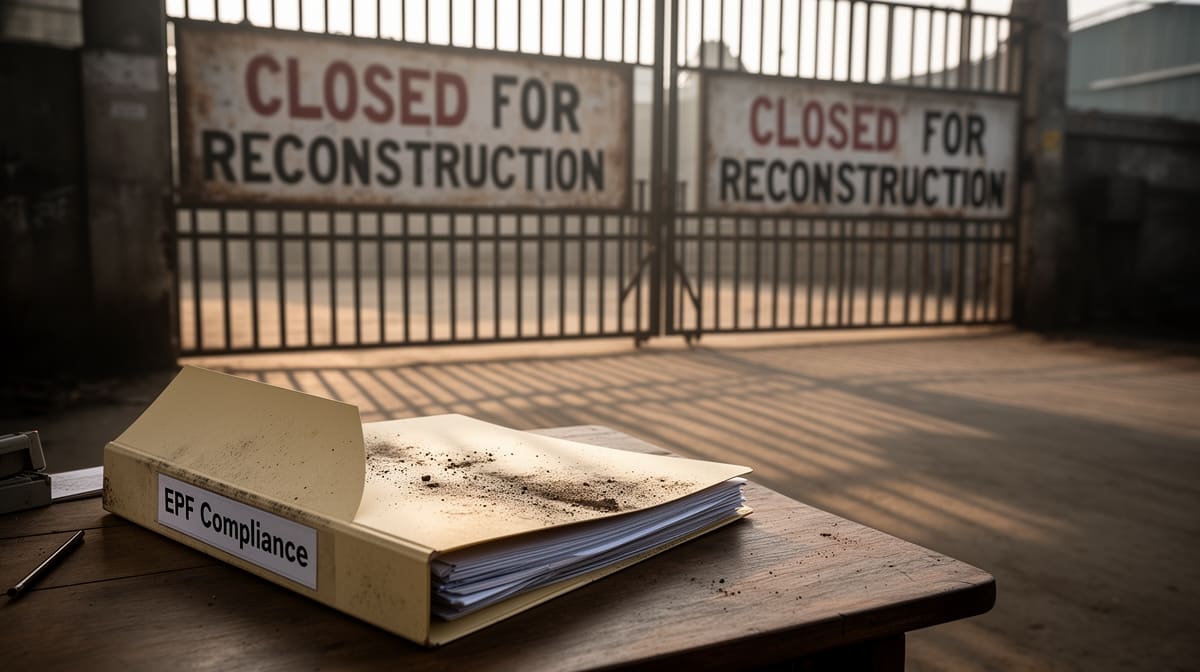
The Karnataka High Court has reaffirmed that administrative or technical difficulties faced by employers cannot mitigate statutory liability for delayed remittances under the Employees Provident Fund and Miscellaneous Provisions Act, 1952. This judgment clarifies the non-negotiable nature of compliance obligations under Section 14B, setting a critical precedent for employers and enforcement authorities alike.
Background & Facts
The Dispute
The dispute arises from the failure of M/s Megha Fruit Processing Private Limited, an establishment covered under the Employees Provident Fund and Miscellaneous Provisions Act, 1952, to remit Employees' Provident Fund dues for the period April 2018 to March 2019. The employer's delay triggered proceedings under Section 14B of the Act, which empowers the Provident Fund Commissioner to impose damages for default in payment.
Key Facts
- The respondent employer was covered under the EPF Act w.e.f. 01.08.2007 with PF Code No. KN/MLR/38570
- Delay in remittance occurred for the financial year April 2018 to March 2019
- On 04.06.2020, the Assistant Provident Fund Commissioner issued a notice under Section 14B seeking explanation
- After opportunity to respond, an order dated 16.07.2020 was passed levying damages of Rs. 2,42,385/-
- The employer contended before the Central Government Industrial Tribunal (CGIT) that technical difficulties in uploading Aadhaar and related details of 30 employees caused the delay
- The CGIT, by order dated 25.03.2025, accepted this contention and reduced the damages by 50%
- The Assistant Provident Fund Commissioner, aggrieved by this reduction, filed the present writ petition
Procedural History
- 01.08.2007: Employer registered under EPF Act
- April 2018 - March 2019: Period of delayed EPF remittances
- 04.06.2020: Notice issued under Section 14B
- 16.07.2020: Order passed by Assistant Provident Fund Commissioner levying damages of Rs. 2,42,385/-
- 25.03.2025: CGIT cum Labour Court, Bangalore, allowed appeal and reduced damages to 50% (Rs. 1,21,192.50)
- 17.02.2026: Emergent notice issued to respondent in writ petition
- 09.06.2026: Judgment delivered by High Court of Karnataka
Relief Sought
The petitioner sought:
- Quashing of the CGIT order dated 25.03.2025 reducing damages by 50%
- Confirmation of the original damages order dated 16.07.2020 of Rs. 2,42,385/-
- Any other relief deemed fit in the interest of justice
The Legal Issue
The central question was whether Section 14B of the EPF Act permits reduction of statutory damages on grounds of alleged technical difficulties in employee data upload, or whether such administrative constraints constitute a legally valid justification for non-compliance.
Arguments Presented
For the Petitioner
The petitioner argued that Section 14B imposes strict liability for delayed remittances, irrespective of the cause. The damages are not punitive but compensatory for the state's loss of interest and operational disruption. The CGIT erred in substituting its own assessment of hardship for the statutory mandate. Technical glitches, even if real, cannot override statutory obligations. The employer had ample time and opportunity to resolve the issue, and the Tribunal's intervention undermined the deterrent purpose of Section 14B.
For the Respondent
The respondent, being unrepresented, did not file any written submissions or appear before the High Court. The Court noted that the respondent neither engaged counsel nor appeared in person, and thus no counter-arguments were formally presented.
The Court's Analysis
The Court examined the nature and purpose of Section 14B of the EPF Act, which empowers the Commissioner to impose damages for delayed payment of contributions. The provision is designed to ensure timely compliance and protect the interests of employees whose statutory benefits are withheld.
"The Tribunal erred in law by modifying the quantum of damages, as the alleged technical difficulties encountered during the uploading of employees' details do not constitute a legally valid ground for reducing statutory liability. Moreover, the administrative constraints do not exonerate the employer from full compliance."
The Court emphasized that statutory obligations under the EPF Act are not subject to judicial discretion based on convenience or operational challenges. The employer's duty to remit contributions is absolute and non-delegable. Even if the delay arose from a technical issue with the online portal, the employer bore the responsibility to ensure compliance through alternative means or timely escalation.
The Court distinguished this from cases where delays arise due to force majeure or government-initiated system failures. Here, the employer failed to demonstrate any external impediment beyond its own internal processes. The CGIT's reduction of damages was therefore found to be without legal basis and contrary to the legislative intent behind Section 14B.
The Court further held that tribunals must not act as equitable arbiters in matters governed by strict statutory liability. Their role is to apply the law, not to mitigate consequences based on subjective hardship.
The Verdict
The writ petition is allowed. The order dated 25.03.2025 passed by the CGIT cum Labour Court, Bengaluru, in EPF/62/2020, reducing the damages by 50%, is quashed. The order dated 16.07.2020 passed by the Assistant Provident Fund Commissioner, Regional Office, Mangaluru, levying damages of Rs. 2,42,385/-, is confirmed. The respondent shall pay the full amount of Rs. 2,42,385/- within 6 weeks from the date of this judgment.
What This Means For Similar Cases
Statutory Compliance Is Non-Negotiable
- Employers cannot invoke technical glitches, software errors, or internal administrative delays as grounds to reduce damages under Section 14B
- The burden of ensuring timely remittance rests entirely on the employer, regardless of platform limitations
- Practitioners must advise clients to maintain backup procedures for EPF uploads and document all attempts to resolve technical issues
Tribunals Cannot Mitigate Statutory Liabilities
- Industrial tribunals and CGITs lack jurisdiction to reduce damages under Section 14B on equitable grounds
- Reductions are permissible only if the employer proves the delay was due to a statutory exemption or force majeure explicitly recognized under the Act
- Appeals must focus on factual inaccuracies in the notice or calculation of dues, not on subjective hardship
Enforcement Will Be Strict
- The judgment signals a zero-tolerance approach toward non-compliance with EPF obligations
- Employers should anticipate full liability even for minor or short-term delays
- Legal advisors must now treat Section 14B notices as high-risk matters requiring immediate remedial action, not negotiable penalties