The Bombay High Court has clarified that while Section 14B of the Employees’ Provident Funds and Miscellaneous Provisions Act, 1952 does not require proof of dishonest intent to impose damages, authorities must conduct a reasoned analysis of the employer’s conduct, particularly when delays arise from genuine industrial disputes or closure-related uncertainty.
Background & Facts
The Dispute
The respondent, National Organic Chemical Industries Ltd., failed to deposit provident fund, family pension, and deposit-linked insurance contributions for the period March 2002 to September 2004. The contributions were eventually paid on 10 November 2004. The Provident Fund Commissioner issued a show cause notice under Section 14B and Section 7Q of the Act, leading to an order dated 25 July 2007 imposing damages and interest.
Procedural History
The case progressed through multiple forums:
- 2007: Commissioner levied damages under Section 14B and interest under Section 7Q
- 2011: Appellate Tribunal initially dismissed the employer’s appeal in absentia
- 2011: Bombay HC quashed the dismissal and remanded for fresh hearing
- 2014: Tribunal allowed the appeal, holding that no willful default was established and beneficiaries were not identifiable
- 2016 & 2017: Commissioner filed writ petitions under Article 227 challenging the 2014 order
Relief Sought
The petitioner sought to set aside the Tribunal’s order and restore the original penalty, arguing that Section 14B does not require proof of mens rea and that the Tribunal erred in treating non-identification of beneficiaries as a bar to damages.
The Legal Issue
The central question was whether Section 14B of the EPF Act requires proof of willful default or mens rea to impose damages, and whether the non-identification of beneficiaries can legally preclude the levy of penalties.
Arguments Presented
For the Petitioner
The petitioner relied on Organo Chemical Industries v. Union of India and Union of India v. Dharamendra Textile Processors to argue that default under Section 14B is a civil liability triggered by non-payment, irrespective of intent. It was contended that the Tribunal misapplied criminal law principles to a civil penalty regime. The petitioner further argued that employee details were available in statutory returns, making beneficiaries identifiable, and that the Tribunal’s reliance on HMT Ltd. was outdated after Dharamendra Textile Processors.
For the Respondent
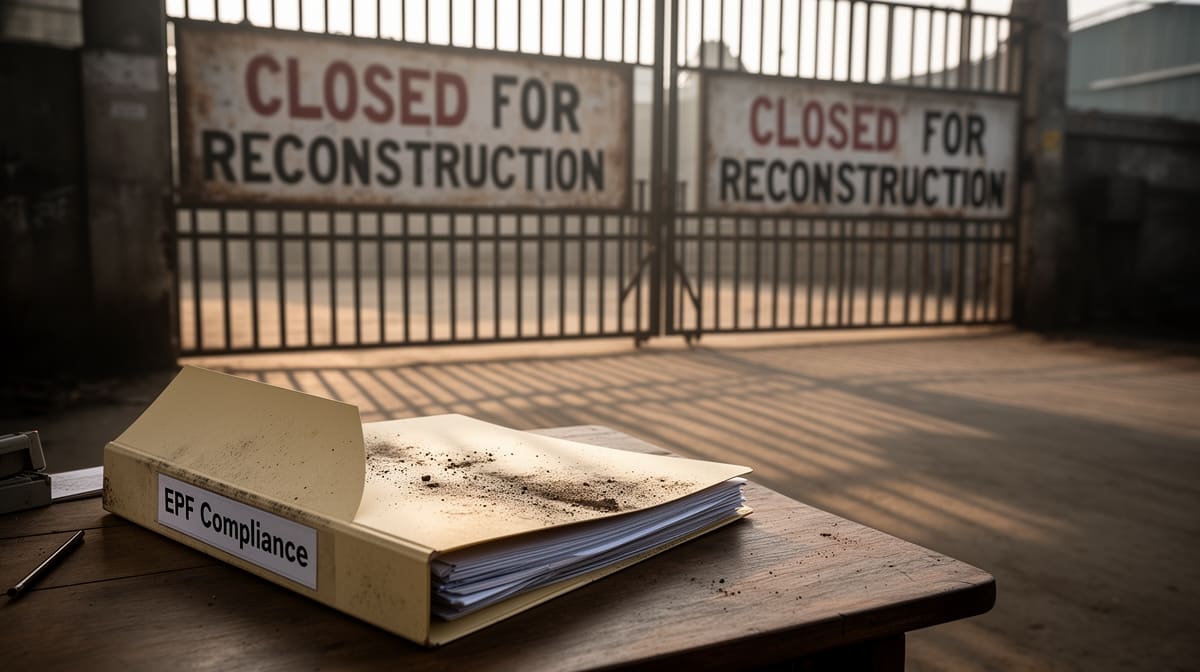
The respondent argued that the delay was not willful but arose from a bona fide industrial dispute following the closure of its unit in March 2003. The Industrial Tribunal had set aside the closure, and wage liability remained uncertain until a tripartite settlement in September 2004. Counsel contended that under Section 2(b) and Clause 29 of the Scheme, contributions are only payable when wages are due, and since wages were in dispute, no liability crystallized. The Tribunal’s finding of no willful default was therefore legally sound.
The Court's Analysis
The Court examined the interplay between statutory liability and equitable considerations. It held that while Section 14B uses the term "default" and not "willful default", this does not mean intent is irrelevant. Rather, conduct must be evaluated as a mitigating or aggravating circumstance.
"The word used in the section is ‘default’, not ‘willful default’. However, that does not mean intention is totally irrelevant. If there is delay, default is made out in principle. But while deciding whether to impose damages and how much, the authority must look at conduct. Was he deliberately avoiding payment? Or was he facing genuine legal uncertainty?"
The Court rejected the Tribunal’s conclusion that absence of mens rea was a complete bar to damages. It emphasized that civil penalties under the EPF Act are designed to ensure compliance and protect the Fund, not to punish moral culpability. The Court also found the Tribunal’s reasoning on beneficiary identification legally flawed, noting that statutory returns filed by the employer contained employee names and details, thereby satisfying the requirement of identification.
Crucially, the Court held that the original order imposing damages was equally defective for failing to address the context of closure, pending litigation, and settlement. The authority had not analyzed whether the delay was due to bona fide uncertainty or mere negligence. The Court stressed that fair inquiry requires more than notice and response - it demands reasoned analysis.
The Verdict
The petitioner’s challenge succeeded. The Court quashed both the original penalty order and the Tribunal’s order setting it aside. It held that Section 14B does not require proof of willful default, but any imposition of damages must be preceded by a reasoned determination of the circumstances surrounding the delay. The matter was remanded for fresh adjudication.
What This Means For Similar Cases
Reasoned Adjudication Is Mandatory
- Practitioners must now ensure that authorities record explicit findings on: (i) the nature of the delay, (ii) existence of bona fide disputes, (iii) timing of settlement, and (iv) whether contributions were eventually paid
- A mechanical imposition of damages without addressing employer’s explanation will be set aside
- Employers should proactively submit evidence of industrial disputes, closure orders, or settlement agreements to rebut allegations of willfulness
Beneficiary Identification Is Not a Legal Barrier
- Filing of statutory returns with employee names satisfies the requirement of identification under Section 14B
- Authorities cannot refuse to impose damages on grounds of "unidentified beneficiaries" unless there is concrete evidence of record inaccuracy or fraud
- This removes a common procedural shield used by defaulting employers
Conduct Trumps Intent in Civil Penalties
- While mens rea is not a statutory precondition, conduct - good faith, prompt compliance, and transparency - must inform the quantum of damages
- Employers who delay due to genuine legal uncertainty may still be liable, but the penalty should reflect mitigating factors
- This aligns EPF enforcement with modern civil penalty jurisprudence, as seen in Dharamendra Textile Processors