The Income Tax Appellate Tribunal, Rajkot, has delivered a decisive ruling reinforcing that reassessment notices under Section 148 of the Income Tax Act cannot be issued beyond the surviving limitation period, even after statutory extensions under TOLA. This judgment clarifies the temporal boundaries of revenue’s power to reopen assessments and reaffirms the primacy of procedural compliance over substantive allegations.
Background & Facts
The Dispute
The appellant, Shiv Extrusion, a partnership firm engaged in brass manufacturing, filed its return for Assessment Year 2016-17 declaring income of Rs. 2,65,490. During a search operation in August 2015, incriminating documents were seized indicating unaccounted sales of Rs. 1,17,14,220. The Assessing Officer (AO) later initiated reassessment proceedings under Section 147, relying on this unaccounted turnover.
Procedural History
The reassessment process unfolded through multiple procedural stages:
- 17.06.2021: Initial notice under Section 148 issued, beyond the normal four-year limitation period.
- 29.07.2022: Subsequent notice under Section 148 issued after the Supreme Court’s judgment in Ashish Agarwal, which mandated compliance with procedural safeguards.
- 17.05.2023: AO completed assessment under Section 147 read with Section 144B, adding Rs. 7,94,224 as unexplained income under Section 69A.
- 30.09.2025: Commissioner of Income Tax (Appeals) dismissed the appeal.
- 12.03.2026: ITAT Rajkot heard the appeal and set aside the reassessment.
Relief Sought
The appellant sought quashing of the reassessment notice and assessment order on grounds of jurisdictional defects, limitation expiry, and non-compliance with mandatory sanction and faceless assessment procedures.
The Legal Issue
The central question was whether a reassessment notice issued under Section 148 on 29.07.2022 was valid, given that the surviving limitation period under the Income-tax Act, as modified by TOLA, 2020, had expired on 22.06.2022.
Arguments Presented
For the Petitioner
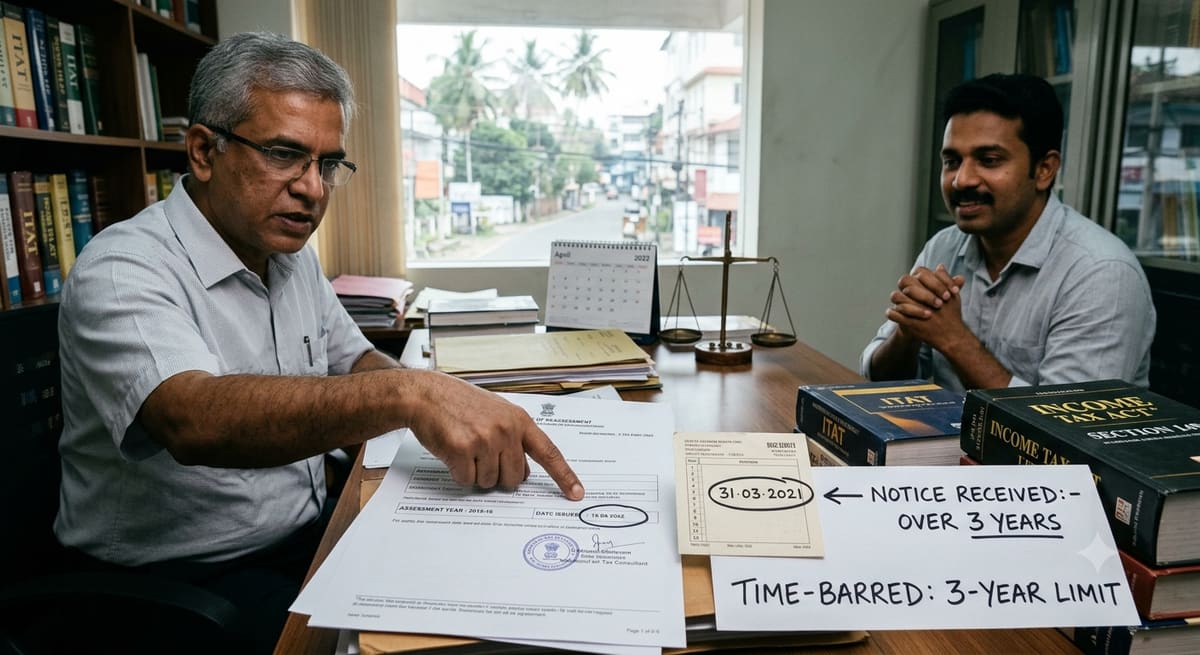
The appellant argued that the notice under Section 148 was time-barred. The original limitation for AY 2016-17 expired on 31.03.2020. TOLA extended it to 30.06.2021. The Supreme Court in Union of India v. Rajeev Bansal held that only the unexpired portion of the limitation period survives after the Ashish Agarwal directions. The assessee filed its reply on 09.06.2022, restarting the clock for the remaining 13 days, making the last permissible date for notice issuance 22.06.2022. The notice dated 29.07.2022 was issued 37 days beyond this limit. The appellant relied on the Gujarat High Court’s decision in Dilipbhai Jayantibhai Patel and the Supreme Court’s ruling in Rajeev Bansal to establish that any notice beyond the surviving period is void ab initio.
For the Respondent
The Revenue contended that the notice was issued in compliance with the Ashish Agarwal judgment and that the AO had acted in good faith. It argued that the procedural delay was technical and did not prejudice the assessee, as the underlying unaccounted income was substantiated by search records. However, the Revenue failed to rebut the specific timeline calculations presented by the appellant or to cite any authority contradicting the Rajeev Bansal precedent.
The Court's Analysis
The Tribunal conducted a meticulous review of the limitation timeline under Section 149 and the impact of TOLA, 2020, as interpreted by the Supreme Court in Union of India v. Rajeev Bansal. It noted that the period between the deemed notice date (17.06.2021) and TOLA expiry (30.06.2021) was 13 days. After the assessee filed its reply on 09.06.2022, the remaining period was recalculated, making 22.06.2022 the final deadline for issuing the notice.
"The Assessing Officers were required to issue the reassessment notice under Section 148 of the new regime within the time limit surviving under the Income-tax Act read with the Taxation and other Laws (Relaxation and Amendment of Certain Provisions) Act, 2020. All notices issued beyond the surviving period are time barred and liable to be set aside."
The Tribunal emphasized that the Supreme Court’s ruling in Rajeev Bansal was not merely advisory but binding on all authorities. It further cited the Gujarat High Court’s application of the same principle in Dilipbhai Jayantibhai Patel, where a notice issued on 28.07.2022 was similarly quashed. The Revenue’s failure to challenge the timeline or provide any legal justification for the delay rendered its arguments untenable. The Tribunal held that jurisdictional defects arising from limitation expiry are incurable and cannot be cured by subsequent substantive findings.
The Verdict
The appellant won. The ITAT Rajkot held that the reassessment notice dated 29.07.2022 was issued beyond the surviving limitation period and was therefore void. The assessment order was set aside. The Tribunal declined to examine other grounds, as they became academic in light of the jurisdictional invalidity.
What This Means For Similar Cases
Limitation Is Absolute, Not Discretionary
- Practitioners must calculate the surviving limitation period strictly: subtract the period already elapsed from the TOLA extension date.
- Any reassessment notice issued after the recalculated deadline is invalid, regardless of the strength of the evidence.
- The Revenue cannot invoke equity or substantive justice to override statutory limitation.
Procedural Compliance Trumps Substantive Allegations
- Even where unaccounted income is evident from search records, non-compliance with Section 148’s procedural safeguards renders the entire proceeding void.
- AO’s reliance on Ashish Agarwal does not cure jurisdictional defects; it mandates stricter adherence to timelines.
- Appeals must be framed to challenge jurisdictional validity first, as it is a threshold issue.
Precedent Binding Across Tribunals
- Rajeev Bansal and Ashish Agarwal now form the definitive framework for reassessment timelines.
- All ITAT benches must follow this interpretation uniformly.
- Revenue authorities must revise internal guidelines to ensure notices are issued within the precise surviving window.