The Income Tax Appellate Tribunal, Jaipur Bench, clarified that a notice issued under section 148 of the Income Tax Act is barred by the three-year limitation of section 149(1)(a) when the income escaping assessment is less than Rs 50 lakh, even if the notice is issued on the basis of information obtained during a search. The decision overturns the assessment order and dismisses the Revenue’s appeal.
Background & Facts
The Dispute
The Revenue (appellant) appealed against the order of the National Faceless Appeal Centre (Delhi) dated 29.12.2025, which had set aside an addition made by the Assessing Officer (AO) on the ground of limitation. The assessee (respondent), Mr. Mayank Khandelwal, had claimed a deduction under section 80GGC for a political donation of Rs 1,00,000, which the Department alleged to be bogus.
Key Facts
- The assessee claimed deduction u/s 80GGC of Rs 1,00,000 for a political donation made during FY 2018-19, relevant to Assessment Year (AY) 2019-20.
- Information about the alleged bogus donation was uncovered during a search on 07.09.2022 on a group of Registered Unrecognised Political Parties (RUPPs) in Ahmedabad.
- The AO reopened the case and issued a notice u/s 148 on 12.04.2023, following the procedure prescribed under section 148A.
- The assessee filed his return of income on 11.05.2023, admitting a total income of Rs 9,20,610.
- The AO framed an assessment order u/s 147 based on the notice u/s 148.
- The Ld. CIT(A) held that the notice was barred by limitation under section 149 and deleted the addition.
- The Revenue appealed the Ld. CIT(A) order; the assessee filed a cross-objection raising a separate limitation ground.
Procedural History
- 07.09.2022: Search action on RUPPs group uncovered documents indicating a bogus political donation by the assessee.
- 12.04.2023: AO issued notice u/s 148 (and order u/s 148A(d)) to the assessee.
- 11.05.2023: Assessee filed return of income for AY 2019-20, admitting total income of Rs 9,20,610.
- 29.12.2025: National Faceless Appeal Centre (Delhi) passed order under section 250, deleting the addition made by the AO.
- Date not specified: Revenue filed appeal before ITAT Jaipur (ITA No. 381/JPR/2026).
- 17.08.2026: Hearing before the Tribunal.
- 25.08.2026: Judgment pronounced.
The Parties' Positions
- Revenue (Appellant): Argued that the notice u/s 148 was valid because the AO had complied with the procedure under section 148A, and that the limitation period was extended under the fifth and sixth provisos of section 149.
- Assessee (Respondent): Contended that the income escaping assessment was only Rs 1,00,000 (less than Rs 50 lakh), so only the three-year limitation of section 149(1)(a) applied, making the notice dated 12.04.2023 time-barred. Also argued that the procedure under section 148A was not required when the information arose from a search.
Relief Sought
- Revenue: Sought reversal of the Ld. CIT(A) order and restoration of the assessment order.
- Assessee: Sought declaration that the notice u/s 148 was barred by limitation and that the assessment order was invalid.
The Legal Issue
What is the correct limitation period for issuing a notice under section 148 of the Income Tax Act when the income escaping assessment is less than Rs 50 lakh, and does the procedure prescribed under section 148A apply when the information prompting reopening is obtained through a search?
Arguments Presented
For the Appellant
The Revenue relied on the fifth and sixth provisos to section 149, arguing that they permitted a statutory extension of the limitation period beyond three years where the Assessing Officer possessed information indicating income of Rs 50 lakh or more, or where the case fell under clause (b) of section 149. It further submitted that the AO had complied with the procedural safeguards of section 148A, thereby validating the notice.
For the Respondent
The assessee emphasized that the income escaping assessment was only Rs 1,00,000, well below the Rs 50 lakh threshold, and therefore clause (b) of section 149 was inapplicable. Consequently, the three-year limitation of section 149(1)(a) was exclusive. It also argued that the provisions of section 148A are not mandatory when the information is obtained during a search, as per the explanatory note to section 148.
The Court's Analysis
The Tribunal began by interpreting section 149(1)(a), which provides a hard three-year limitation for issuing a notice under section 148 where the income escaping assessment is less than Rs 50 lakh. The fifth and sixth provisos to section 149 extend the limitation only when the income escaping assessment is Rs 50 lakh or more, or when the case falls under clause (b). The Tribunal noted that the assessee’s income escaping assessment was Rs 1,00,000, thereby excluding the applicability of the extended limitation.
"In the light of the above, we have no hesitation in holding that the jurisdiction assumed by the AO to frame assessment u/s 147 of the Act was not as per law and was invalid."
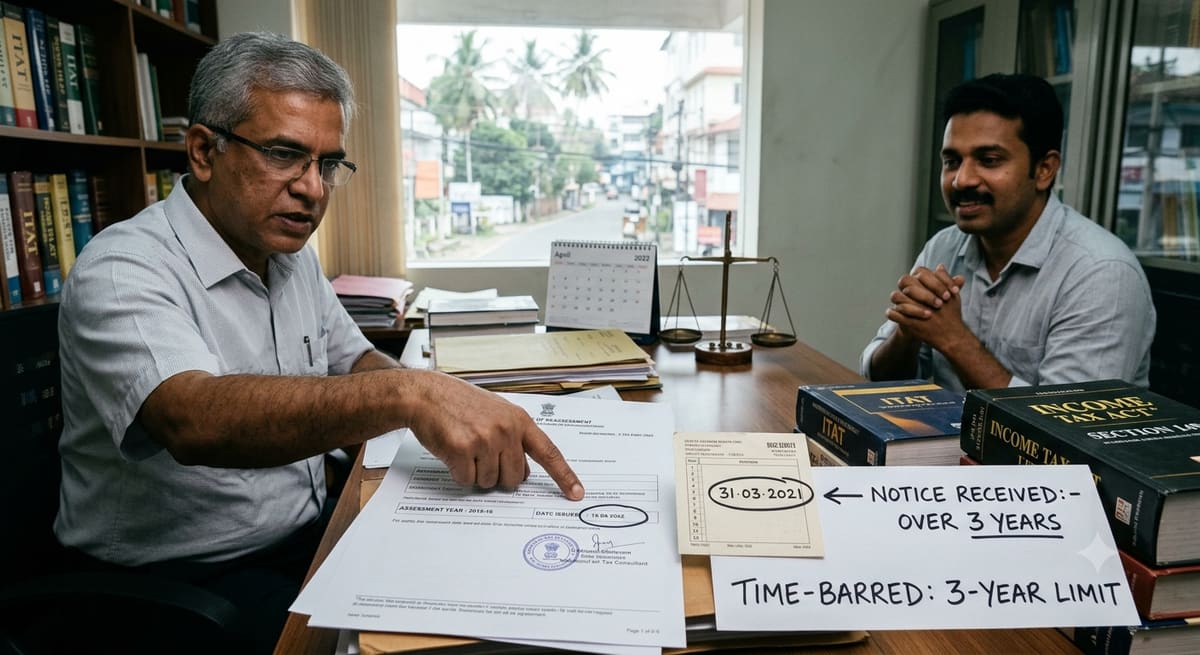
The Tribunal then examined the relevance of section 148A. It observed that the explanatory note to section 148 expressly states that when information is obtained through a search, the procedural requirements of section 148A are not mandatory. However, the Tribunal clarified that the non-application of section 148A does not alter the statutory limitation prescribed by section 149(1)(a). Hence, even though the AO followed the procedure under section 148A, the notice dated 12.04.2023 was issued beyond the three-year period ending on 31.03.2020 (the end of AY 2019-20).
The Tribunal further held that the notice u/s 148 was the jurisdictional notice for framing assessment u/s 147; because it was time-barred, the assessment order itself was invalid. Accordingly, the legal ground raised by the assessee in the cross-objection was allowed, and the Revenue’s appeal dismissed.
The Verdict
The Revenue’s appeal is dismissed. The notice issued under section 148 on 12.04.2023 is held to be barred by the three-year limitation of section 149(1)(a) because the income escaping assessment was Rs 1,00,000, i.e., less than Rs 50 lakh. Consequently, the assessment order passed under section 147 is declared invalid, and the assessee’s cross-objection is allowed.
What This Means For Similar Cases
Limitation Is Strict When Income < 50 Lakh
- Practitioners must verify the quantum of income escaping assessment before invoking the extended limitation under section 149.
- If the amount is below Rs 50 lakh, the three-year period is absolute, irrespective of procedural compliance under section 148A.
Search-Based Information Bypasses Section 148A Procedure
- When the Assessing Officer relies on information obtained from a search, the procedural safeguards of section 148A are not mandatory.
- However, the limitation period under section 149 still governs the validity of the notice.
Assessing Officers Must Align Notice Dates with Assessment Year End
- The clock for the three-year limitation starts from the end of the relevant assessment year (31 March).
- Issuing a notice after this period, even by a few days, renders the notice and any subsequent assessment invalid.
Practical Checklist for Tax Practitioners
- Determine the amount of income escaping assessment.
- Calculate the exact three-year deadline from the assessment year end.
- Ascertain whether the information originates from a search; if so, note that section 148A procedure is not required but limitation still applies.
- Advise clients to contest any notice issued beyond the statutory period promptly.
Impact on Revenue Appeals
- Appeals based solely on procedural compliance under section 148A will fail if the limitation period is breached.
- Revenue must focus on substantive grounds beyond limitation when contesting assessments.