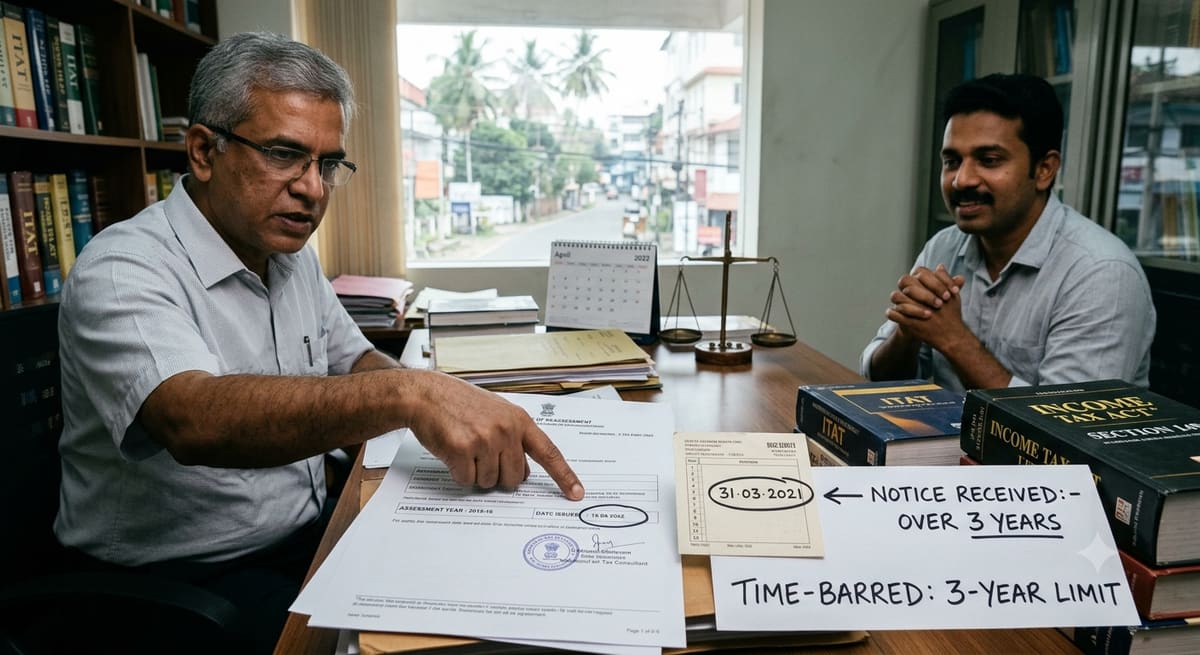
The Income Tax Appellate Tribunal held that a reassessment notice issued under Section 148 on 29 July 2022 was beyond the surviving limitation period prescribed by Section 149 in view of the Taxation Laws (Relaxation and Amendment) Act, 2020 (TOLA) and Supreme Court precedents, thereby quashing the notice and the subsequent assessment order for assessment years 2016-17 and 2017-18.
Background & Facts
The Dispute
The appellant, Karimulla Habibulla Sayed, a resident individual, contested the addition of Rs 32,32,410 to his total income for assessment years 2016-17 and 2017-18 under Section 69C of the Income Tax Act, 1961. The addition was based on alleged purchases from M/s N. I. Associates, which the appellant denied.
Key Facts
- 30.06.2021: Original notice under Section 148 issued (deemed notice).
- 24.05.2022: Fresh notice under Section 148A(b) issued.
- 27.07.2022: Order under Section 148A(d) passed and fresh notice under Section 148 issued on the same day.
- 27.08.2022: Appellant filed return declaring income of Rs 3,39,520.
- 22.05.2023: Assessing Officer completed assessment under Section 147 r.w.s. 144, 144B, fixing total income at Rs 35,71,930, including the disputed addition.
- 29.10.2025: Ld. CIT(A)/NFAC dismissed the appellant’s appeal.
- 12.06.2026: Appeal filed before ITAT (ITA Nos.410 & 411/PAN/2025).
- 30.07.2026: ITAT delivered the present judgment.
Procedural History
- 29.06.2021: Notice under erstwhile Section 148 (deemed as Section 148A(b)) issued.
- 04.05.2022: Supreme Court judgment in Ashish Agarwal delivered.
- 20.05.2022: Notice conveying reasons for reopening issued.
- 03.06.2022: Appellant’s first reply to Section 148A(b) notice filed.
- 04.06.2022: Two-week response period elapsed.
- 28.06.2022: Second reply filed.
- 14.07.2022: Additional one-week time granted due to change of incumbent.
- 21.07.2022: Additional one-week period elapsed.
- 29.07.2022: Order under Section 148A(d) passed and notice under Section 148 issued.
- 07.05.2023: Show-cause notice under Section 147 issued.
- 29.05.2023: Assessment order under Section 147 r.w.s. 144, 144B passed.
- 12.06.2026: Appeal heard before ITAT.
- 30.07.2026: Judgment pronounced.
Parties' Positions
- Appellant: Contended that the notice dated 29 July 2022 was issued beyond the surviving limitation period calculated under Section 149 as interpreted in Union of India v. Rajeev Bansal and Ashish Agarwal; therefore, the reassessment and assessment order were void.
- Respondent (Revenue): argued that the time limit was extended by TOLA notifications up to 30 June 2021 and that the subsequent notices and order were within the permissible period, relying on the procedural timeline prescribed under Section 148A(d).
Relief Sought
The appellant sought quashing of the notice dated 29 July 2022 issued under Section 148, setting aside the assessment order dated 22 May 2023, and reversal of the CIT(A) order for both assessment years.
The Legal Issue
Whether a notice issued under Section 148 of the Income Tax Act on 29 July 2022 is time-barred under Section 149(1) in light of the Taxation Laws (Relaxation and Amendment) Act, 2020 (TOLA) and the Supreme Court’s interpretation in Ashish Agarwal and Union of India v. Rajeev Bansal.
Arguments Presented
For the Appellant
- The appellant relied on Ashish Agarwal and Rajeev Bansal to argue that the surviving period for issuing a reassessment notice ended on 16 June 2022; any notice thereafter is beyond the limitation.
- Emphasised that the two-week response period granted under the deemed notice must be excluded from the limitation calculation as per the third proviso to Section 149.
- Submitted that the notice dated 29 July 2022 was issued after the cut-off date of 16 June 2022, rendering it void ab initio.
For the Respondent
- Asserted that TOLA notifications extended the limitation up to 30 June 2021 and that the notice dated 29 July 2022 fell within the extended period because the Assessing Officer acted under Section 148A(d) within one month of receiving the appellant’s reply.
- Relied on the procedural timeline in the Income Tax Act, contending that the one-month period under Section 148A(d) governs the final order, not the limitation under Section 149.
- Cited several High Court and Supreme Court decisions predating Rajeev Bansal to support the view that the notice was valid.
The Court's Analysis
The Tribunal first examined the statutory framework governing reassessment. Section 149(1) prescribes a four-year limitation for issuing a notice under Section 148 of the old regime, which, after the amendment effective 1 April 2021, is read with the substituted provisions. The Taxation Laws (Relaxation and Amendment) Act, 2020 (TOLA) extended the time limit to 30 June 2021 for notices deemed issued between 1 April 2021 and 30 June 2021.
The Court then applied the ratio from Ashish Agarwal that the period during which the show-cause notice is deemed stayed (1 April 2021 to 30 June 2021) and the two-week response period must be excluded from the limitation computation. Consequently, the surviving period for issuing a reassessment notice was reduced to the two days remaining in June 2021 (30 June 2021 - 28 June 2021).
"The notice dated 29/07/2022, issued by Respondent no.1 under Section 148 of the IT Act is beyond the time period specified under Section 149(1) of the IT Act. It is therefore quashed."
The Tribunal rejected the Revenue’s reliance on the one-month period under Section 148A(d), holding that this provision governs the order under Section 148A(d), not the notice under Section 148. The entire process from issuance of the deemed notice to the final order must be completed within the limitation prescribed by Section 149(1). Since the notice under Section 148 was issued on 29 July 2022, well after the surviving cut-off of 16 June 2022, it was time-barred.
The Tribunal also noted that the Revenue’s argument that the notice was issued after prior approval from the Competent Authority does not cure the statutory limitation. The Court affirmed the Supreme Court’s view in Rajeev Bansal that the surviving period is calculated by excluding the deemed-notice stay and the response period, and any notice beyond that is void.
The Verdict
The appeal filed by the appellant in ITA No.410/PAN/2025 (AY 2016-17) is allowed. The notice dated 29 July 2022 issued under Section 148 is declared time-barred and quashed. Consequently, the assessment order dated 22 May 2023 passed under Section 147 r.w.s. 144, 144B is set aside. The same reasoning is applied mutatis mutandis to ITA No.411/PAN/2025 (AY 2017-18); that appeal is also allowed, and the corresponding notice and assessment order are quashed. No costs were awarded.
What This Means For Similar Cases
Limitation Must Be Computed Strictly
- Practitioners must calculate the surviving period by excluding the deemed-notice stay (1 April 2021-30 June 2021) and the two-week response window under the third proviso of Section 149.
- Any reassessment notice issued after the computed cut-off is void, irrespective of subsequent approvals or procedural compliance under Section 148A(d).
TOLA Extensions Do Not Override Section 149
- Extensions granted by TOLA apply only up to 30 June 2021; they do not extend the limitation beyond the surviving period.
- Counsel should verify the exact expiry date before issuing notices; reliance on later dates such as 29 July 2022 will be rejected.
Procedural Timelines Govern Final Orders
- The one-month period under Section 148A(d) governs the order after the notice, not the notice itself.
- Ensure that the notice under Section 148 is served within the limitation; otherwise, the subsequent order, even if timely, will be invalidated.