Topic

Section 149

Section 149 of various Indian statutes, such as the Income Tax Act and Companies Act, prescribes procedural conditions for reassessment, compliance, or notice validity, often with strict time limits or substantive requirements.

9 articlesLatest July 2026
Section 148 Re-assessment Notice Time-Barred Under Section 149(1)(a) - Quashed for AY 2016-17 & 2017-18 | ITAT Panaji
|Income Tax Appellate Tribunal

Section 148 Re-assessment Notice Time-Barred Under Section 149(1)(a) - Quashed for AY 2016-17 & 2017-18 | ITAT Panaji

ITAT Panaji quashed the 29 July 2022 Section 148 notice as time-barred under Section 149(1)(a), setting aside assessments for AY 2016-17 and 2017-18. The tribunal held that reassessment cannot proceed when the three-year limitation expires and the monetary threshold is below Rs 50 lakh, applying the Ganesh Dass Khanna test. Taxpayers gain protection from stale reassessment notices.

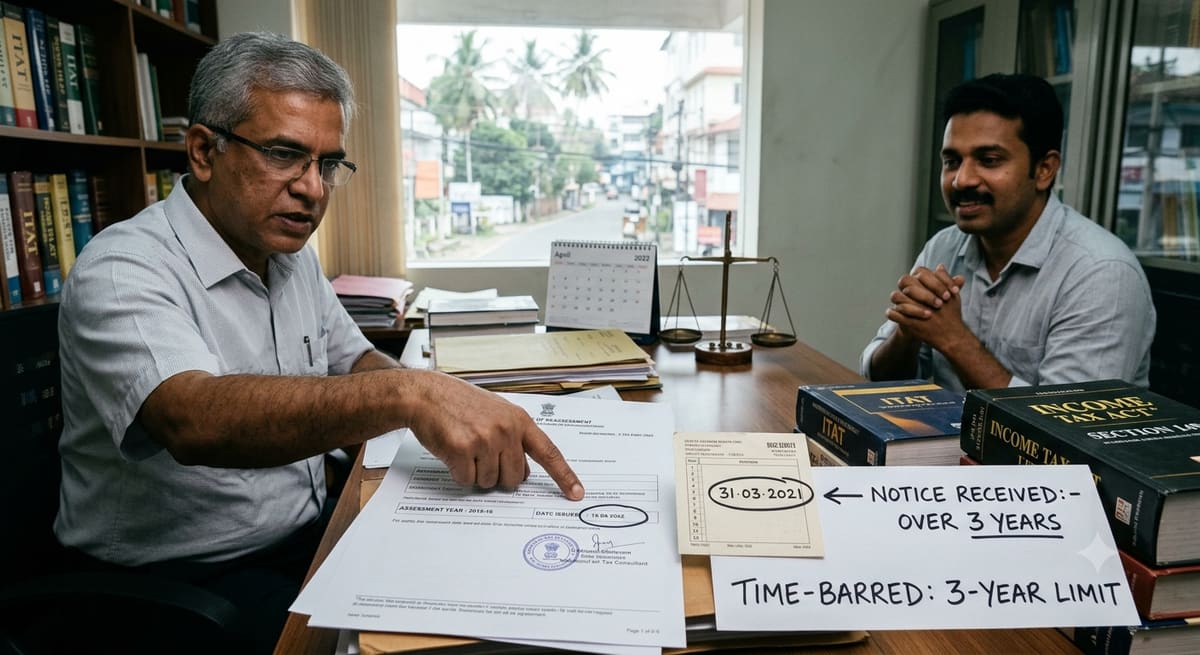
Section 149(1) First Proviso | Reassessment Notice Issued After 31.03.2022 for AY 2015-16 Barred by 3-Year Limit: ITAT Cochin
Case Law Analysis
|Income Tax Appellate Tribunal

Section 149(1) First Proviso | Reassessment Notice Issued After 31.03.2022 for AY 2015-16 Barred by 3-Year Limit: ITAT Cochin

ITAT Cochin has ruled that a reassessment notice issued on 06.05.2022 for AY 2015-16 is time-barred because the income escaped assessment did not exceed ₹50 lakh, triggering the three-year limitation under Section 149(1). This reinforces that post-2022 notices for pre-2019 assessments cannot be revived unless the monetary threshold is crossed, protecting taxpayers from arbitrary reopening.

Section 149(1)(b) IT Act | Notice u/s 148 Invalid If Escaped Income Below ₹50 Lakh Without Asset Representation : ITAT Delhi
Case Law Analysis
|Income Tax Appellate Tribunal

Section 149(1)(b) IT Act | Notice u/s 148 Invalid If Escaped Income Below ₹50 Lakh Without Asset Representation : ITAT Delhi

ITAT Delhi quashes reassessment proceedings where the escaped income was below ₹50 lakh and not represented by assets, holding that Section 149(1)(b) preconditions were not met. The ruling reinforces strict compliance requirements for reopening assessments beyond three years, impacting taxpayers facing similar notices.

Section 149 Companies Act | Substantive Proof Required for Women Director Compliance, Not Just Penalty Payment : Calcutta HC
Case Law Analysis
|Calcutta High Court

Section 149 Companies Act | Substantive Proof Required for Women Director Compliance, Not Just Penalty Payment : Calcutta HC

Calcutta High Court ruled that mere payment of penalty does not constitute compliance with Section 149 of the Companies Act, 2013, requiring appointment of a woman director. The Court held that the question of compliance is a triable issue necessitating substantive evidence, impacting corporate governance standards for unlisted companies.

Section 149(1)(b) IT Act | Rs. 50 Lakh Escaped Income Threshold Mandatory for Reassessment Beyond 3 Years : ITAT Ahmedabad
Case Law Analysis
|Income Tax Appellate Tribunal

Section 149(1)(b) IT Act | Rs. 50 Lakh Escaped Income Threshold Mandatory for Reassessment Beyond 3 Years : ITAT Ahmedabad

ITAT Ahmedabad quashes reassessment proceedings for AY 2017-18, ruling that escaped income below Rs. 50 lakhs does not trigger jurisdiction under Section 149(1)(b) of the Income Tax Act. The decision reinforces the statutory threshold as a non-negotiable precondition for reassessment beyond three years, impacting tax authorities' powers to reopen closed assessments.