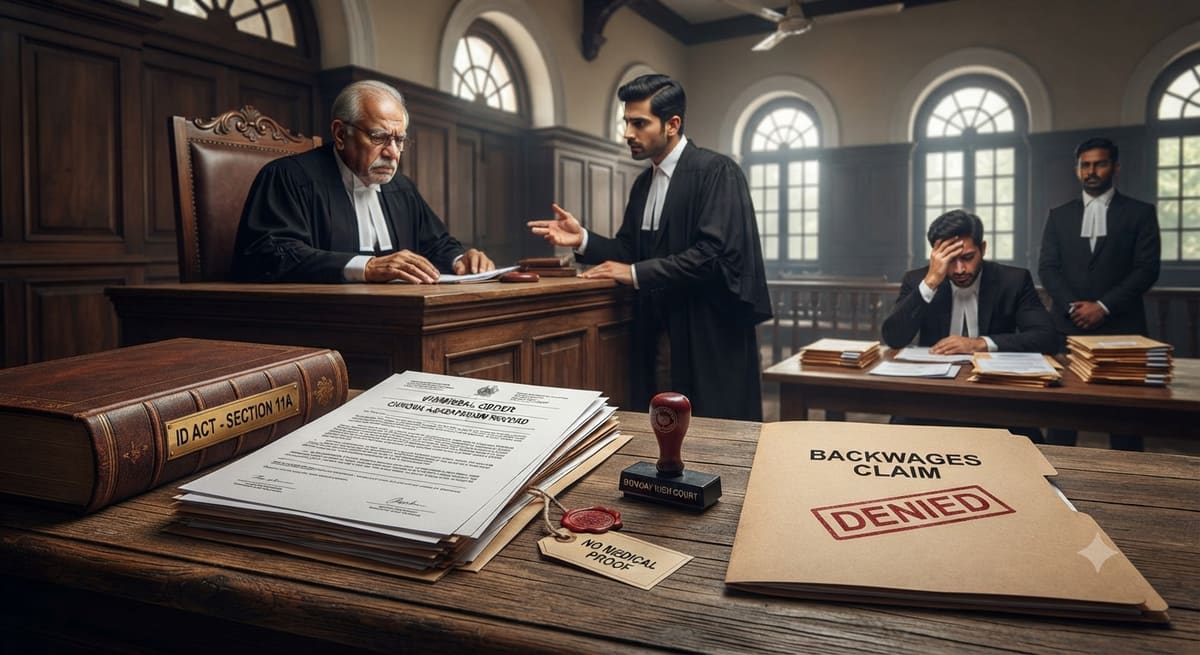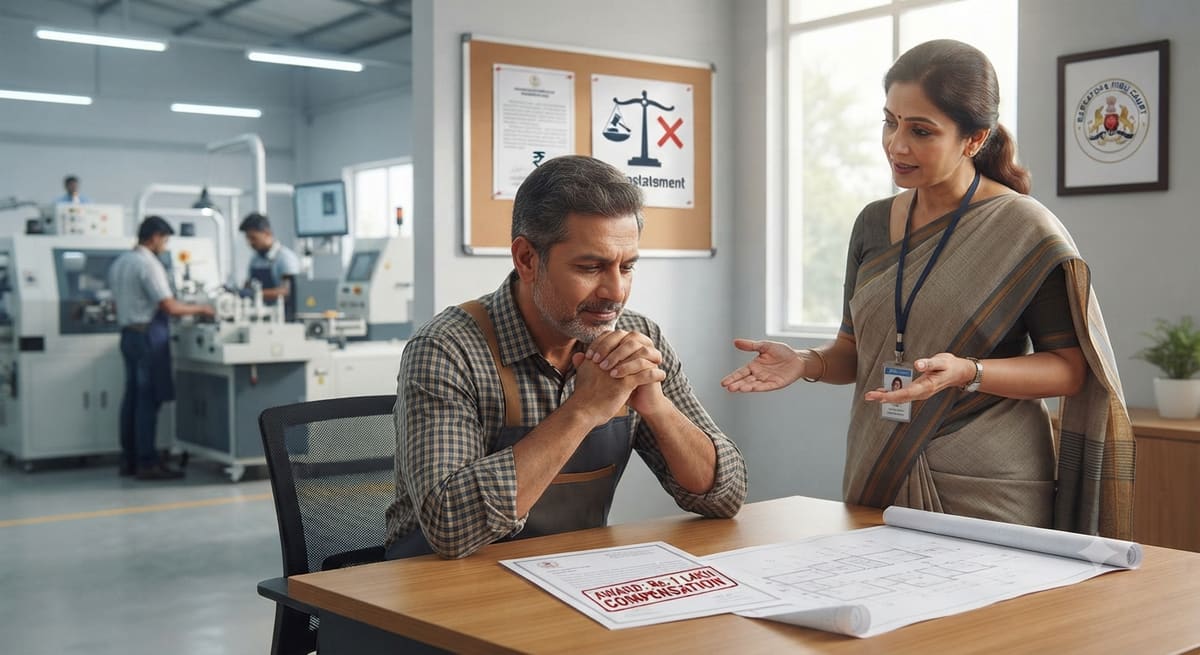
The Karnataka High Court has reaffirmed that an employee’s status as a workman under the Industrial Disputes Act, 1947, depends solely on the nature of duties performed, not on designation, salary, or hierarchical position. In a significant ruling, the Court upheld the Labour Court’s order reinstating an employee terminated for alleged misconduct but modified the award to grant 60% back wages, balancing the employer’s disciplinary concerns with the employee’s right to fair treatment.
Background & Facts
The Dispute
The dispute arose from the termination of Mr. Hemakumar, a Customer Service Executive, by HSBC Electronic Data Processing India Private Limited on 23.05.2016. The employer alleged multiple instances of misconduct, including insubordination, unauthorized absence, and violation of internal communication protocols. The employee challenged the termination before the Labour Court, seeking reinstatement with full back wages, continuity of service, and consequential benefits.
Key Facts
- The respondent joined the petitioner on 15.10.2007 as a Customer Service Executive
- His annual salary was approximately Rs. 2,20,000
- He reported directly to the Assistant Manager - Operations, with no subordinates under him
- The organizational hierarchy included: Assistant Manager → Manager → Assistant Vice President → Vice President → Centre Head
- The respondent was at the lowest rung of the hierarchy
- He was accused of sending emails directly to senior officers bypassing his immediate superior, on matters unrelated to his duties
- He was alleged to have been absent without authorization on seven dates in 2016: 04.02.2016, 05.02.2016, 23.03.2016, 24.03.2016, 29.03.2016, 06.04.2016, and 26.04.2016
- A charge memo dated 10.05.2016 was issued, alleging seven distinct charges including insubordination, lack of confidence, and unauthorized absence
- The employer conducted a domestic enquiry and terminated the respondent on 23.05.2016
- The respondent filed a claim before the Labour Court on 28.06.2016
- The Labour Court held the domestic enquiry unfair and permitted both parties to lead evidence
- The Labour Court delivered its award on 14.05.2019, reinstating the respondent with continuity of service but denying back wages
Procedural History
- 15.10.2007: Respondent appointed as Customer Service Executive
- 08.07.2015, 05.01.2016, 19.01.2016, 26.04.2016: Emails sent by respondent to senior officers
- 10.05.2016: Charge memo issued by employer
- 23.05.2016: Termination order passed
- 28.06.2016: Industrial dispute raised by respondent
- 14.05.2019: Labour Court award passed (Reference No. 58/2016)
- 12.06.2019: Writ Petition No. 43700/2019 filed by employer challenging reinstatement
- 18.06.2019: Writ Petition No. 49431/2019 filed by employee challenging denial of back wages
- 10.03.2026: Hearings concluded and reserved
- 02.06.2026: Judgment pronounced by Karnataka High Court
The Parties' Positions
Employer (Petitioner): Contended that the respondent was not a workman as he performed administrative and supervisory duties, earned a high salary, and held a position of responsibility. Argued that unauthorized absence of 38 days and repeated insubordination justified termination. Relied on H.R. Adhyanthaya v. Sandoz (India) Ltd., Mukund Staff and Officers Association v. Mukund Limited, and Mukesh K. Tripathi v. LIC to argue that designation and salary are relevant indicators.
Employee (Respondent): Asserted he was a workman as he performed routine, non-supervisory duties, had no subordinates, and followed instructions from superiors. Denied the allegations of misconduct, claimed the charge memo was vague and did not reflect actual dates of absence. Submitted that only three days of absence were documented, and two of those had valid reasons (medical visit and school fee payment). Argued that the penalty of termination was disproportionate.
Relief Sought
The respondent sought:
- Reinstatement with continuity of service
- Full back wages from 23.05.2016 to date of reinstatement
- All consequential benefits
The employer sought:
- Setting aside of the Labour Court’s award
- Declaration that the respondent was not a workman
- Upholding of termination order
The Legal Issue
The central questions were: (1) Whether the respondent, a Customer Service Executive earning Rs. 2.2 lakh per annum, qualifies as a "workman" under Section 2(s) of the Industrial Disputes Act, 1947, based on the nature of his duties? (2) Whether the penalty of termination was disproportionate to the established misconduct of three days of unauthorized absence, and if so, what quantum of back wages is just?
Arguments Presented
For the Appellant/Petitioner
The petitioner’s Senior Counsel argued that the respondent was not a workman because he independently discharged duties requiring skill and judgment, earned a salary far above manual workers, and occupied a position that involved interaction with clients and internal systems. Relied on H.R. Adhyanthaya v. Sandoz (India) Ltd. to contend that mere placement at the bottom of the hierarchy does not confer workman status. Asserted that the respondent’s emails to senior officers bypassing hierarchy constituted insubordination, and 38 days of absence amounted to gross misconduct. Cited L & T Komatsu Ltd. v. N. Udayakumar and Delhi Transport Corporation v. Sardar Singh to argue that absenteeism is a serious breach warranting termination.
For the Respondent
The respondent’s counsel contended that the nature of duties - processing assigned tasks, adhering to schedules, and reporting to superiors - was clearly manual and semi-skilled. Emphasized that no subordinate reported to him and he had no administrative or supervisory authority. Argued that the charge memo was defective for alleging seven days of absence when only three were documented in employer’s records (Annexure-P). Highlighted that two of those three days had valid reasons, leaving only one day of unexplained absence. Submitted that the employer failed to produce documents defining the respondent’s duties, thereby shifting the burden to prove non-workman status.
The Court's Analysis
The Court began by affirming the settled principle that designation and salary are not determinative of workman status under Section 2(s) of the Industrial Disputes Act, 1947. The critical test is the nature of the work performed. The Court noted that the respondent’s appointment order was vague and did not specify supervisory or managerial functions.
"The burden lies on the person asserting workman status, but once a plausible case is made - such as being at the lowest rung with no subordinates - the onus shifts to the employer to produce documents defining the role."
The Court observed that the employer, in possession of all employment records, failed to produce any job description, role charter, or organizational chart that would demonstrate the respondent was engaged in managerial, administrative, or supervisory work. The absence of such evidence led the Court to draw an adverse inference against the employer.
Regarding misconduct, the Court found that the charge memo alleged unauthorized absence on seven specific dates, but the employer’s own records (Annexure-P) only confirmed three: 31.03.2016, 06.04.2016, and 12.04.2016. Of these, 06.04.2016 (medical visit) and 12.04.2016 (school fee payment) were substantiated, leaving only 31.03.2016 as a genuine case of unauthorized absence. The Court held that the charge memo’s failure to include these dates rendered the charge legally defective.
"The penalty of termination cannot be sustained for a misconduct not even alleged in the charge sheet."
The Court further noted that the respondent’s emails to senior officers, while a breach of protocol, were met with a prior warning and no recurrence occurred. The Labour Court’s finding that insubordination and disrespect were not established was upheld as plausible.
On back wages, the Court rejected the Labour Court’s complete denial. While acknowledging the respondent’s unauthorized absence, it held that 100% back wages were excessive. However, since there was no evidence the respondent was gainfully employed during the termination period, 60% back wages were deemed appropriate.
The Verdict
The writ petition filed by the employer was dismissed. The writ petition filed by the employee was allowed in part. The Labour Court’s award dated 14.05.2019 was modified: the respondent is reinstated with continuity of service and all consequential benefits. He is entitled to 60% back wages from 23.05.2016 until the date of reinstatement. Any Section 17-B wages already paid shall be adjusted against this amount. The employer must comply with the order within 45 days from 02.06.2026. No costs were awarded.
What This Means For Similar Cases
Workman Status Is Determined by Function, Not Title
- Practitioners must focus on actual duties, not job titles, when arguing workman status under the ID Act
- Employers must maintain and produce detailed job descriptions at the earliest stage of dispute
- Salary above Rs. 10,000/month is no longer a conclusive bar to workman status post-2010 amendments
- Employees at the lowest hierarchy with no supervisory powers have a strong prima facie claim to workman status
Back Wages Must Reflect Proportionality to Misconduct
- Full back wages are not automatic even upon reinstatement
- Partial back wages (e.g., 60%) are justified where minor misconduct is established
- Employers must prove actual gainful employment by the employee during termination to reduce back wages
- Courts will not penalize employees for technical defects in charge sheets - the penalty must match the alleged misconduct
Procedural Defects in Disciplinary Proceedings Are Fatal
- Charge sheets must precisely list dates and nature of misconduct
- Failure to include actual dates of absence in charge sheet invalidates the entire disciplinary process
- Domestic enquiries based on defective charge sheets are inherently unfair
- Employers cannot rely on post-hoc justifications to sustain termination