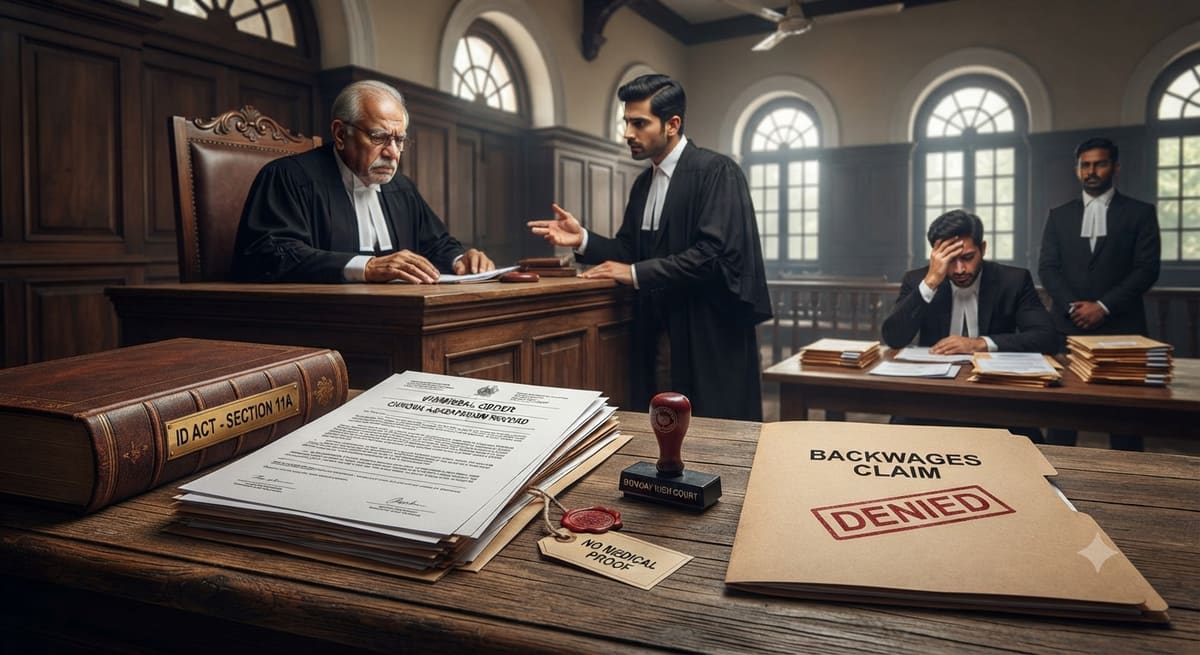
The Bombay High Court has remanded an industrial dispute to the Labour Court for fresh adjudication, emphasizing that prolonged absence due to judicial custody does not automatically excuse misconduct - proof of communication and intent remains essential. The judgment clarifies that even involuntary absence must be evaluated through the lens of procedural compliance and evidentiary record under the Industrial Disputes Act.
Background & Facts
The Dispute
The petitioner, Fiat India Automobiles Private Limited, terminated the services of the respondent, Sandeep Bhaskar Patekar, on 20 February 2015, citing continuous unauthorized absence from 21 November 2013. The respondent, employed as an Associate Team Member since 5 June 2009, was absent without leave or formal intimation for over two years. The petitioner contends that the termination was justified as misconduct under the Certified Standing Orders, while the respondent claims his absence was due to incarceration in connection with his wife’s alleged suicide, followed by acquittal on 30 January 2015.
Key Facts
- Respondent joined employment on 05.06.2009
- Respondent ceased reporting to duty from 21.11.2013
- Petitioner issued first notice on 09.01.2014 via ordinary post; returned undelivered
- Second notice dated 07.04.2014 sent via Registered Post Acknowledgment Due; successfully delivered
- Respondent’s reply to the second notice was deemed forged upon signature verification
- Third notice dated 07.01.2015 sent via Speed Post; no response received
- Respondent sent letter dated 14.01.2015 claiming arrest and magisterial custody due to criminal case related to his wife’s suicide
- Respondent was acquitted on 30.01.2015
- Respondent reportedly attempted to resume duty on 10.02.2015 but was denied entry
- Termination order issued on 20.02.2015, accompanied by retrenchment compensation of Rs. 1,09,468/-, one month’s wages, and gratuity form
- Industrial dispute referred to Labour Court on 02.01.2016
- Labour Court delivered Award on 27.03.2025, holding termination illegal and ordering reinstatement with 50% back wages and 9% interest if unpaid within two months
Procedural History
- 05.06.2009: Respondent appointed as Associate Team Member
- 21.11.2013: Respondent stopped reporting to duty
- 09.01.2014: First notice issued; returned undelivered
- 07.04.2014: Second notice sent via Registered Post; delivered
- 14.01.2015: Respondent’s letter claiming custody received
- 20.02.2015: Termination order issued
- 02.01.2016: Industrial dispute referred to Labour Court under Reference (IDA) No. 33 of 2016
- 27.03.2025: Labour Court awarded reinstatement and 50% back wages
- 27.03.2025: Petitioner filed Writ Petition (St.) No. 27576 of 2025 before Bombay High Court
- 24.04.2026: Judgment reserved
- 30.04.2026: Judgment pronounced
The Parties' Positions
Petitioner: Argued that the respondent’s absence was unauthorized, uncommunicated, and constituted grave misconduct under Clause 25(5) of the Certified Standing Orders. Contended that no leave application was filed, no authenticated communication was received, and the forged reply invalidated any claim of justification. Asserted that termination was not retrenchment but disciplinary action, and even if Section 25F applied, compliance was satisfied by payment of compensation.
Respondent: Claimed absence was involuntary due to judicial custody and subsequent acquittal. Asserted that the letter dated 14.01.2015 constituted sufficient intimation. Argued that termination after acquittal was unjustified, and that the employer failed to follow Rule 81 (last-in-first-out) for retrenchment. Maintained that absence was not willful and therefore not misconduct.
Relief Sought
The petitioner sought quashing of the Labour Court’s Award dated 27.03.2025, and a direction to uphold the termination order. The respondent sought enforcement of reinstatement, 50% back wages from 21.11.2013 to 20.02.2015, consequential benefits, and 9% interest on unpaid dues.
The Legal Issue
The central question was whether Section 11A of the Industrial Disputes Act, 1947 permits a Labour Court to adjudicate the legality of termination based solely on pleadings when the employer has reserved the right to prove misconduct, and whether prolonged absence due to judicial custody constitutes willful misconduct in the absence of authenticated communication.
Arguments Presented
For the Petitioner
The petitioner’s counsel argued that the Labour Court erred in not permitting evidence to establish misconduct. Relied on State of U.P. v. Ashok Kumar Singh (1996) and State of Uttarakhand v. Sureshwati (2021) to assert that even without a prior domestic inquiry, an employer may justify termination before the Labour Court by leading evidence. Contended that the respondent’s letters were unauthenticated, unproved, and could not substitute formal leave applications under the Certified Standing Orders. Argued that the Labour Court misapplied Krushnakant B. Parmar v. Union of India by extending its holding on short-term illness to prolonged, uncommunicated absence. Asserted that the termination was for misconduct, not retrenchment, and thus Section 25F compliance was incidental, not mandatory.
For the Respondent
The respondent’s counsel contended that the absence was not willful due to incarceration and acquittal, relying on Maharashtra State Road Transport Corporation v. Alfred James Gamare (2009) and Krushnakant B. Parmar. Argued that the fact of custody negated intent, and that the employer’s failure to frame a specific issue on misconduct precluded it from leading evidence. Maintained that Section 11A empowers the Labour Court to examine the justification of dismissal without requiring additional evidence if the facts are admitted.
The Court's Analysis
The Court examined the interplay between procedural fairness under Section 11A and the employer’s right to prove misconduct despite the absence of a prior domestic inquiry. It held that while the respondent’s absence was not voluntary in the traditional sense, the legal question of willfulness could not be resolved without evidence.
"The employer is entitled to know whether the employee has informed about such custody, whether any leave was applied for, whether there was any effort to communicate the situation, and whether the absence was unavoidable."
The Court rejected the respondent’s argument that admission of absence alone sufficed to determine willfulness. It emphasized that the Labour Court’s reliance on unauthenticated photocopies of letters, without verification or opportunity for cross-examination, was legally unsustainable. The petitioner had explicitly reserved its right to prove misconduct in its written statement and had moved an application to frame an issue on unauthorized absence. The Court found that denying this opportunity violated the principles of natural justice.
The Court distinguished Krushnakant B. Parmar, noting that it concerned temporary absence due to illness or accident, not a two-year uncommunicated absence. It also rejected the notion that procedural technicalities in issue-framing could override substantive justice, citing that pleadings must be construed liberally to advance fairness.
The Court further clarified that termination for misconduct and retrenchment are distinct under the Industrial Disputes Act. While the petitioner had paid retrenchment compensation, this did not convert a disciplinary dismissal into a retrenchment. The Labour Court’s conflation of the two was erroneous.
The Verdict
The writ petition was partly allowed. The Labour Court’s Award dated 27 March 2025 was quashed and set aside. The reference was remanded to the Labour Court, Pune, for fresh adjudication. The Labour Court shall permit the petitioner to lead evidence to prove misconduct of unauthorized absence, and the respondent shall be at liberty to rebut. The matter shall be decided afresh within six months of the first appearance of parties. All contentions of both parties are kept open. No order as to costs.
What This Means For Similar Cases
Evidence on Willfulness Is Mandatory
- Practitioners must now ensure that in cases of prolonged absence due to incarceration or other external factors, the Labour Court must permit both parties to lead evidence on intent and communication
- Mere assertion of custody or acquittal is insufficient; authenticated proof of intimation to the employer is required
- Employers must preserve specimen signatures and maintain records of all communications to challenge forged or unverified replies
Section 11A Empowers, But Does Not Obligate, Evidence Admission
- Section 11A grants the Labour Court wide powers to examine the justification of dismissal, but this does not preclude the employer’s right to present evidence
- Reservation of right to prove misconduct in the written statement triggers the obligation to permit evidence
- Courts must avoid rigid adherence to issue-framing formalities; pleadings must be interpreted to ensure substantive justice
Misconduct vs. Retrenchment Must Be Clearly Distinguished
- Termination for unauthorized absence is disciplinary misconduct, not retrenchment
- Payment of retrenchment compensation does not convert a misconduct-based dismissal into a retrenchment
- Employers need not comply with Section 25F or Rule 81 if termination is for misconduct, but doing so does not invalidate the action
- Labour Courts must not conflate statutory frameworks to grant relief based on sympathy rather than legal principle