The Bombay High Court has clarified that compensation awarded in lieu of reinstatement for illegal termination must bear a rational relationship to the length of service, last drawn wages, and actual loss suffered. A nominal award of Rs. 2,00,000 for eleven years of service was held to be legally unsustainable, prompting a significant enhancement to Rs. 6,00,000.
Background & Facts
The Dispute
The petitioner, Rajkumar Harishankar Jaiswal, was employed by Mohit Synthetic Pvt Ltd as a Mehta from 5 December 2006 until his termination on 10 August 2017. He alleged that his employment was terminated without any notice, charge-sheet, show cause notice, or compliance with Sections 25F and 25G of the Industrial Disputes Act, 1947. He further claimed he worked twelve hours daily without statutory benefits such as overtime, weekly offs, leave encashment, or identity documentation.
Key Facts
- The petitioner was appointed on 5 December 2006 and worked continuously until termination on 10 August 2017
- His last drawn monthly salary was Rs. 14,000
- He completed over 240 days of service annually, qualifying him for statutory protection
- The respondents did not maintain muster cards, attendance registers, or wage records despite repeated demands
- No notice of termination, retrenchment compensation, or notice pay was provided
- A demand notice dated 1 September 2017 went unanswered
- Conciliation proceedings failed on 29 December 2017, leading to reference before the Labour Court
Procedural History
- 05.12.2006: Petitioner appointed as Mehta
- 10.08.2017: Termination without procedural compliance
- 01.09.2017: Demand notice issued by petitioner
- 29.12.2017: Conciliation failed; reference made by appropriate Government
- 2018: Reference (IDA) No. 119 of 2018 registered before Labour Court, Thane
- 16.11.2021: Petitioner applied for production of attendance, wage, and payment records; respondents failed to comply
- 03.07.2024: Labour Court awarded Rs. 2,00,000 as compensation, denied reinstatement and back wages
- 25.07.2024: Writ Petition No. 7793 of 2025 filed before Bombay High Court
- 30.04.2026: Judgment reserved
- 07.05.2026: Judgment pronounced
The Parties' Positions
Petitioner: Argued that termination was illegal, procedural safeguards were ignored, and he remained unemployed for nearly seven years. He contended that reinstatement with full back wages was the natural remedy, and even if reinstatement was not sought, compensation must reflect the loss.
Respondents: Contended that the Labour Court’s award of Rs. 2,00,000 was reasonable, discretionary, and sufficient in light of the circumstances. They argued that compensation in lieu of reinstatement is not bound by rigid formulas.
Relief Sought
The petitioner sought enhancement of compensation from Rs. 2,00,000 to Rs. 11,50,000 (representing seven years of back wages at Rs. 14,000/month), or alternatively, reinstatement with full back wages. He withdrew the prayer for reinstatement during oral arguments but insisted on adequate compensation.
The Legal Issue
The central question was whether a compensation of Rs. 2,00,000 for eleven years of service and seven years of unemployment following an illegal termination under the Industrial Disputes Act, 1947, is legally sustainable in the absence of any reasoned justification or quantification.
Arguments Presented
For the Petitioner
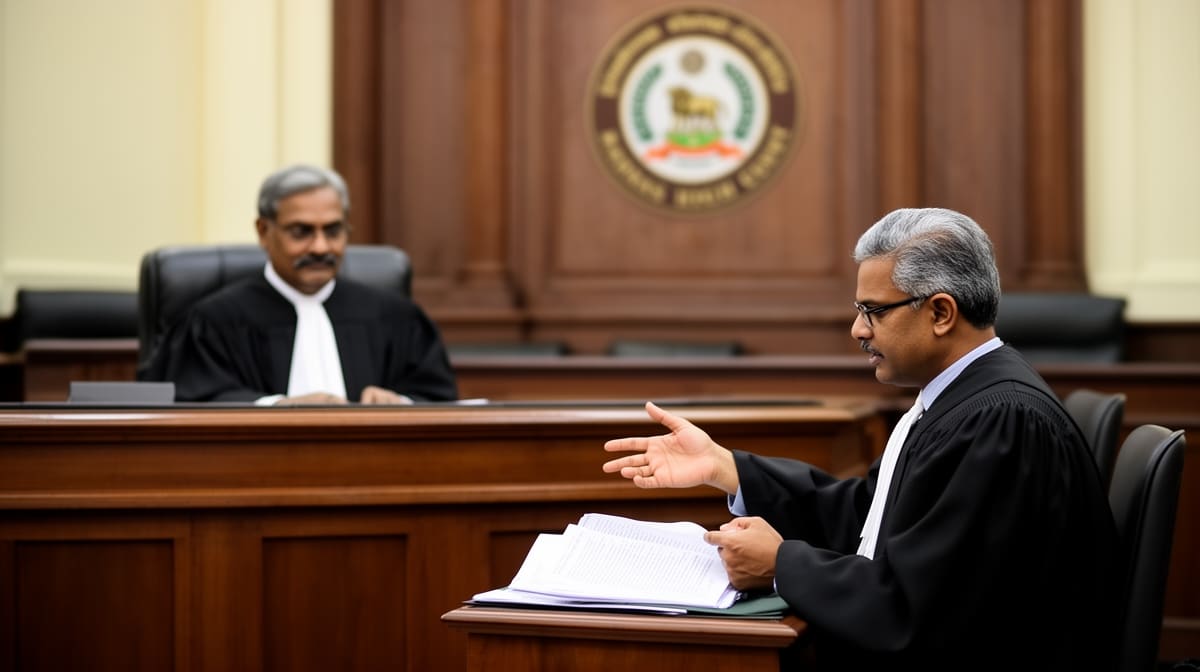
Learned counsel argued that once illegality of termination is established, reinstatement with full back wages is the default remedy unless exceptional circumstances exist. He emphasized the petitioner’s unblemished service record, prolonged unemployment, and absence of any evidence of misconduct. He cited B. Choudhury v. Presiding Officer, Labour Court and S.S. Shetty v. Bharat Nidhi Ltd. to assert that compensation must reflect loss of future prospects, age, service duration, and salary. He contended that Rs. 2,00,000 is less than two years’ salary and bears no relation to eleven years of service.
For the Respondent
The respondents’ counsel submitted that compensation in lieu of reinstatement is discretionary and not bound by mathematical precision. He relied on Assam Oil Co. Ltd. v. Its Workmen and Utkal Machinery Ltd. v. Shanti Patnaik to argue that courts have awarded varying amounts based on facts. He maintained that Rs. 2,00,000 was a fair compromise and that interference under Articles 226 and 227 was unwarranted.
The Court's Analysis
The Court affirmed that the Labour Court correctly held the termination illegal and found no misconduct. However, it held that the quantum of compensation was arbitrary and unsupported by reasoning. The Court observed:
"The compensation fixed by the Labour Court does not appear to reflect the loss suffered. It also does not appear to have been supported by any reasoning showing how the figure was reached."
The Court emphasized that while no rigid formula exists, the factors enumerated in B. Choudhury - including length of service, last drawn wages, age, future prospects, and mitigation of loss - must be weighed. The petitioner served for nearly eleven years, earning Rs. 14,000 per month. Even if full back wages are not mandated, a compensation of Rs. 2,00,000 for such a tenure is disproportionate.
The Court rejected the petitioner’s claim of Rs. 11.5 lakhs as it equated compensation with full back wages, which is not legally required. However, it noted that the Labour Court’s award was so low as to be unjust. The Court held:
"Compensation cannot be reduced to a nominal amount which has no relation to the service lost."
It concluded that a middle path was necessary: upholding the finding of illegality, denying reinstatement due to the passage of time and lack of pursuit, but enhancing compensation to reflect the gravity of the loss.
The Verdict
The writ petition was partly allowed. The Labour Court’s award of Rs. 2,00,000 was enhanced to Rs. 6,00,000. Respondent Nos. 1 and 2 were directed to jointly and severally pay this amount within eight weeks. In case of default, the amount shall carry interest at 6% per annum from the date of this order. The finding of illegal termination was upheld. Reinstatement was denied. No costs were awarded.
What This Means For Similar Cases
Compensation Must Reflect Service Duration
- Practitioners must argue that compensation in lieu of reinstatement cannot be nominal when service exceeds ten years
- A figure below two years’ salary for long-term employees is prima facie unsustainable without justification
- Courts must articulate how factors like age, salary, and unemployment duration were weighed
Failure to Produce Records Adversely Affects Respondents
- When employers fail to produce attendance, wage, or muster records despite court orders, the employee’s version gains credibility
- This shifts the evidentiary burden and strengthens claims of continuous service and illegal termination
Reinstatement Is Not Always Mandatory, But Compensation Must Be Meaningful
- Withdrawal of reinstatement prayer does not justify minimal compensation
- Courts must balance equity and practicality: full back wages are not automatic, but compensation must be proportionate
- Rs. 6,00,000 sets a benchmark for cases involving 10+ years of service and no misconduct