
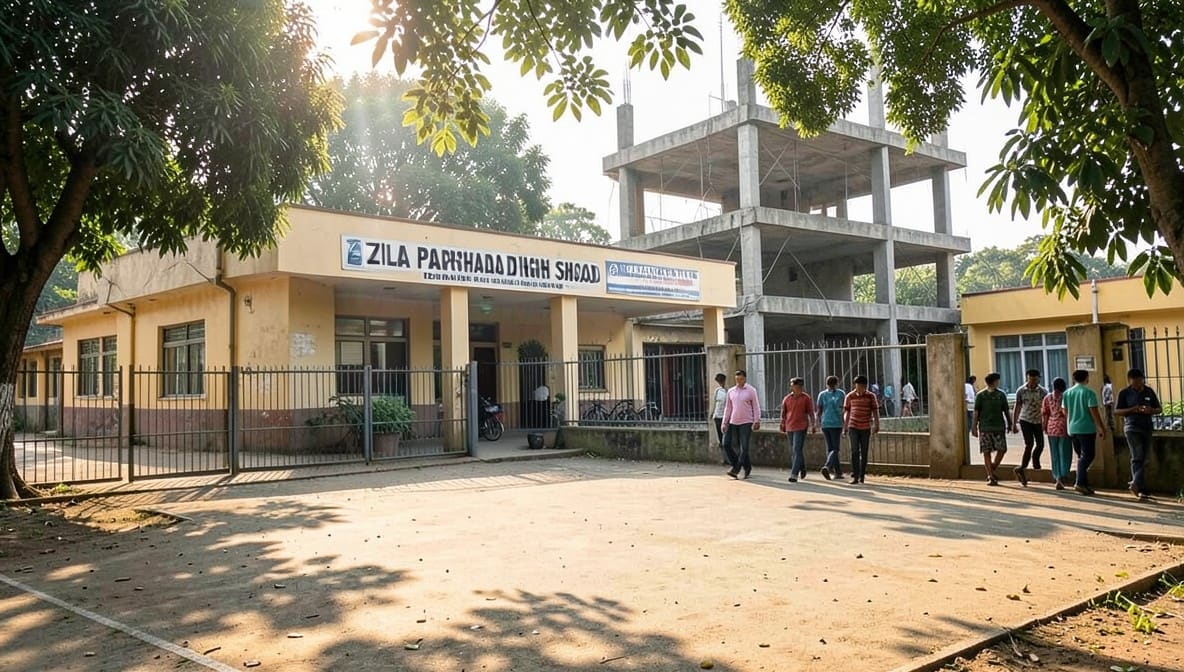
The Telangana High Court has reaffirmed that government land earmarked for educational purposes cannot be diverted for non-educational infrastructure, even when proposed by public authorities. In a decisive interim order, the Court halted construction of a Mahila Bhavan on the premises of a Zilla Parishad High School, emphasizing the constitutional and statutory obligation to preserve school infrastructure for children’s welfare.
Background & Facts
The Dispute
The petitioners, Mohammad Riyaz and Neralla Srinivas, are residents of Upparamallial Village in Gangadhara Mandal, Karimnagar District. They filed a writ petition challenging the unauthorized construction of a Mahila Bhavanam (Women’s Center) on the premises of the Zilla Parishad High School (ZPHS), Upparamallial. The petitioners contended that the land, which is government-owned and specifically designated for educational use, is being illegally occupied for a purpose unrelated to schooling, thereby violating the rights of students under the Right to Education Act, 2009 and Article 21A of the Constitution.
Key Facts
The ZPHS Upparamallial is a government-aided school serving children in a rural village.
The land on which the school stands is classified as government land earmarked exclusively for educational purposes.
The respondents, including the State of Telangana, District Collector, Zilla Parishad, District Education Officer, and Mandal Parishad authorities, permitted the construction of a Mahila Bhavanam on the school premises.
The construction was executed by respondent No. 13, Bathini Satyanaryana, a contractor.
The petitioners submitted two representations: one dated 18.03.2026 and another dated 30.03.2026, requesting immediate cessation of construction and restoration of the land for playground and academic use.
No response or action was taken by any of the respondents to either representation prior to the filing of the writ petition.
Procedural History
18.03.2026: First representation submitted to concerned authorities seeking stoppage of construction.
30.03.2026: Second representation filed, reiterating demand and highlighting violation of RTE Act and constitutional obligations.
12.04.2026: Writ Petition No. 12431 of 2026 filed before the Telangana High Court.
22.04.2026: Respondent No. 1 (Department of School Education) issued written instructions (Lr.No.Spl18112026) directing suspension of construction.
23.04.2026: Interlocutory Application No. 1 of 2026 filed under Section 151 CPC seeking immediate direction to halt construction and restore land.
23.04.2026: Hearing held before Justice Juvvadi Sridevi.
Relief Sought
The petitioners sought:
Immediate direction to stop and demolish the Mahila Bhavan construction on ZPHS premises.
Restoration of the land for use as a playground and other educational purposes.
Direction to the authorities to consider their representations dated 18.03.2026 and 30.03.2026 and pass reasoned orders.
The Legal Issue
The central question was whether public authorities can lawfully divert government land designated for educational purposes to construct non-educational infrastructure, and whether such action violates the Right to Education Act, 2009 and the constitutional duty under Article 21A to protect school infrastructure.
Arguments Presented
For the Petitioner
Sri R Kishan Prasad, counsel for the petitioners, argued that:
The land occupied by ZPHS Upparamallial is government land earmarked exclusively for educational use under the provisions of the Right to Education Act, 2009 and state education policies.
The construction of a Mahila Bhavanam on school premises constitutes a clear violation of Section 19(2) of the RTE Act, which mandates that school infrastructure must be preserved for educational purposes.
Public authorities, including the Zilla Parishad and District Education Department, have a non-delegable duty under Article 21A and Article 47 to ensure the integrity of educational spaces.
The failure to respond to two formal representations amounted to administrative apathy and denial of natural justice.
For the Respondent
Smt. A. Santhosh Kumari, Assistant Government Pleader for School Education, appearing for respondents 1, 3, 4, 10 and 12, submitted that:
The construction had been initiated by the Mandal Parishad under a rural development scheme.
The project was intended to benefit women in the community and was not maliciously intended to harm education.
Upon notice from the Court, the Department of School Education had already issued instructions on 22.04.2026 to suspend construction activities.
No further objection was raised to the interim relief sought, as construction had already been halted.
The Court's Analysis
The Court examined the nature of the land, the statutory framework governing school infrastructure, and the obligations of public authorities under the Constitution and the RTE Act. It noted that the Right to Education Act, 2009, particularly Section 19(2), mandates that "the school building and other infrastructure shall be used exclusively for educational purposes." The Court further relied on the principle that government land allocated for education cannot be repurposed without statutory authority and public consultation.
"The school premises are not merely physical structures but sanctuaries of learning. Any diversion of such land for non-educational purposes, even under the guise of social welfare, undermines the very foundation of the Right to Education."
The Court observed that the respondents, as public authorities, are bound by the doctrine of public trust, which requires them to hold public resources for the benefit of the community, particularly children. The construction of a Mahila Bhavanam, while potentially beneficial, cannot override the primary statutory mandate to preserve school land.
The Court also emphasized that the petitioners’ representations dated 18.03.2026 and 30.03.2026 had been ignored, constituting a failure in administrative accountability. The Court held that such inaction cannot be condoned, especially when fundamental rights of children are at stake.
The Verdict
The Court allowed the interlocutory application. It directed:
All construction activities for the Mahila Bhavanam on the ZPHS Upparamallial premises to be immediately and permanently stopped.
The land currently occupied by the construction to be restored for use as a playground and other educational purposes for students.
The concerned authorities to consider the petitioners’ representations dated 18.03.2026 and 30.03.2026 and pass reasoned orders within four weeks from the date of receipt of a copy of this order.
The State of Telangana, Zilla Parishad, and District Education Department to ensure compliance with the order.
What This Means For Similar Cases
School Land Is Inviolable
Practitioners must now treat any proposal to use school land for non-educational purposes as prima facie illegal under the RTE Act.
Legal notices and writ petitions can be filed immediately upon unauthorized construction, without waiting for administrative inaction to become final.
Public Authorities Must Act on Representations
Failure to respond to formal representations within a reasonable time constitutes a violation of natural justice.
Courts may now impose timelines for disposal of such representations, as done here (four weeks).
RTE Act Overrides Development Schemes
Rural development projects, including Mahila Bhavans, cannot override statutory protections for school infrastructure.
Any such project must be located on non-educational government land, with prior approval from the State Education Department.
Always verify land classification records before approving any construction near schools.
File writ petitions under Article 226 immediately upon discovery of unauthorized use of school land.
Cite Section 19(2) of the RTE Act and Article 21A as non-negotiable legal anchors in such disputes.





