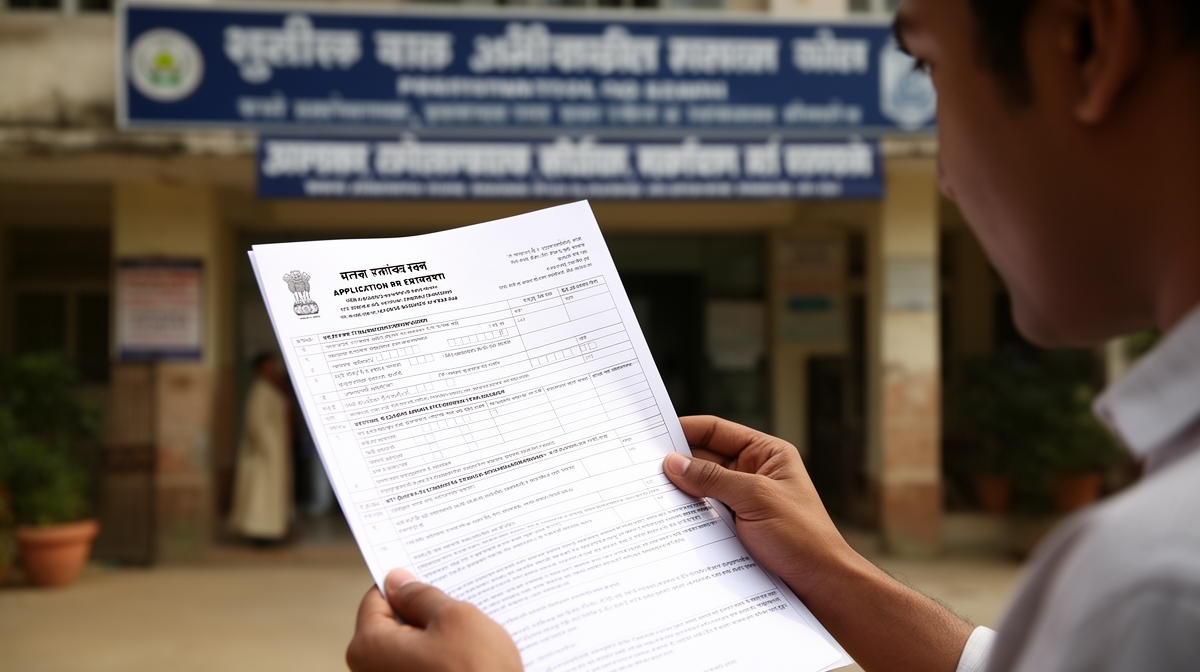

The Central Information Commission has directed a public authority to provide specific factual information sought under the RTI Act, rejecting the argument that alternative procedural mechanisms absolve the authority of its statutory obligation. The Commission emphasized that the existence of other avenues for obtaining information does not negate the duty to respond to RTI requests with clarity and completeness.
The Verdict
The appellant won. The Central Information Commission held that a public authority cannot refuse to provide simple, existing factual information under the RTI Act merely because similar information may be obtainable through other procedural mechanisms. The Commission directed the respondent to issue a revised, point-wise reply in Hindi, incorporating the exact dates sought regarding receipt of documents and their filing in case records.
Background & Facts
The appellant filed an RTI application on 22 April 2024 seeking two specific pieces of information related to First Appeal No. FA/2215/2019: (1) the date on which a document dated 19 February 2024 was received by the National Consumer Disputes Redressal Commission (NCDRC), and (2) the date on which that document was formally attached to the case file. The application was filed in Hindi and referenced a courier consignment number.
The Central Public Information Officer (CPIO) responded on 3 May 2024, directing the appellant to access orders available on the NCDRC website and citing Office Memorandum No. 1/18/2011-IR, which prohibits public authorities from creating or interpreting information. The CPIO also referred the appellant to Regulation 21 and 22 of the Consumer Protection (Consumer Commission Procedure) Regulations, 2020, suggesting inspection of case records as the proper channel.
The First Appellate Authority upheld this response on 3 June 2024. The appellant then filed a second appeal with the Central Information Commission on 29 July 2024. During the hearing on 21 January 2026, the respondent conceded that the information sought was readily available and could be provided without creating or interpreting records. The appellant requested the revised reply be issued in Hindi, which the respondent also agreed to.
The Legal Issue
Can a public authority deny information under the RTI Act on the ground that the same information can be obtained through other procedural mechanisms, such as inspection of case records under subordinate regulations?
Arguments Presented
For the Appellant
The appellant argued that the information sought was factual, existing, and purely administrative in nature - specific dates of receipt and filing. He contended that the CPIO’s reliance on Regulation 21 and 22 of the Consumer Protection Regulations was misplaced, as those provisions govern access for parties to litigation, not citizens seeking public information under the RTI Act. He cited the preamble of the RTI Act, which mandates transparency and ease of access, and argued that requiring a litigant to file a separate application for inspection imposes an unnecessary burden inconsistent with the spirit of the RTI Act.
For the Respondent
The respondent argued that the information sought was part of judicial records and could only be accessed under Regulation 21 and 22 of the Consumer Protection Regulations, which require formal applications, payment of fees, and party status. The CPIO relied on the Department of Personnel & Training’s O.M. No. 1/18/2011-IR, asserting that it cannot be compelled to extract or compile data from case files. The respondent also cited the Supreme Court’s decision in Chief Information Commissioner v. High Court of Gujarat, arguing that RTI should not be used as a substitute for judicial record access procedures.
The Court's Analysis
The Commission rejected the respondent’s attempt to equate RTI with judicial record inspection. It held that the information sought - dates of receipt and filing of a document - was not an interpretation or creation of information, but a straightforward factual retrieval. The Commission noted that the CPIO’s reply failed to address the specific queries and instead offered generic directions to access the website or file for inspection.
"The sought points are simple in nature and the respondent can provide the sought information to the appellant explicitly."
The Commission emphasized that Section 11 of the RTI Act, which deals with third-party information, was not applicable here, as the information did not pertain to a third party. The reference to the Supreme Court’s judgment in CIC v. High Court of Gujarat was found to be inapposite, as that case concerned the inefficiency of using RTI to obtain certified copies of court orders, not the disclosure of basic administrative dates.
The Commission clarified that the existence of alternative mechanisms does not extinguish the obligation under the RTI Act. The Act is designed to be a primary, accessible, and independent right. If the information exists in a retrievable form, the Public Information Officer must provide it in the manner requested, unless exempted under Section 8 or 9.
What This Means For Similar Cases
This decision reinforces that public authorities cannot deflect RTI requests by pointing to other procedural avenues, especially when the information sought is factual, non-judicial, and readily available. Practitioners should now confidently challenge replies that cite subordinate regulations or judicial procedures as grounds for denial of RTI requests for simple data points.
The ruling also clarifies that Section 11 of the RTI Act is not a blanket shield for refusing information merely because it resides in case files. The burden remains on the public authority to demonstrate that the information is either exempted or genuinely not held in a retrievable form. This is particularly significant for litigants and advocates who routinely seek administrative timelines in pending cases. Future RTI applications should be framed precisely to request dates, file numbers, or receipt acknowledgments - details that are routinely maintained and should be disclosed without delay.
The Commission’s directive to provide the reply in Hindi also underscores the obligation under Section 6(3) of the RTI Act to respond in the language of the application, unless impracticable.