
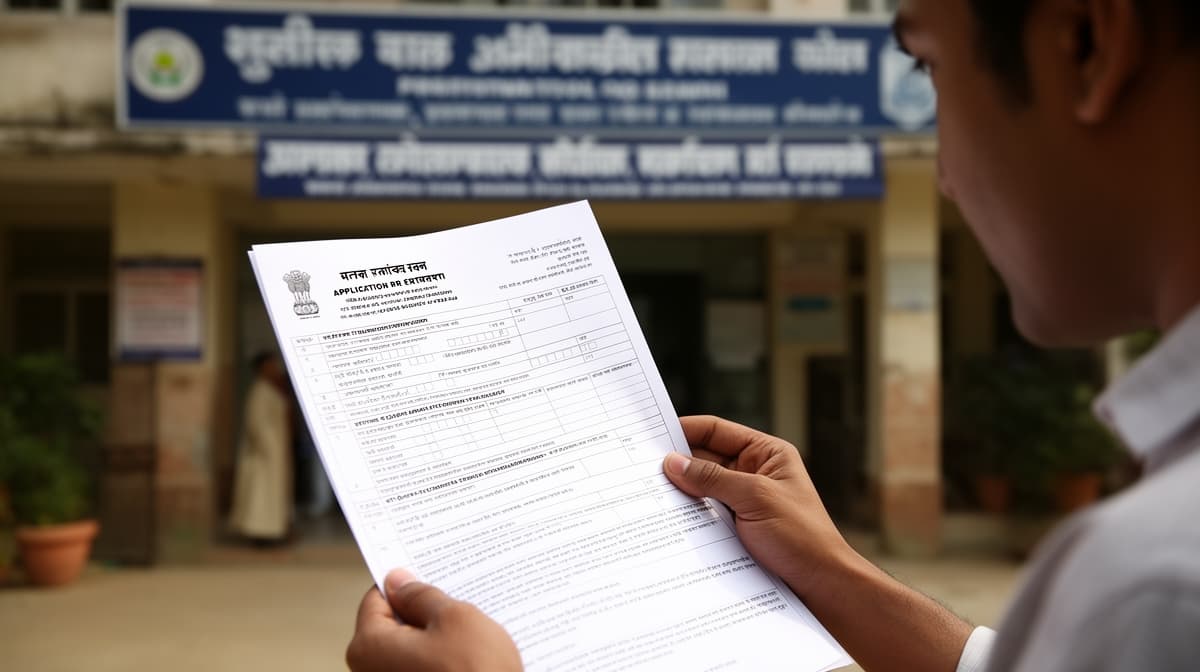
The Central Information Commission has clarified a critical boundary under the Right to Information Act, 2005: individuals cannot demand copies of their own documents from public authorities merely because those documents were submitted to them. This ruling reinforces the statutory definition of 'information' and prevents misuse of the RTI mechanism for personal record retrieval.
Background & Facts
The Dispute
The appellant, Pratyoosh Prashant, filed an RTI application seeking details regarding his application for the post of Assistant Registrar at NIT Durgapur. Among the eight queries, the third sought a certified copy of his own application form and payment proof submitted for the post. The CPIO denied this request, stating the information was not available under the RTI Act, and directed the appellant to submit the documents himself to initiate a refund process.
Procedural History
The case progressed through the following stages:
- 25 October 2024: RTI application filed seeking eight categories of information, including copies of his own application and payment proof.
- 6 November 2024: CPIO responded, rejecting query no. 3 on grounds that the documents were the appellant’s own and not held by the authority as 'information'.
- 20 November 2024: First appeal filed challenging the CPIO’s reply.
- 18 December 2024: First Appellate Authority upheld the CPIO’s response.
- 25 October 2024: Second appeal filed before the Central Information Commission.
Relief Sought
The appellant sought a direction to the CPIO to provide certified copies of his application form and payment proof, arguing that these were public records held by the institution and therefore accessible under the RTI Act.
The Legal Issue
The central question was whether a citizen can compel a public authority to provide copies of documents that the citizen themselves originally submitted, under the definition of 'information' in Section 2(f) of the RTI Act, 2005.
Arguments Presented
For the Appellant
The appellant’s representative contended that the application form and payment proof, once submitted to the NIT, became part of the institution’s records and thus qualified as 'information' under Section 2(f). He argued that the refusal to provide certified copies violated the spirit of transparency and the right to information, especially since the authority had already acknowledged receipt of his application.
For the Respondent
The CPIO countered that the documents sought were personal records created and retained by the appellant. The authority had no obligation to provide copies of documents that the applicant had failed to retain. The CPIO emphasized that the refund process required the appellant to submit original or certified copies of his application and payment proof, and that the refusal was procedural, not substantive.
The Court's Analysis
The Commission examined the statutory definition of 'information' under Section 2(f) of the RTI Act, 2005, which includes any material in any form, including records, documents, memos, emails, opinions, etc., held by or under the control of a public authority. The Commission noted that while the documents were physically in the possession of the public authority, they were not created or maintained by it for its own purposes.
"...they are not the information available within the knowledge of the petitioner; on the other hand, admittedly, they are the documents of the second respondent himself, and therefore, if he does not have copies of the same, he has to blame himself and he cannot seek those details as a matter of right..."
The Commission relied on the Madras High Court’s decision in The Central Information Commission v. B. Bharathi, which held that documents created and submitted by an applicant cannot be treated as 'information' held by the public authority under the RTI Act. The Commission emphasized that the Act is not a substitute for personal record-keeping. The appellant’s failure to retain his own documents does not shift the burden onto the public authority to produce them. The CPIO’s response was found to be legally sound and procedurally correct.
The Verdict
The appellant’s appeal was dismissed. The Central Information Commission held that copies of an applicant’s own submitted documents do not constitute 'information' under Section 2(f) of the RTI Act, 2005, and public authorities are not obligated to provide them. The CPIO was directed to process the refund upon receipt of the appellant’s supporting documents.
What This Means For Similar Cases
Personal Documents Are Not RTI Information
- Practitioners must advise clients that RTI cannot be used to retrieve personal documents they failed to retain
- Public authorities may lawfully refuse requests for copies of application forms, fee receipts, or affidavits submitted by the requester
- Applicants must maintain their own records; the RTI Act does not function as a document recovery service
Refund Processes Require Proactive Submission
- Public institutions can condition refunds on submission of original or certified copies of payment and application documents
- Repeated RTI requests for the same information without providing required supporting documents may be deemed frivolous
- Authorities may direct applicants to submit documents before processing claims, without violating transparency obligations
Clarification on Section 2(f) Interpretation
- The definition of 'information' excludes documents that are inherently personal and created by the requester
- This aligns with the principle that RTI is meant to access information generated or maintained by the public authority, not to recover lost personal records
- Legal teams should distinguish between institutional records and applicant-submitted materials when drafting RTI applications