
Topic

Public Information Officer

4 articlesLatest June 2026
Section 20(2) RTI Act | Commission Cannot Order Disciplinary Action Against Non-PIOs or Demand Action Taken Reports : Karnataka HC
Case Law Analysis
|Karnataka High Court

Section 20(2) RTI Act | Commission Cannot Order Disciplinary Action Against Non-PIOs or Demand Action Taken Reports : Karnataka HC

The Karnataka High Court has ruled that the Information Commission lacks power under Section 20(2) of the RTI Act to direct disciplinary action against senior bureaucrats who are not Public Information Officers, or to compel submission of Action Taken Reports. This clarifies the statutory limits of the Commission’s authority, protecting non-PIO officials from overreach and reinforcing that remedial powers under the RTI Act are confined to PIOs alone.
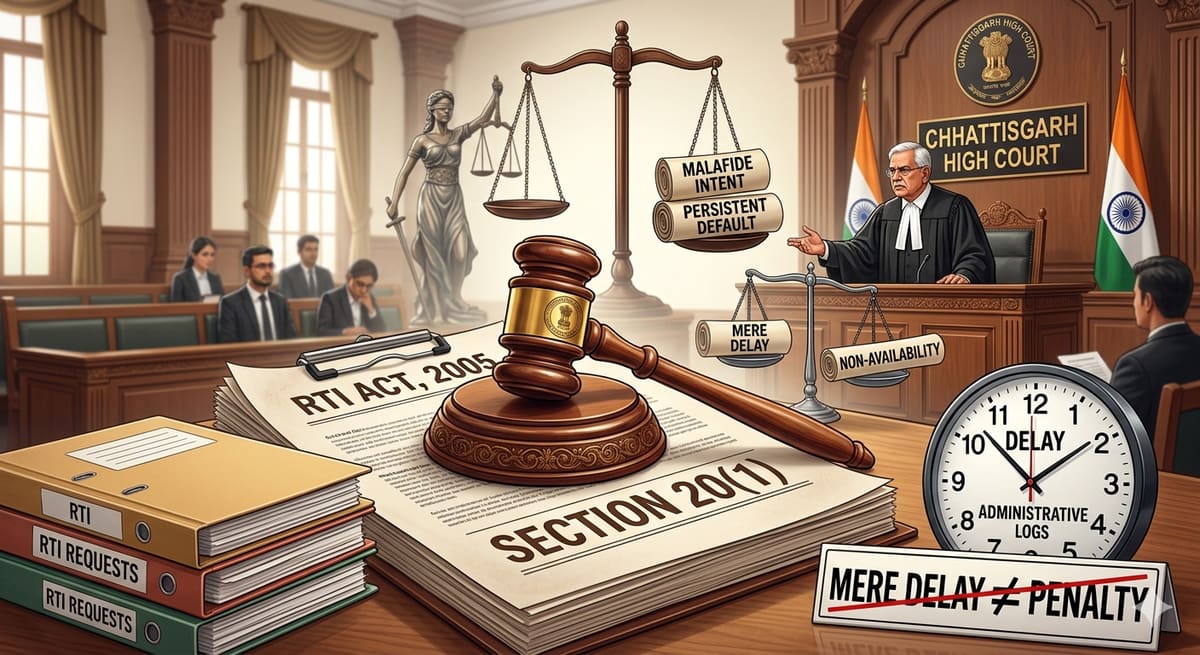
Section 20(1) RTI Act | Penalty Requires Proven Malafide Intent or Persistent Default, Not Mere Delay or Non-Availability : Chhattisgarh HC
Case Law Analysis
|Chhattisgarh High Court

Section 20(1) RTI Act | Penalty Requires Proven Malafide Intent or Persistent Default, Not Mere Delay or Non-Availability : Chhattisgarh HC

The Chhattisgarh High Court has ruled that Public Information Officers cannot be penalized under Section 20(1) of the RTI Act for mere delay or incomplete information unless there is a clear finding of malafide intent or persistent, unreasonable default. This sets a vital safeguard for PIOs acting in good faith and reinforces that procedural lapses alone do not justify financial penalties under the law.

RTI Act Section 6(5) | SPIOs Must Obtain & Provide Information Even If Not Record Custodian; Unilateral Corrigenda Void : Calcutta HC
Case Law Analysis
|Calcutta High Court

RTI Act Section 6(5) | SPIOs Must Obtain & Provide Information Even If Not Record Custodian; Unilateral Corrigenda Void : Calcutta HC

Public Information Officers cannot evade their duty under the RTI Act by claiming they are not custodians of records-they must actively seek and furnish information. The Calcutta High Court has ruled that attempting to terminate proceedings via unilateral corrigenda violates natural justice and undermines the fundamental right to information under Article 19(1)(a), setting a binding precedent for all SPIOs across India.