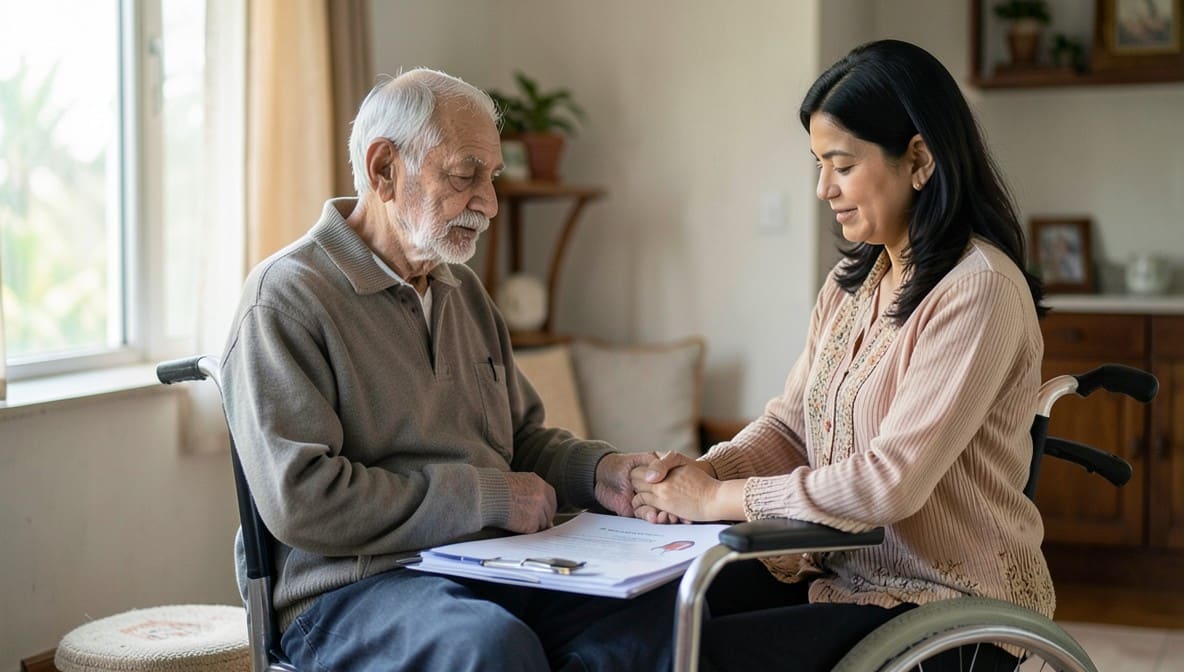
The Madras High Court has affirmed that birth within a jurisdiction is sufficient to claim a nativity certificate, even when temporary relocation occurs due to compelling personal circumstances. In a landmark ruling, the Court also held that denial of employment to a person with disability based on a mechanical medical assessment violates the statutory mandate of reasonable accommodation under the Rights of Persons with Disabilities Act, 2016.
Background & Facts
The Dispute
The petitioner, E. Hariharan, a person with 40% locomotor disability due to hereditary sensory motor neuropathy, was provisionally selected for the post of Junior Engineer (Electrical) in the Puducherry Electricity Department. He was denied a nativity certificate and subsequently rejected for employment on grounds of alleged medical unfitness. The denial of the nativity certificate was based solely on his temporary stay with relatives in Arasalankudi Village, Tamil Nadu, following his mother’s death during the Covid-19 pandemic.
Procedural History
- 2007: Issued community certificate and resident certificate by Puducherry authorities.
- 2009: Medical certificate issued certifying 40% orthopaedic disability by Puducherry Government hospitals.
- 2022: Completed B.Tech in Electrical and Electronics Engineering from Pondicherry Engineering College.
- 2024: Cast vote in Lok Sabha elections from Puducherry constituency.
- 2025: Applied for Junior Engineer post; secured 65.50 marks; provisionally selected.
- June 2025: Applied for nativity and community certificates; denied by Tahsildar on grounds of temporary absence from Puducherry.
- July 2025: Medical Board declared petitioner unfit for the post without functional assessment.
The Parties' Positions
Petitioner’s Claim:
- Born, educated, and raised in Puducherry.
- All identity documents (Aadhaar, Voter ID, Ration Card, PAN) reflect Puducherry as native place.
- Temporary relocation to Tamil Nadu was due to caregiving exigencies post-Covid, not abandonment of nativity.
- Successfully completed engineering coursework with practicals and worked four years as Electrical Supervisor.
- Denial of nativity certificate violates G.O.Ms.No.48/2002.
- Medical rejection ignores functional capability and statutory duty of reasonable accommodation.
Respondents’ Position:
- Petitioner resides in Tamil Nadu and thus does not meet continuous residence criteria.
- G.O.Ms.No.48/2002 requires ordinary residence in Puducherry, which they claim is not established.
- Medical Board concluded petitioner’s chronic neurological condition renders him unfit for the post.
- Petitioner’s disability category is not listed in the recruitment notification for reserved posts.
Relief Sought
The petitioner sought a writ of mandamus directing respondents 1 to 3 to issue nativity and community certificates and respondent 4 to appoint him upon issuance, arguing that the refusals were arbitrary, discriminatory, and violative of constitutional and statutory rights.
The Legal Issue
The central questions were: (1) Whether temporary residence outside Puducherry, due to compelling personal circumstances, invalidates a claim to nativity certificate based on birth under G.O.Ms.No.48/2002? and (2) Whether denial of employment based on a non-functional, categorical medical assessment without considering reasonable accommodation violates the Rights of Persons with Disabilities Act, 2016?
Arguments Presented
For the Petitioner
Learned Senior Counsel Ms. R. Vaigai relied on M. Malarvizhy v. Union of India to argue that nativity by birth is distinct from residence and does not require continuous physical presence. She emphasized that G.O.Ms.No.48/2002 explicitly permits temporary absence for reasons of education or family exigencies, provided intention to return is established. She cited the petitioner’s voter registration, educational history, and employment record as conclusive proof of intent. She further invoked the UNCRPD, Section 3 and Section 20 of the RPwD Act, 2016, and Supreme Court precedents in Vikash Kumar v. UPSC, Omkar Ramachandra Gond, and Anmol v. Union of India to argue that the Medical Board’s assessment was mechanistic and ignored the statutory obligation of reasonable accommodation.
For the Respondent
Mr. V. Vasanthakumar, Additional Government Pleader, contended that the petitioner failed both limbs of G.O.Ms.No.48/2002: he was neither continuously residing in Puducherry nor born and residing there simultaneously. He argued that the petitioner’s stay in Tamil Nadu was not temporary but permanent, evidenced by land ownership and agricultural activity by his father. He further asserted that the Medical Board’s opinion, based on neurologist’s assessment of chronic neurological impairment, was valid and that the petitioner’s disability category was not listed in the recruitment notification for reserved posts, rendering him ineligible for consideration.
The Court's Analysis
The Court undertook a rigorous analysis of both the nativity certificate denial and the medical unfitness determination, grounding its reasoning in statutory interpretation, constitutional principles, and binding precedents.
Regarding nativity, the Court emphasized that G.O.Ms.No.48/2002 explicitly permits temporary absence for reasons including education and family exigencies, provided the applicant demonstrates intention to return. The petitioner’s birth certificate, educational records, voter registration, and continuous use of Puducherry-based identity documents were deemed conclusive evidence of such intent. The Court observed that the authorities’ mechanical denial, based solely on physical location during a global health crisis, was “pervasive, arbitrary, and insensitive.” The Court held that the petitioner’s temporary relocation did not extinguish his birth-based nativity rights.
"The only reason... is that the petitioner for some time was residing near his sister’s place... This finding of the respondents is not only perverse, mechanical and arbitrary, but lacks sensitivity while dealing with an application of a person suffering from disability."
On the issue of medical fitness, the Court found the Medical Board’s assessment fundamentally flawed. The Board relied on the petitioner’s diagnosis of hereditary sensory motor neuropathy and 40% disability, without evaluating functional capacity. The Court noted that the recruitment notification did not exclude this specific disability category, unlike visual impairment. The petitioner’s successful completion of B.Tech with practicals and four years of employment as Electrical Supervisor constituted a de facto functional assessment. The Court cited Vikash Kumar v. UPSC and Omkar Ramachandra Gond to affirm that reasonable accommodation requires individualized evaluation, not categorical exclusion.
"Disabilities Assessment Boards are not monotonous automations to just look at the quantified benchmark disability... Such an approach would be antithetical to Article 14 and Article 21."
The Court further held that the State’s duty under Section 20 of the RPwD Act to provide reasonable accommodation and barrier-free environment was non-negotiable. The Board’s failure to include a departmental officer familiar with the job’s functional demands rendered the assessment legally inadequate.
The Verdict
The petitioner won. The Court held that birth in Puducherry, coupled with demonstrable intent to return, suffices for a nativity certificate under G.O.Ms.No.48/2002, regardless of temporary relocation. It further held that denial of employment based on a non-functional medical assessment, without considering reasonable accommodation, violates the Rights of Persons with Disabilities Act, 2016. The Court directed immediate issuance of the nativity certificate and ordered a fresh medical evaluation by a properly constituted board.
What This Means For Similar Cases
Nativity by Birth Is Not Voided by Temporary Absence
- Practitioners must challenge denials of nativity certificates where birth is proven and temporary relocation is due to exigencies like illness, education, or caregiving.
- Voter registration, educational records, and continuous use of local identity documents are strong evidence of intent to return.
- Authorities cannot impose a de facto residency requirement where the policy explicitly permits temporary absence.
Reasonable Accommodation Requires Functional Assessment, Not Categorical Exclusion
- Medical boards must evaluate functional capacity, not merely disability percentage.
- Employers must involve job-specific officers in medical assessments for roles requiring technical or physical skills.
- Past successful performance in similar roles (e.g., academic practicals, prior employment) must be given decisive weight.
- Denial of employment based on disability category not listed in reservation list does not preclude consideration under general category if functional fitness is established.
Procedural Compliance in Disability Assessments Is Non-Negotiable
- Failure to constitute a multidisciplinary medical board including departmental experts renders assessments legally invalid.
- Courts will intervene where assessments are mechanistic, stereotypical, or ignore assistive devices and functional adaptations.
- Public authorities must conduct regular sensitization training for officials dealing with persons with disabilities, as mandated by the Court.