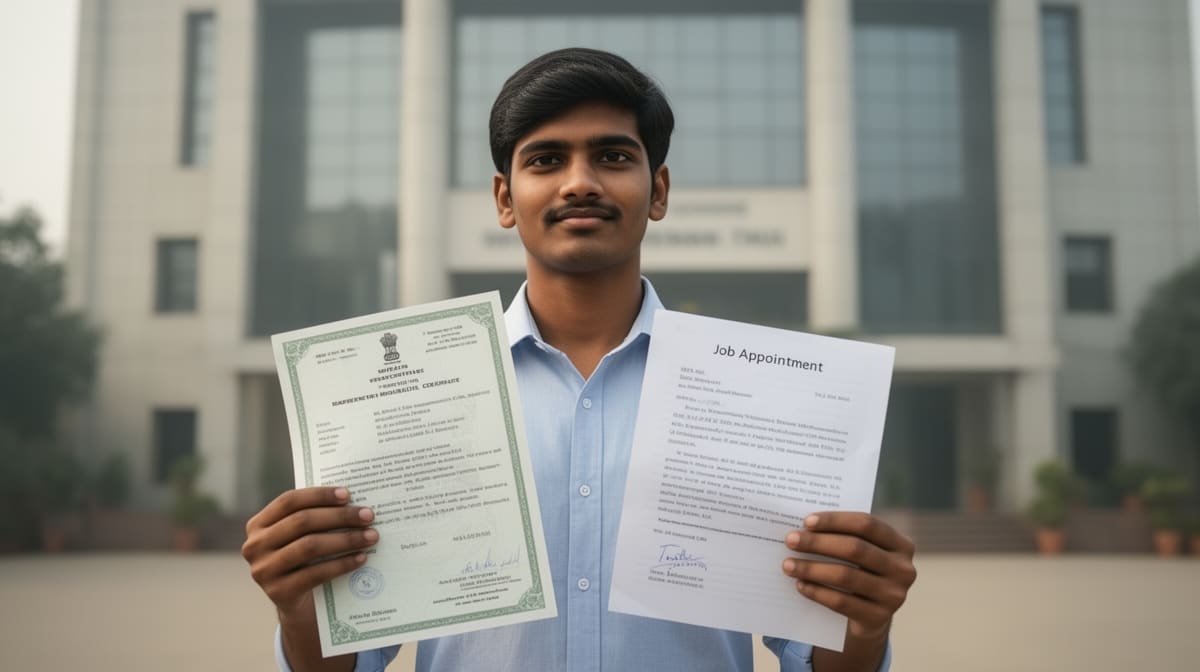
The Calcutta High Court has affirmed that a statutory disability certificate issued under the Rights of Persons with Disabilities Act, 2016, cannot be disregarded by state authorities on the basis of a general medical fitness assessment conducted for employment purposes. This ruling reinforces the primacy of legally recognized disability certification over ad hoc medical evaluations in public recruitment.
Background & Facts
The Dispute
The writ petitioner, Soumya Kanti Biswas, has been diagnosed with Mild Cerebral Palsy with Right Sided Hemiparesis since the age of four. His disability has been consistently certified at 55 percent by authorized medical boards under the framework of the Persons with Disabilities (Equal Opportunities, Protection of Rights and Full Participation) Act, 1995, and its successor, the Rights of Persons with Disabilities Act, 2016.
Key Facts
- The first disability certificate was issued on 22.10.1998 by the District Hospital, Howrah, certifying 55 percent disability.
- A second certificate, dated 20.11.2004, was issued by a board of four doctors when the petitioner was ten years old, reaffirming the same disability extent.
- A third and most recent certificate, dated 06.09.2014 (Certificate No. DHH/1058/14), was issued by a board constituted under the Ministry of Welfare, Government of India, Office Memorandum No. 4-2/83 III dated 06.08.1986, again certifying 55 percent permanent disability.
- The petitioner completed a Diploma in Ayurvedic Pharmacy and registered as an Ayurvedic Pharmacist with the Paschim Banga Ayurved Parishad (PBAP).
- He applied for the post of Ayurvedic Pharmacist under a recruitment notification dated 15.03.2023 issued by the West Bengal Health Recruitment Board.
- His name appeared in the final selection list dated 16.10.2023 for the sole PWD vacancy under the General (Unreserved) category.
- The panel was valid for one year.
- Document verification was scheduled on 28.11.2023, and counselling was notified on 02.02.2024.
- On 15.01.2024, a General Medical Board at Kolkata Medical College and Hospital conducted a medical fitness examination for employment purposes.
- On 20.01.2024, a medical certificate was issued indicating the petitioner’s disability percentage as below the 40 percent threshold required for reservation.
- On 04.03.2024, the Special Secretary (AYUSH), Health & Family Welfare Department, cancelled the petitioner’s candidature on the ground of "below benchmark disability."
- The petitioner challenged this cancellation before the West Bengal State Administrative Tribunal in OA No. 423 of 2024.
- The Tribunal dismissed the application on 15.05.2025.
- The petitioner filed the present writ petition on 20.05.2025.
Procedural History
- 22.10.1998: First disability certificate issued (55%)
- 20.11.2004: Second disability certificate issued (55%)
- 06.09.2014: Third and statutory disability certificate issued (55%) under Ministry of Welfare guidelines
- 15.03.2023: Recruitment notification issued by West Bengal Health Recruitment Board
- 16.10.2023: Final selection list published; petitioner selected for PWD vacancy
- 28.11.2023: Document verification schedule issued
- 02.02.2024: Counselling notification issued
- 15.01.2024: General medical fitness examination conducted by Kolkata Medical College Board
- 20.01.2024: Medical fitness certificate issued questioning disability percentage
- 04.03.2024: Candidature cancelled by Special Secretary (AYUSH)
- 12.05.2024: OA No. 423 of 2024 filed before West Bengal State Administrative Tribunal
- 15.05.2025: Tribunal dismissed OA
- 20.05.2025: Writ Petition filed before Calcutta High Court
- 20.03.2026: Judgment delivered
Relief Sought
The petitioner sought quashing of the order dated 04.03.2024 cancelling his candidature, restoration of his selection, and direction to issue an appointment letter based on the statutory disability certificate dated 06.09.2014.
The Legal Issue
The central question was whether a statutory disability certificate issued under the Rights of Persons with Disabilities Act, 2016, and its predecessor rules, can be overridden by a general medical fitness assessment conducted under the West Bengal Service Rules for the purpose of public employment.
Arguments Presented
For the Petitioner
The petitioner relied on the statutory validity of the certificate dated 06.09.2014, issued under the Ministry of Welfare’s guidelines and recognized under the Persons with Disabilities Act, 1995. He argued that Rule 19 of the Rights of Persons with Disabilities Rules, 2017, mandates that such certificates are valid for all purposes, including reservation in public employment. He cited Debika Karmakar v. State of West Bengal (2025 (4) CHN (CAL) 517) to establish that once a certificate is issued by a competent authority under the statutory framework, it cannot be re-examined or invalidated by a general medical board. He further contended that the medical fitness certificate under WBSR Part I is meant only to detect communicable diseases or physical infirmities that impede job performance - not to reassess a pre-existing, legally certified disability.
For the Respondent
The State argued that the medical examination conducted on 15.01.2024 was necessary to ensure the petitioner’s fitness for the duties of an Ayurvedic Pharmacist under Rule 10 of the West Bengal Service Rules. It contended that the certificate dated 06.09.2014 was outdated and that the current medical assessment, conducted by a qualified board, should prevail. It further argued that the 40 percent threshold under the 1999 Rules must be verified at the point of appointment, and that the petitioner’s current physical condition did not meet this benchmark.
The Court's Analysis
The Court examined the statutory framework under the Rights of Persons with Disabilities Act, 2016, and the Rules framed thereunder, particularly Rule 19 and Rule 20. Rule 19 explicitly states that a certificate issued under Rule 18 entitles the holder to apply for all government benefits, including reservation in public employment. Rule 20 provides that certificates issued under the repealed 1995 Act continue to be valid for the period specified therein.
"The Certificate of Disability dated 06.09.2014 clearly records that the petitioner has 55 per cent permanent disability. The certificate also took into consideration the old certificate dated 20.11.2004. The petitioner’s Certificate of Disability, therefore, continues to be valid in terms of the statutory Rules."
The Court emphasized that the medical examination under WBSR Part I, conducted under Rule 10 and Form prescribed under Rule 13, is designed to detect communicable diseases or constitutional weaknesses that may impede job performance. It does not contain any provision for evaluating or re-certifying the degree of a pre-existing, legally recognized disability. The Court held that the 2024 medical assessment was not conducted under any statutory authority for disability certification, and therefore lacked the legal sanctity of the 2014 certificate.
The Court distinguished between the purpose of a disability certificate and a medical fitness certificate. The former is a rights-based certification under protective legislation; the latter is an administrative requirement for employment. The Court held that allowing the latter to override the former would defeat the very object of the RPwD Act - to ensure non-discrimination and substantive equality.
The Court also relied on its own coordinate bench’s decision in Debika Karmakar, which held that disability certificates issued under the 1995 Act are valid across the country under Section 58 of the 2016 Act. The Court concluded that the authorities had no legal basis to ignore the statutory certificate, and that the cancellation order was arbitrary and violative of the petitioner’s rights under Article 14 and Article 21 of the Constitution.
The Verdict
The writ petition was allowed. The order dated 04.03.2024 cancelling the petitioner’s candidature was quashed. The Tribunal’s order dated 15.05.2025 was set aside. The authorities are directed to issue an appointment letter to the petitioner based on the statutory disability certificate dated 06.09.2014, without raising any objection to its validity. The authorities must complete all other recruitment formalities and issue the appointment within eight weeks from the date of receipt or production of a copy of this order.
What This Means For Similar Cases
Statutory Disability Certificates Are Non-Negotiable
- Practitioners must assert that any disability certificate issued under the RPwD Act, 2016, or its predecessor, is binding on all government departments for the purpose of reservation and benefits.
- Employers cannot demand re-certification or conduct new medical evaluations to challenge the percentage of disability already certified by a statutory board.
- The burden lies on the employer to prove that the certificate was obtained fraudulently or has been lawfully revoked - not to substitute its own assessment.
Medical Fitness ≠ Disability Assessment
- Medical fitness certificates under WBSR or similar service rules are not tools for re-evaluating disability.
- These certificates must be confined to detecting conditions that directly impair job performance, such as infectious diseases or acute physical incapacity.
- Any attempt to use a fitness certificate to deny reservation benefits based on disability percentage is legally unsustainable and subject to immediate quashing.
Procedural Compliance Is Mandatory
- Departments must verify the validity of disability certificates at the time of application, not at the final stage of appointment.
- If a certificate is challenged, the proper procedure under Rule 18(2) of the 2017 Rules - requiring a review by a designated authority - must be followed.
- Failure to follow due process renders cancellation orders void ab initio.