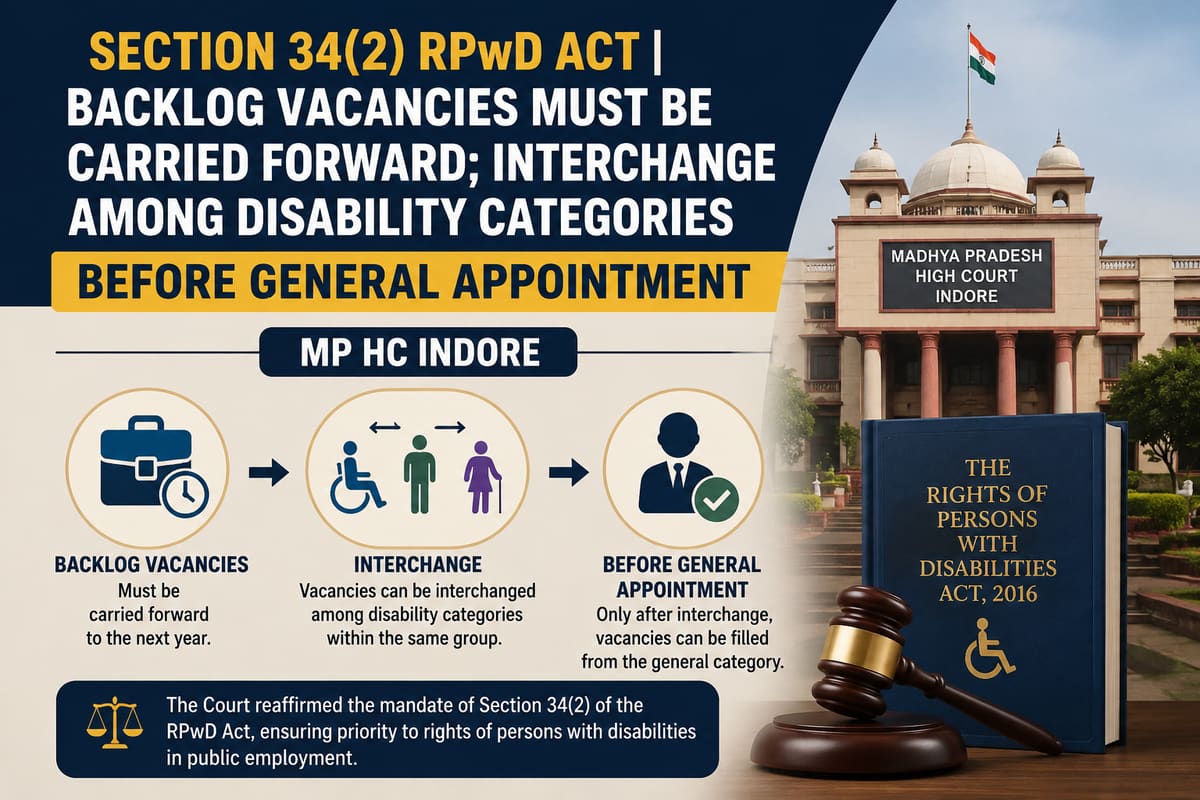
The Madhya Pradesh High Court has reinforced the statutory obligation of state employers to prioritize the filling of backlog vacancies for persons with benchmark disabilities under the Rights of Persons with Disabilities Act, 2016. This judgment clarifies that procedural delays or administrative inaction cannot override the mandatory carry-forward mechanism designed to ensure substantive equality in public employment.
Background & Facts
The Dispute
The petitioner, Sakshi Dhakad, suffers from a 40% to 50% locomotor disability and applied for the post of Rural Horticulture Extension Officer (RHEO) under a recruitment drive aimed at addressing backlog vacancies for persons with benchmark disabilities. Despite being placed at serial number 5 on the select list issued on 29.09.2025, her candidature was not considered for appointment. She contends that the state has failed to comply with the mandatory reservation framework under the Rights of Persons with Disabilities Act, 2016, particularly Section 34(2), which governs the handling of unfilled vacancies for persons with disabilities.
Key Facts
The petitioner has a certified locomotor disability of 40% to 50%, qualifying her as a person with benchmark disability under the RPwD Act, 2016
The State Government was directed by this Court in W.P. No. 7275/2019 dated 30.01.2025 to fill backlog vacancies for persons with benchmark disabilities
A select list for RHEO posts was published on 29.09.2025, wherein the petitioner was ranked at serial number 5 (Annexure P/4)
No appointment has been made to the petitioner despite her position on the list and the existence of unfilled vacancies
The petitioner has not been provided any written explanation for non-consideration of her candidature
Procedural History
29.09.2025: Select list for RHEO posts issued, petitioner ranked at serial no. 5
Before 06.05.2026: Petitioner approached the High Court via writ petition seeking appointment or, alternatively, consideration under Section 34(2)
06.05.2026: Writ Petition No. 16078 of 2026 filed before the High Court at Indore
Relief Sought
The petitioner sought:
Direct appointment to the post of Rural Horticulture Extension Officer (RHEO)
Alternative consideration of her candidature under any other eligible category
Consequential benefits including pay, seniority, and service benefits
Any other relief deemed fit by the Court
The Legal Issue
The central question was whether Section 34(2) of the Rights of Persons with Disabilities Act, 2016 mandates that unfilled backlog vacancies for persons with benchmark disabilities must be carried forward to the next recruitment year and filled through interchange among the five disability categories before being offered to persons without disabilities, and whether the state’s failure to apply this provision violates the petitioner’s statutory rights.
Arguments Presented
For the Petitioner
The petitioner’s counsel argued that Section 34(2) imposes a non-discretionary duty on the state to carry forward unfilled vacancies meant for persons with benchmark disabilities. He emphasized that the petitioner’s placement at serial number 5 on the select list demonstrates her eligibility and that the state’s inaction constitutes a violation of the statutory mandate. He relied on the Court’s earlier direction in W.P. No. 7275/2019 dated 30.01.2025, which had specifically ordered the state to address backlog vacancies for persons with disabilities. He further contended that the state’s silence amounts to constructive denial of rights under the RPwD Act.
For the Respondent/State
The State, through its Government Advocate, did not contest the applicability of Section 34(2) but submitted that the petitioner’s candidature had not been formally evaluated for suitability under the specific vacancy. No written order or reasoning was provided to the petitioner, and the state did not dispute her inclusion on the select list.
The Court's Analysis
The Court examined the language and intent of Section 34(2) of the Rights of Persons with Disabilities Act, 2016, which mandates a cascading mechanism for filling vacancies reserved for persons with benchmark disabilities. The provision is not directory but mandatory, designed to prevent the erosion of reservation benefits through administrative inertia.
"Where in any recruitment year any vacancy cannot be filled up due to non-availability of a suitable person with benchmark disability or for any other sufficient reasons, such vacancy shall be carried forward in the succeeding recruitment year and if in the succeeding recruitment year also suitable person with benchmark disability is not available, it may first be filled by interchange among the five categories and only when there is no person with disability available for the post in that year, the employer shall fill up the vacancy by appointment of a person, other than a person with disability."
The Court observed that the petitioner’s name appears on the select list, indicating her suitability for the post. The state has not demonstrated that the vacancy was filled by a person without a disability, nor has it shown that interchange among the five disability categories was attempted. The absence of any communication or reasoned order denying the petitioner’s claim is legally unsustainable.
The Court further noted that the earlier direction in W.P. No. 7275/2019 was not merely advisory but a binding judicial order requiring compliance. The state’s failure to act in accordance with both the statute and the Court’s prior direction amounts to a violation of the petitioner’s right to equal opportunity under Article 14 and the statutory rights under the RPwD Act.
The Verdict
The petition is disposed of with directions. The respondent no. 2 is directed to consider the petitioner’s case under Section 34(2) of the Rights of Persons with Disabilities Act, 2016. If the petitioner, ranked at serial number 5 on the select list, qualifies under the provisions of the Act, she must be granted appointment with all consequential benefits. If the state concludes she does not qualify, it must provide cogent, written reasons and communicate them to the petitioner. This exercise must be completed within 45 days from the date of receipt of a certified copy of this order.
What This Means For Similar Cases
Reservation Must Be Proactively Implemented
Public employers cannot treat reservation for persons with benchmark disabilities as a formality
Backlog vacancies must be tracked, carried forward, and filled in strict sequence under Section 34(2)
Silence or inaction by the state is not a valid substitute for a reasoned decision
Interchange Among Disability Categories Is Mandatory
Before filling a reserved vacancy with a person without disability, the employer must first exhaust interchange among the five categories of disability
Failure to document or attempt interchange renders the appointment legally vulnerable
Practitioners must demand proof of compliance with Section 34(2) in all cases involving backlog vacancies
Judicial Directions Bind Administrative Action
Court orders directing implementation of statutory rights are binding and enforceable
Non-compliance with such orders may attract contempt proceedings
Petitioners in similar cases may rely on prior judicial directions to compel action