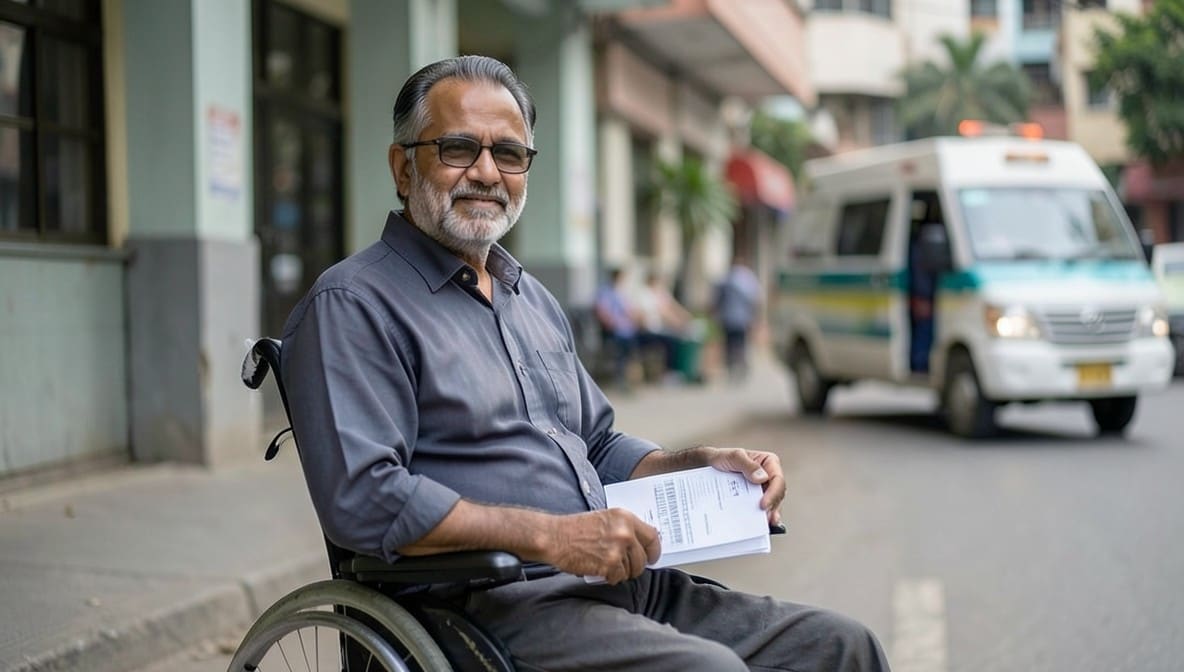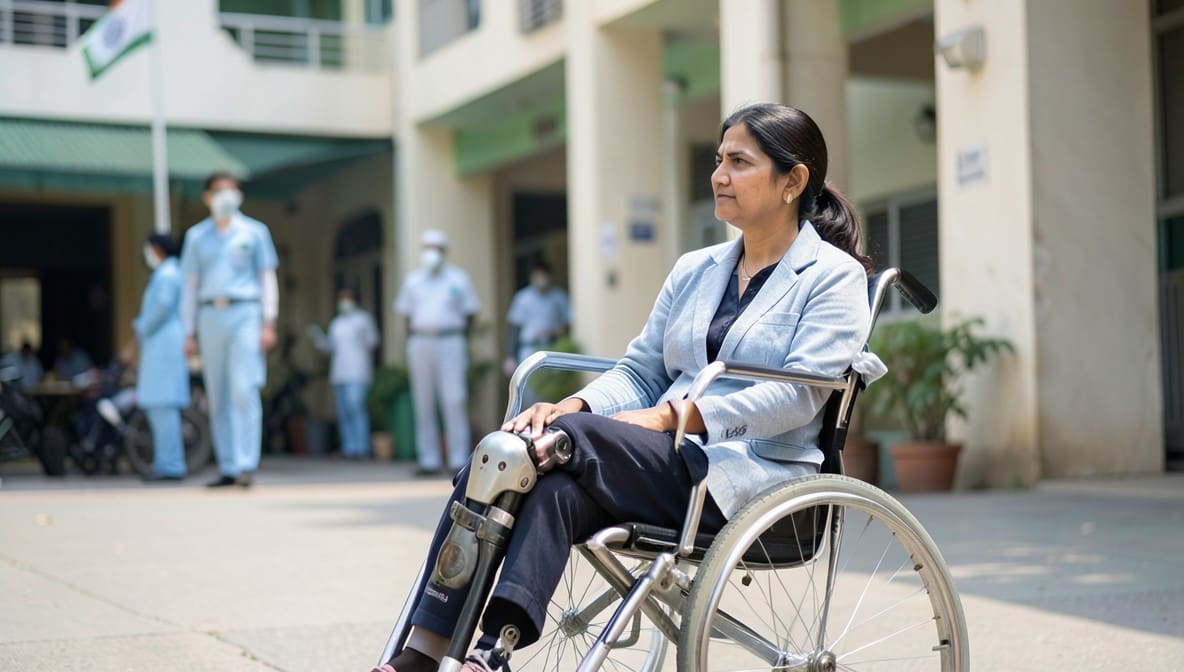
The Madhya Pradesh High Court has clarified that disability certificates issued under the Rights of Persons with Disabilities Act, 2016, carry statutory weight and do not require corroboration through the examination of the issuing medical officer, provided their genuineness is not reasonably challenged. This ruling reinforces the evidentiary value of official disability certifications in motor accident claims and sets a clear precedent for tribunals and courts handling compensation cases involving permanent disability.
Background & Facts
The Dispute
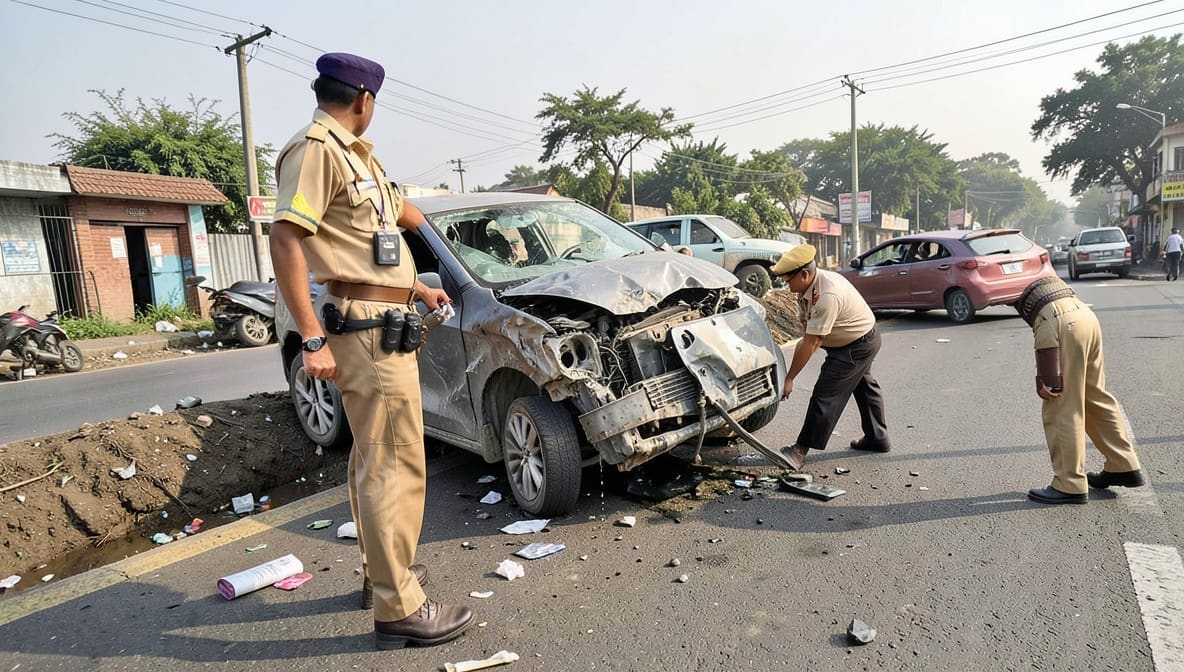
The dispute arose from a motor accident that occurred on 02.12.2018 in Gwalior, Madhya Pradesh. Dinesh Kumar, the husband of respondent no.1 (claimant), was riding a motorcycle with his wife as the pillion rider when it was struck by a dumper bearing registration number MP-41-HA-0759. The dumper was driven negligently by respondent no.4 and owned by respondent no.3. The accident resulted in severe injuries to claimant no.1, leading to permanent functional disability. The offending vehicle was insured with the appellant, The Oriental Insurance Company Ltd.
Key Facts
- The accident occurred on 02.12.2018
- Claimant no.1 sustained injuries requiring prolonged medical treatment
- A disability certificate (Ex. P/63) was issued by the Civil Surgeon, Gwalior, certifying 50% permanent disability
- The certificate was issued under the Rights of Persons with Disabilities Act, 2016, and Rules, 2017
- Claimant submitted medical records (Ex. P/22 to P/61, P/64 to P/83, P/86 to P/189) documenting treatment from 02.12.2018 onwards
- Dr. Anand Sharma, Neurologist (PW/4), testified regarding the nature and extent of injuries and functional impairment
- Amit Shivhare (PW/3), Record Keeper at District Hospital, produced the official register entries confirming claimant’s appearance before the Medical Board and issuance of the certificate
- Applications for the disability certificate (Ex. P/84 and P/85) were submitted on 15.06.2019 and 20.07.2019
- The certificate was issued on 10.08.2019
- Claimant filed a claim petition under Section 160 read with Section 140 of the Motor Vehicles Act, 1988 on 15.01.2020
Procedural History
- 15.01.2020: Claim petition filed before 23rd Motor Accident Claims Tribunal, Gwalior (MACC No. 249/2020)
- 26.09.2024: Tribunal awarded total compensation of Rs. 22,16,480/-, including Rs. 15,05,280/- for permanent disability based on 70% functional disability
- 11.07.2024: Tribunal rejected claimants’ application under Order XVI Rule 1 CPC to summon the issuing doctor
- 18.03.2025: Appeal filed by The Oriental Insurance Company Ltd. before the High Court of Madhya Pradesh at Gwalior (M.A. No. 167/2025)
- 18.03.2026: Appeal heard and reserved
- 31.03.2026: Judgment delivered
The Parties' Positions
Appellant (Insurance Company): Argued that the disability certificate (Ex. P/63) was inadmissible because the issuing doctor was not examined. Relied on Kamal Kumar Jain v. Tazuddin to assert that medical certificates require scientific examination and testimony.
Respondents (Claimants): Contended that the certificate was issued by a statutory Medical Board under the RPWD Act, 2016, and was duly authenticated by hospital records and corroborated by treating physician Dr. Anand Sharma. Submitted that the Tribunal correctly rejected the request to summon the doctor as unnecessary.
Relief Sought
The appellant sought reduction or deletion of the Rs. 15,05,280/- awarded for permanent disability, arguing that the certificate was unproved. The respondents sought dismissal of the appeal and confirmation of the Tribunal’s award.
The Legal Issue
The central question was whether a disability certificate issued under Section 58 of the Rights of Persons with Disabilities Act, 2016, by a duly constituted Medical Board, must be proved by examining the issuing doctor, or whether its statutory validity and corroboration through official records suffice in the absence of any challenge to its genuineness.
Arguments Presented
For the Appellant
Learned counsel for the Insurance Company relied on the Full Bench decision in Kamal Kumar Jain v. Tazuddin & Ors. (2004 MPLJ 472), which held that mere certificates without scientific examination and testimony of the doctor are inadmissible. He argued that Ex. P/63, though issued by the Civil Surgeon, was not proved because the doctor did not testify. He contended that the statement of Amit Shivhare, a record keeper, was insufficient to establish the authenticity of the certificate. He further submitted that the Tribunal erred in accepting a 50% disability certificate to determine a 70% functional disability without expert testimony.
For the Respondent
Learned counsel for the claimants submitted that the disability certificate was issued under Section 58 of the RPWD Act, 2016, and Rule 18 of the 2017 Rules, which prescribe a formal, statutory procedure. He produced Ex. P/84 and P/85 - the application and hospital register entries - to prove the certificate’s issuance. He emphasized that Dr. Anand Sharma’s testimony corroborated the functional impairment. He also noted that the claimants had applied under Order XVI Rule 1 CPC to summon the doctor, but the Tribunal rightly rejected it as redundant since the certificate was already exhibited and unchallenged for forgery.
The Court's Analysis
The Court undertook a detailed examination of the statutory framework governing disability certification under the Rights of Persons with Disabilities Act, 2016. It noted that Section 57 designates certifying authorities, Section 58 prescribes the procedure for certification, and Rule 18 of the 2017 Rules mandates that the medical authority issue the certificate after due assessment in accordance with Central Government guidelines. The Court held that such certificates are not mere opinions but statutory documents with legal force.
"The certificate issued under the Act/Rules is thus recognized to be a valid proof of disability. Thus, a disability certificate issued pursuant to the provisions of Section 57 & 58 and after following procedure prescribed Rule 17 & 18, bears a statutory force and cannot be brushed aside without there being any cogent reason therefore."
The Court distinguished Kamal Kumar Jain, which dealt with informal medical opinions without statutory backing, from the present case where the certificate was issued by a Medical Board constituted under a comprehensive statutory regime. The Court emphasized that the appellant did not allege forgery, fraud, or procedural irregularity in the issuance of the certificate.
The Court further relied on the recent Supreme Court decision in Anoop Maheshwari v. Oriental Insurance Company Ltd. (2025 SCC OnLine SC 1918), which held that disability certificates issued by Medical Boards under the RPWD Act can be accepted without examining the issuing doctor. The Apex Court clarified that functional disability - not merely medical diagnosis - is the relevant metric for compensation, and that prosthetic adaptation and loss of earning capacity are key indicators.
The Court also noted that the Tribunal did not rely solely on the 50% certificate. It independently assessed medical records and Dr. Sharma’s testimony to conclude a 70% functional disability, a finding unchallenged by the appellant. The rejection of the application to summon the doctor was justified, as the claimants had already discharged their burden of proof through statutory documentation and corroborative evidence.
The Verdict
The appeal was dismissed. The High Court upheld the Motor Accident Claims Tribunal’s award of Rs. 15,05,280/- for permanent disability, Rs. 6,06,200/- for medical expenses, and Rs. 22,16,480/- in total compensation. The Court held that the disability certificate issued under the RPWD Act, 2016, is admissible without examination of the issuing doctor if its genuineness is not disputed. No modification to the award was ordered.
What This Means For Similar Cases
Statutory Certificates Are Presumptively Valid
- Practitioners must treat disability certificates issued under the RPWD Act, 2016, as prima facie valid unless specific allegations of fraud or procedural violation are raised
- Mere non-examination of the issuing doctor is not a ground to reject such certificates
- Tribunals and courts must prioritize statutory compliance over evidentiary formalities when the certificate is issued under a comprehensive legal framework
Functional Disability Trumps Medical Diagnosis
- Compensation must be based on functional impairment affecting earning capacity, not just clinical diagnosis
- Evidence such as prosthetic use, vocational history, and treatment records carry equal or greater weight than percentage ratings on certificates
- Claimants should submit vocational assessments and income loss projections alongside medical certificates
Procedural Applications Must Be Timely and Strategic
- Applications under Order XVI Rule 1 CPC to summon witnesses should be filed early and with clear justification
- If the Tribunal rejects such an application and the certificate is otherwise corroborated, the rejection will not be grounds for appeal unless procedural bias is shown
- Insurance companies must challenge certificates on substantive grounds (e.g., non-compliance with guidelines) rather than procedural technicalities