The Andhra Pradesh High Court has clarified that insurance companies cannot escape liability in motor accident claims merely by alleging the driver lacked a valid licence unless they substantiate this claim with concrete evidence. The judgment reinforces the principle that claimants need only establish liability on a balance of probabilities, not beyond reasonable doubt, and places the burden squarely on insurers to disprove negligence or licensing defects.
Background & Facts
The Dispute
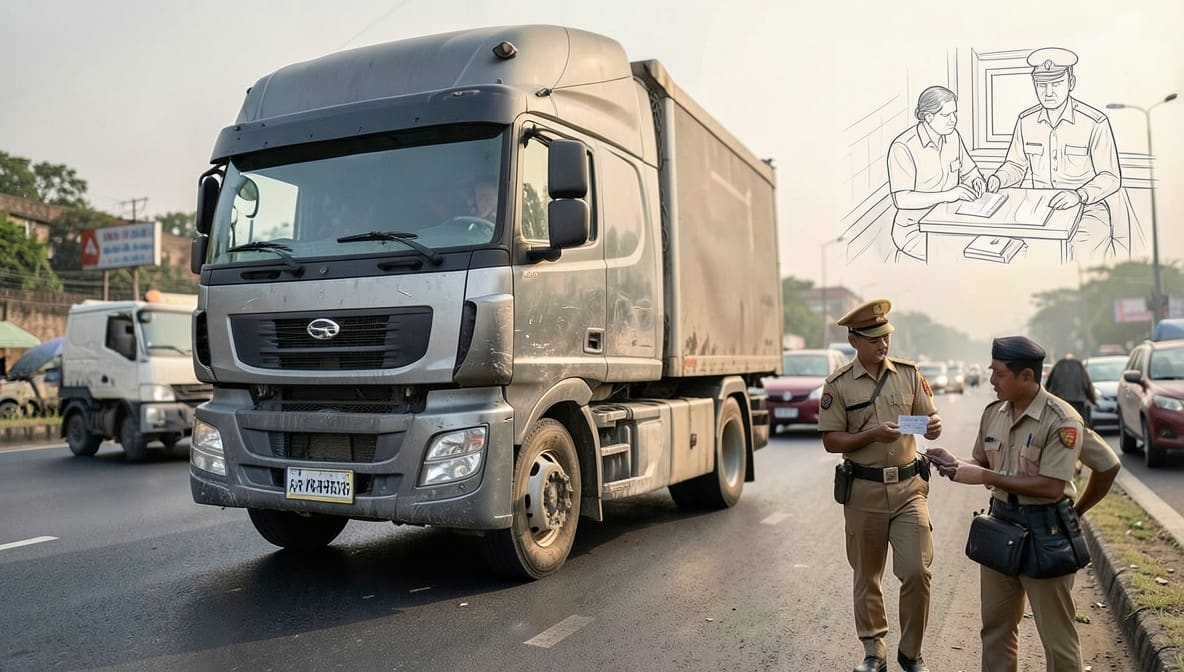
The appellant, Palem Chandrayudhu, a daily wage coolie aged approximately 35 years, was injured on 18.03.2013 when a tipper vehicle bearing registration number AP 04 W 6793, owned by the first respondent, A Vivekananda Reddy, collided with his auto-rickshaw near Nallavan Ka on the Kamalapuram to Ayyavaripalli road. The collision resulted in a fracture of the right femur and multiple other injuries requiring surgical intervention and prolonged medical care.
Key Facts
- The accident occurred on 18.03.2013 at approximately 10:30 AM.
- The appellant was admitted to Government Hospital, Proddatur, on the same day and underwent surgery with insertion of three rods.
- He was hospitalized for 16 days and later received follow-up treatment at a private hospital in Kadapa.
- He incurred Rs.20,000 towards medicines, transport, attendant charges, and special diet.
- He suffered permanent physical disability, losing the ability to walk independently, squat, or sit properly.
- Prior to the accident, he was employed as a coolie and daily wage laborer, earning approximately Rs.3,000 per month.
- The appellant filed a claim petition before the Motor Accidents Claims Tribunal (MACT) on 15.04.2014 seeking Rs.2,00,000 in compensation.
- The first respondent (owner) remained ex parte throughout the proceedings.
- The second respondent, Sriram General Insurance Company Limited, was the insurer under Policy No.10003/1/365942, valid from 15.10.2012 to 14.10.2013.
- The FIR (Ex.A1) was registered on 18.03.2013, and a charge sheet (Ex.A3) was filed against the driver of the offending vehicle.
- The disability certificate (Ex.A4) issued by RIMS Hospital, Kadapa, on 09.05.2014 assessed permanent disability at 40% for court purposes.
- The insurance company relied on oral testimony from RW1 (legal officer) and RW2 (stenographer, Transport Department) to allege the driver lacked a valid licence.
- The insurance company produced Ex.B2 (legal notice) returned unserved and Ex.X1 (letter from Deputy Transport Commissioner) asserting no licence was registered in the name of Suresh Reddy.
Procedural History
- 18.03.2013: Accident occurred.
- 18.03.2013: FIR registered.
- 15.04.2014: Claim petition filed before MACT (M.V.O.P. No. 98/2014).
- 19.09.2014: MACT awarded Rs.93,400 against the first respondent only; dismissed claim against insurer on grounds of unproven driving licence.
- 07.10.2014: Notice of appeal filed.
- 06.01.2015: Appeal filed before the High Court as M.A.C.M.A. No. 6/2015.
- 11.02.2026: Judgment reserved.
- 07.05.2026: Judgment pronounced.
The Parties' Positions
For the Appellant
- The driver of the offending vehicle was negligent, as evidenced by FIR and charge sheet.
- The insurer failed to prove the driver lacked a valid licence.
- The MACT erred in reducing disability from 40% to 15% without independent medical reassessment.
- Compensation was inadequate and failed to reflect actual loss of earning capacity.
For the Respondent (Insurance Company)
- The accident was caused by the appellant’s auto being overloaded and driven without a valid licence.
- The driver of the offending vehicle did not possess a valid licence, as per Transport Department records.
- The insurer discharged its burden by producing Ex.B1 (policy), Ex.B2 (unserved notice), Ex.X1 (departmental letter), and Ex.X2 - X4 (registration, permit, fitness records).
- The claimant’s income and disability assessment were speculative.
Relief Sought
The appellant sought:
- Inclusion of the insurance company as jointly liable.
- Enhancement of compensation from Rs.93,400 to Rs.2,00,000.
- Revision of disability percentage from 15% to 40%.
- Interest at 12% per annum from the date of petition.
- Costs of litigation.
The Legal Issue
The central questions were: (1) Whether the insurance company can be exonerated from liability merely on the basis of uncorroborated oral testimony asserting the absence of a driving licence, without producing official records or examining the driver or owner? (2) Whether the MACT’s reduction of permanent disability from 40% to 15% was legally sustainable in the face of a court-issued medical certificate and unchallenged medical testimony?
Arguments Presented
For the Appellant
The appellant relied on Bimla Devi v. Himachal Road Transport Corporation to argue that in motor accident claims, the standard of proof is preponderance of probability, not beyond reasonable doubt. He contended that the charge sheet and FIR established a prima facie case of negligence by the offending vehicle’s driver. The insurer’s reliance on RW2’s oral testimony - unsupported by Motor Vehicles Inspector’s report or official licence verification - was insufficient to discharge its burden. He further cited Rajkumar v. Ajay Kumar to argue that disability percentage and loss of earning capacity are distinct, and the Tribunal must assess the latter based on occupation, age, and evidence, not arbitrarily reduce medical assessments.
For the Respondent
The insurer argued that the burden of proving the driver’s valid licence lay with the claimant, and since the claimant failed to produce the driver’s licence, the insurer was entitled to exoneration. It relied on Sidram v. United India Insurance Co. to assert that the Tribunal may reject medical certificates if inconsistent with other evidence. It claimed Ex.X1 and Ex.X2 established the driver’s lack of licence, and the unserved notice (Ex.B2) demonstrated the owner’s non-cooperation. It further contended that the MACT’s assessment of Rs.3,000/month income and 15% disability was reasonable given the claimant’s socio-economic status.
The Court's Analysis
The Court undertook a rigorous analysis of evidentiary standards under the Motor Vehicles Act and relevant precedents. It emphasized that the MACT, as a statutory tribunal, must adopt a holistic and liberal approach, recognizing the social welfare character of the legislation. The Court held that official records such as FIR and charge sheet are presumptively reliable under Rule 476 of the A.P. Motor Vehicles Rules, 1989, and may be relied upon unless contradicted by credible evidence.
"The plea is taken generally that there is no proper registration certificate, no driving licence to the driver and no fitness to the vehicle. The Insurance Company failed to prove that there is no driving licence to the driver of the offending vehicle."
The Court found the insurer’s evidence wholly inadequate. RW1, a legal officer, merely repeated allegations without producing any official licence verification. RW2, a stenographer, offered oral testimony that Suresh Reddy had no licence, but no supporting document from the Regional Transport Office (RTO) was produced. The Court noted that even the letter from the Deputy Transport Commissioner (Ex.X1) merely stated that records were transmitted - not that the driver was unlicensed. Crucially, the insurer did not summon the driver or the owner, nor did it obtain a certified extract from the RTO’s licence database.
Regarding disability, the Court held that the MACT’s reduction of 40% to 15% was arbitrary. The disability certificate (Ex.A4) was issued by RIMS Hospital’s Medical Board for court purposes and was corroborated by PW2, an Assistant Professor in Orthopaedics, who detailed the appellant’s non-union fracture, osteoporosis, restricted mobility, and antalgic gait. The Court cited Rajkumar v. Ajay Kumar to clarify that while disability percentage does not automatically equate to loss of earning capacity, the Tribunal must not disregard unchallenged medical evidence without independent reassessment. The MACT’s failure to order a fresh medical evaluation rendered its reduction legally unsustainable.
The Court further affirmed that the multiplier method must be applied with a liberal approach, as held in Yadava Kumar v. National Insurance Co., to restore the claimant to his pre-accident position. The monthly income of Rs.3,000 was upheld as reasonable for a daily wage labourer in 2013, and the multiplier of 11 (for age 35) was correctly applied, yielding Rs.1,58,400 for loss of earning capacity.
The Verdict
The appeal was allowed in part. The High Court set aside the MACT’s order dated 19.09.2014 and enhanced the compensation to Rs.1,98,400, comprising Rs.20,000 for pain and suffering, Rs.5,000 for transportation, Rs.10,000 for medical expenditure, Rs.5,000 for extra nourishment, and Rs.1,58,400 for loss of earning capacity due to 40% permanent disability. Interest was fixed at 6% per annum from the date of the petition (15.04.2014) until realization. Respondents 1 and 2 are jointly and severally liable, with Respondent 2 (Insurance Company) liable under the policy. Payment must be made within two months: if the claimant provides bank details within 15 days, the insurer must deposit directly; otherwise, the amount must be deposited with the MACT for withdrawal.
What This Means For Similar Cases
Insurance Liability Cannot Be Avoided on Speculative Evidence
- Practitioners must challenge insurers who rely on unverified oral testimony to deny liability.
- Insurers must produce certified RTO records or official reports to substantiate claims of invalid licences.
- Mere production of unserved notices or departmental letters without corroboration is insufficient.
Medical Disability Assessments Must Be Respected Unless Rebutted by Independent Evaluation
- Courts and tribunals cannot arbitrarily reduce medically certified disability percentages.
- If a medical board or treating physician provides a credible assessment, the burden shifts to the insurer to seek a second opinion.
- Failure to obtain independent medical reassessment renders reduction of disability unlawful.
Preponderance of Probability Governs Motor Accident Claims
- Claimants need not prove negligence beyond reasonable doubt.
- FIRs, charge sheets, and hospital records form a strong evidentiary base.
- Tribunals must adopt a liberal, victim-centric approach consistent with Bimla Devi and Yadava Kumar.