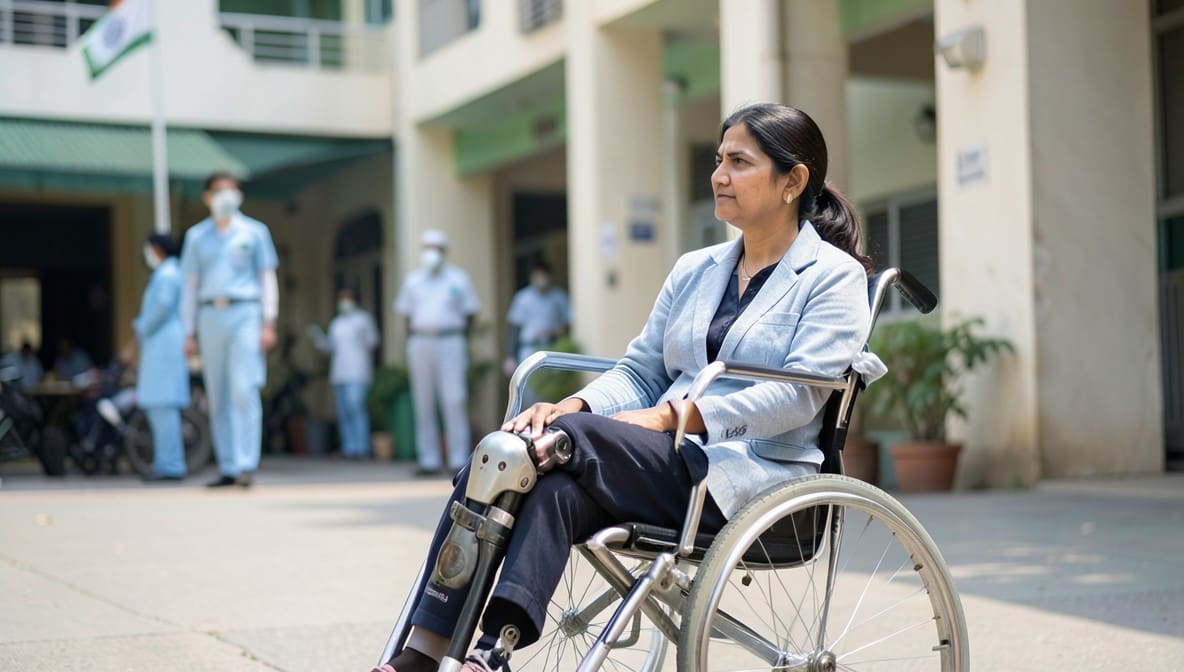
A landmark ruling by the Bombay High Court has clarified that a disability certificate under the Employees' Compensation Act, 1923, need not be issued by the doctor who personally treated the injured worker. The judgment removes a significant procedural barrier faced by claimants and reinforces the statutory intent of ensuring timely compensation for workplace injuries.
Background & Facts
The Dispute
The appellant, Mahendra Sabharu Majhi, sustained back injuries while working at a construction site in Thane on 22 March 2010. He was hospitalized until 29 March 2010 and later filed a claim for compensation under the Employees' Compensation Act, 1923, seeking Rs. 5,95,584 from his employer and its insurer. The claim was supported by a disability certificate issued by a qualified medical practitioner who had not personally attended to him during hospitalization but had reviewed his medical records and testified before the Commissioner.
Procedural History
- 2010: Injury occurred at construction site
- 2012: Application for compensation filed before Commissioner for Workmen’s Compensation
- 19 June 2012: Commissioner dismissed the claim solely on the ground that the disability certificate was issued by a doctor who did not treat the appellant
- 2012: First Appeal filed before Bombay High Court
- 2026: Appeal heard ex parte due to non-appearance of Respondent No. 2 (Insurance Company)
Relief Sought
The appellant sought setting aside of the Commissioner’s order and a direction to recalculate compensation based on the disability certificate issued by the qualified medical practitioner, irrespective of whether he had treated the appellant.
The Legal Issue
The central question was whether Section 4(1)(c)(ii) and Section 2(1)(i) of the Employees' Compensation Act, 1923 require a disability certificate to be issued only by the medical practitioner who personally attended to the injured workman, or whether a qualified medical practitioner may issue such a certificate based on medical records and examination, even without direct treatment.
Arguments Presented
For the Appellant
Ms. Varsha Nichani argued that the Commissioner’s reasoning was legally unsustainable. She relied on the plain language of Section 2(1)(i), which defines a "qualified medical practitioner" as any person registered under a recognized medical register or declared qualified by the State Government. She emphasized that the Act imposes no requirement for direct attendance. She cited Mukesh Kumar v. Kulhari Tours and Travels (2025 SCC OnLine Kar 808) to show that other High Courts have consistently held that cross-examination of a non-treating doctor suffices to test credibility.
For the Respondent
Respondent No. 1 appeared but did not contest the legal point. Respondent No. 2, the insurer, did not appear despite notice. No counter-arguments were formally presented before the Court.
The Court's Analysis
The Court undertook a textual and purposive interpretation of the Employees' Compensation Act, 1923. It noted that Section 4(1)(c)(ii) mandates a disability certificate from a "qualified medical practitioner" but contains no condition restricting issuance to treating physicians. The Court emphasized that the Act’s objective is to ensure swift and fair compensation, not to impose unnecessary procedural hurdles.
"The object of obtaining a medical disability certificate from a medical expert is to arrive at the percentage of disability by taking the help of an expert in the field."
The Court rejected the Commissioner’s approach as arbitrary and contrary to statutory intent. It held that a qualified medical practitioner may rely on medical reports, diagnostic imaging, and clinical history to form an opinion. The opportunity for cross-examination, which was available in this case, ensures evidentiary reliability. The Court distinguished between "treatment" and "evaluation" - the former being clinical care, the latter being forensic assessment. Both are valid under the Act.
The Court further held that the Commissioner erred in using the certificate’s origin to reject all other issues - such as employer-employee relationship and occurrence of accident in the course of employment - when those issues were independently established by evidence. The dismissal of the entire claim on a single, legally invalid ground was procedurally flawed.
The Verdict
The appellant won. The Bombay High Court held that a disability certificate issued by a qualified medical practitioner who did not personally treat the injured workman is admissible and valid under the Employees' Compensation Act, 1923, provided the practitioner is duly qualified and subject to cross-examination. The Commissioner’s order was set aside and the matter remanded for recalculation of compensation based on the existing evidence.
What This Means For Similar Cases
Disability Certificates Are Not Tied to Treating Physicians
- Practitioners must no longer insist that claimants obtain certificates only from hospital doctors
- A certificate from a specialist in occupational medicine, even if consulted post-treatment, is legally sufficient
- Insurers and employers cannot challenge compensation claims solely on the basis that the certifying doctor did not treat the worker
Cross-Examination Validates Expert Opinion
- The credibility of a non-treating doctor’s opinion is tested through cross-examination, not by the timing of their involvement
- Medical reports, X-rays, and discharge summaries are legitimate bases for certification
- Tribunals must evaluate the substance of the opinion, not the pedigree of the doctor
Procedural Fairness Requires Separate Adjudication of Issues
- Issues like employment status and accident causation must be decided independently of the disability certificate
- A flawed certificate cannot be used to dismiss unrelated factual claims
- Commissioners must avoid "all-or-nothing" reasoning when multiple issues are involved