The Supreme Court has affirmed that a person directly and demonstrably affected by an interim order in a writ petition cannot be denied impleadment merely because they were not an original party. This ruling reinforces the principle that procedural justice demands participation when judicial orders have immediate civil consequences on third parties.
Background & Facts
The Dispute
The Appellant, M/s Chopra Hotels Private Limited, owns property at B-XIII-294, Police Lines Road, Jalandhar, Punjab. The land was originally residential but was granted change of land use to commercial on 09.10.2006. On 28.04.2011, the Municipal Corporation, Jalandhar approved the building plan for a hotel. On 31.07.2024, the Appellant applied for a completion certificate, but a discrepancy was raised regarding the front setback, allegedly due to the trapezium shape of the plot versus the rectangular depiction in the sanctioned plan.
Key Facts
- The Punjab Unified Building Rules, 2025 were notified on 15.12.2025, reducing the minimum front setback for commercial buildings to 10%.
- The Appellant’s building maintained a front setback of 15.37%, which would have rendered it compliant under the 2025 Rules.
- On 24.12.2025, the High Court of Punjab and Haryana passed an interim order in CWP No. 38742 of 2025, keeping in abeyance provisions of the 2025 Rules inconsistent with earlier regulations, and directing that violations under prior rules not be regularized.
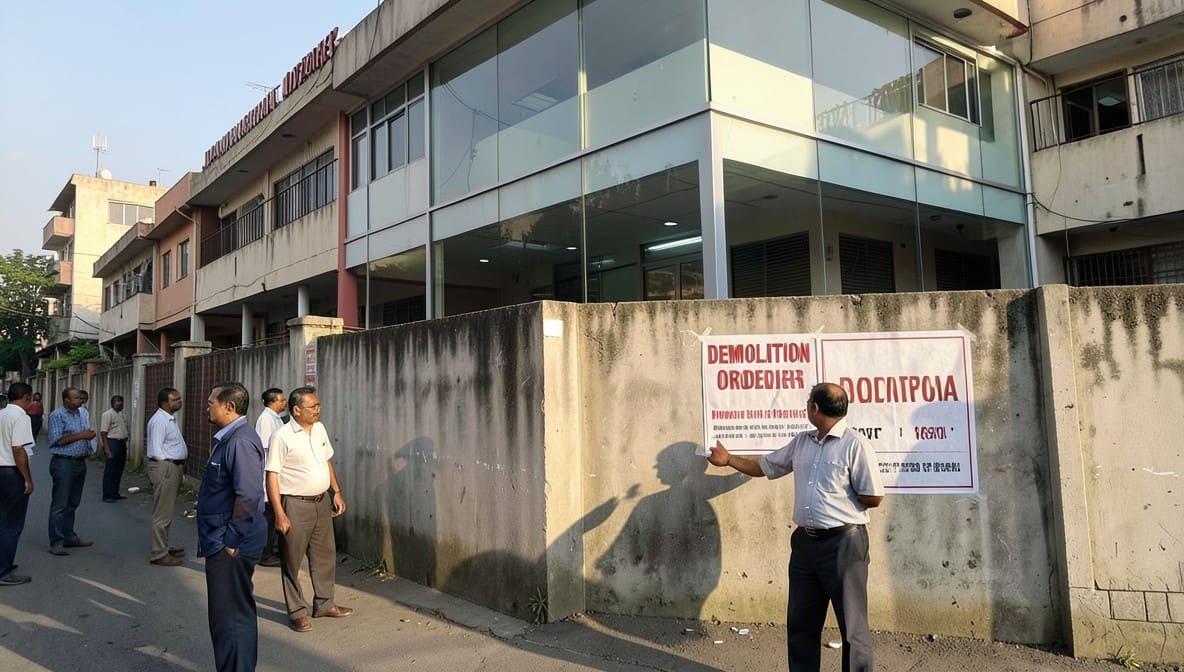
- On 05.02.2026, the Municipal Corporation sealed the property and issued a demolition order on 06.02.2026, relying on the interim order dated 24.12.2025.
- The Appellant submitted representations on 12.02.2026 and revised building plans on 13.02.2026 seeking recognition under the 2025 Rules; both were rejected on 13.02.2026 and 14.02.2026.
- On 16.03.2026, the High Court dismissed CWP No. 5839 of 2026 filed by the Appellant, holding that the 2025 Rules were in abeyance and thus could not be considered.
- On 17.03.2026, the statutory appeal under Section 269 of the Punjab Municipal Corporation Act, 1976 was dismissed by the Additional District Judge, Jalandhar.
- On 17.03.2026, demolition commenced at 05:30 PM, immediately after the appellate order was pronounced at 05:00 PM.
- On 18.03.2026, the High Court recorded the Advocate General’s undertaking that demolition would be halted until the next hearing.
- On 24.03.2026, the High Court adjourned LPA No. 760 of 2026 and CR No. 2579 of 2026 to 01.04.2026, but the Advocate General withdrew the earlier assurance against demolition.
Procedural History
- 09.10.2006: Change of land use from residential to commercial granted.
- 28.04.2011: Building plan approved for hotel construction.
- 31.07.2024: Application for completion certificate filed.
- 15.12.2025: Punjab Unified Building Rules, 2025 notified.
- 24.12.2025: High Court issues interim order in CWP No. 38742 of 2025 keeping 2025 Rules in abeyance.
- 05.02.2026: Property sealed by Municipal Corporation.
- 06.02.2026: Demolition order issued.
- 10.02.2026: High Court dismisses CWP No. 4023 of 2026, relegating Appellant to statutory remedy.
- 12.02.2026: LPA No. 415 of 2026 filed; Division Bench grants limited protection till 16.02.2026.
- 12.02.2026: Appellant submits representation seeking benefit under 2025 Rules.
- 13.02.2026: Revised building plans submitted.
- 13.02.2026 & 14.02.2026: Representations and revised plans rejected.
- 17.02.2026: Statutory appeal under Section 269 filed; interim protection denied.
- 18.02.2026: High Court stays coercive action till decision of statutory appeal.
- 20.02.2026: Appellant files C.M. No. 2967-CWP-2026 (impleadment) and C.M. No. 2968-CWP-2026 (clarification) in CWP No. 38742 of 2025.
- 26.02.2026: High Court dismisses both applications, holding Appellant has no lis.
- 16.03.2026: High Court dismisses CWP No. 5839 of 2026.
- 17.03.2026: Statutory appeal dismissed; demolition commences.
- 17.03.2026: CR No. 2579 of 2026 filed before High Court against dismissal of statutory appeal.
- 18.03.2026: High Court records undertaking to halt demolition pending LPA No. 760 of 2026.
- 24.03.2026: LPA No. 760 of 2026 and CR No. 2579 of 2026 adjourned to 01.04.2026; undertaking withdrawn.
- 13.03.2026: Supreme Court issues notice in SLPs and stays further proceedings.
- 01.04.2026: Supreme Court records Advocate General’s undertaking: no demolition till orders are passed.
- 08.04.2026: Supreme Court delivers judgment.
The Parties' Positions
Appellant: Argued that the interim order dated 24.12.2025 directly affected its rights by being used to reject its compliance claims and justify demolition. It sought impleadment to challenge the application of the interim order to its property and clarification to prevent misuse.
Respondents (State of Punjab): Contended that the Appellant was not a party to CWP No. 38742 of 2025, had no locus standi, and could pursue remedies independently under statutory provisions. The State maintained that the interim order was not intended to bind non-parties.
Relief Sought
The Appellant sought:
- Impleadment as a party in CWP No. 38742 of 2025.
- Clarification or modification of the interim order dated 24.12.2025 to exclude its property from its operation.
- Stay of demolition and preservation of status quo.
- Direction to the High Court to hear its independent remedies (LPA No. 760 of 2026 and CR No. 2579 of 2026) without delay.
The Legal Issue
The central question was whether a person who is directly and demonstrably affected by an interim order in a writ petition, even if not an original party, has the right to seek impleadment and clarification of that order under Article 226 of the Constitution.
Arguments Presented
For the Appellant
Dr. A.M. Singhvi, Senior Counsel, relied on Mumbai International Airport Private Limited v. Regency Convention Centre and Hotels Private Limited to argue that the principles of Order I Rule 10 CPC apply to writ proceedings as guiding norms. He emphasized that the interim order dated 24.12.2025 was not abstract - it was actively invoked by municipal authorities to reject the Appellant’s compliance claims and justify sealing and demolition. The Appellant’s rights were being adjudicated in its absence, violating natural justice. The fact that another party (KCB Infra LLP) had been impleaded earlier demonstrated the High Court’s willingness to allow participation where warranted.
For the Respondent
Mr. Shadan Farasat, Senior Counsel for the State, contended that the Appellant was not a necessary or proper party to CWP No. 38742 of 2025, which challenged the validity of the 2025 Rules as a whole. He argued that the Appellant’s remedies lay in statutory appeals under the Punjab Municipal Corporation Act, 1976, and that allowing impleadment would unnecessarily complicate the writ petition. He maintained that the interim order was not a binding adjudication on the Appellant’s rights.
The Court's Analysis
The Court examined the nature of writ jurisdiction under Article 226 and the applicability of procedural principles from the Code of Civil Procedure. It held that while writ proceedings are not bound by technical pleadings, the underlying rationale of ensuring complete and fair adjudication remains intact.
"The record before us shows that the interim order dated 24.12.2025 in CWP No. 38742 of 2025 did not remain confined to an abstract challenge to the 2025 Rules. The said order was in fact relied upon by the municipal authorities while dealing with the case of the Appellant."
The Court observed that the High Court’s dismissal of CWP No. 5839 of 2026 explicitly tied the Appellant’s fate to the interim order, confirming that the order had direct, concrete consequences. The Appellant was not a stranger to the controversy; it was a proper party whose presence would enable the High Court to fully and fairly adjudicate the impact of its own order.
The Court further noted that the High Court had previously permitted impleadment of KCB Infra LLP, indicating that the proceedings were not closed to third parties when their interests were materially affected. The rejection of the Appellant’s prayer for clarification was also found to be legally untenable: "The grievance of the Appellant was not detached from the writ proceedings. It arose precisely from the operation attributed by the authorities and by the learned Single Judge to the order dated 24.12.2025."
However, the Court declined to rule on the merits of the 2025 Rules or the Appellant’s entitlement to their benefit, recognizing that such issues were pending in independent proceedings - LPA No. 760 of 2026 and CR No. 2579 of 2026. It emphasized that overlap between proceedings does not equate to identity, and that independent remedies must not be stultified merely because a broader challenge is pending.
"To require the Appellant to wait for the final decision in CWP No. 38742 of 2025 before LPA No. 760 of 2026 and CR No. 2579 of 2026 can even be heard would, in effect, postpone adjudication of the Appellant’s independent remedies to an uncertain stage."
The Court concluded that justice required recognizing the interconnection without collapsing the proceedings. The Appellant must be heard in the writ petition where its rights are directly impacted, but its other remedies must proceed independently.
The Verdict
The appeals are allowed. The High Court’s order dated 26.02.2026 dismissing the Appellant’s applications for impleadment and clarification is set aside. The Appellant is impleaded as a party respondent in CWP No. 38742 of 2025. The High Court shall proceed with CWP No. 38742 of 2025 independently of LPA No. 760 of 2026 and CR No. 2579 of 2026. LPA No. 760 of 2026 and CR No. 2579 of 2026 shall be heard together and decided independently on their own merits. The status quo regarding the property shall be maintained until disposal of LPA No. 760 of 2026 and CR No. 2579 of 2026. No opinion is expressed on the merits of any claim.
What This Means For Similar Cases
Impleadment Is Not Limited to Original Parties
- Practitioners must now argue that any person directly affected by an interim order in a writ petition - regardless of original party status - is entitled to seek impleadment under Article 226.
- Courts cannot dismiss impleadment applications on technical grounds if the order has been invoked to cause concrete civil consequences.
- The precedent in Mumbai International Airport must be cited to establish that "proper party" status arises from direct impact, not formal involvement.
Clarification Requests Cannot Be Dismissed as Redundant
- A request for clarification of an interim order must be addressed on its merits if the order is being used to the detriment of a non-party.
- Telling a party to "pursue another remedy" is insufficient when the grievance arises directly from the court’s own order.
- Courts must provide an opportunity to be heard in the very proceeding that caused the prejudice.
Independent Remedies Must Not Be Stalled Indefinitely
-
The pendency of a broader constitutional challenge does not justify delaying statutory or civil remedies with immediate consequences.
-
Courts must avoid creating procedural bottlenecks that render remedies illusory.
-
Where proceedings are interlinked but distinct, they may be heard together for efficiency, but not held in abeyance pending final resolution of another.
-
Practitioners should file parallel remedies (statutory appeals, writs) without waiting for broader challenges to conclude.
-
Always document how interim orders are being used against your client - this forms the factual basis for impleadment.