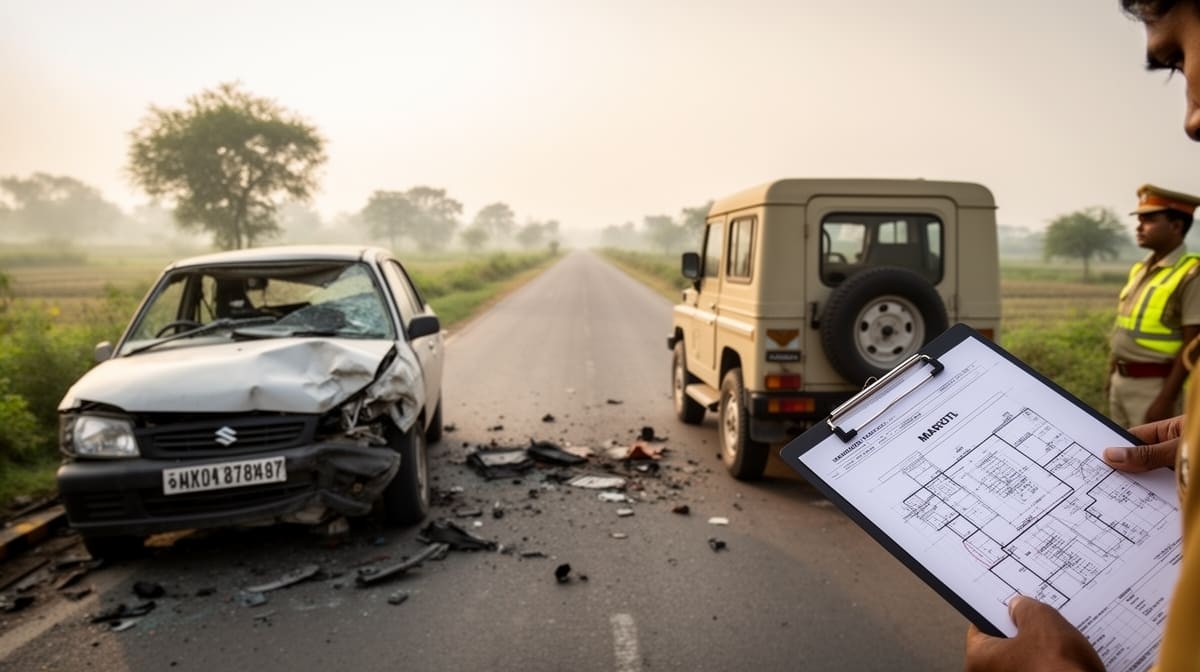
The Madras High Court has affirmed that in motor accident claims, the right to a fair defence includes the opportunity to implead third parties whose negligence may have contributed to the accident. Denying such an application at an early stage, without examining the merits of the allegation, violates the principles of natural justice and risks defeating the claimant’s ability to establish liability fully.
Background & Facts
The Dispute
The dispute arises from a motor accident involving a car and a lorry. The original claim was filed by the respondents (claimants) against the driver and insurer of the car (Registration No. unknown), alleging that the car driver’s negligence caused the accident resulting in the death of one claimant and injuries to others. However, the claimants later sought to implead the owner and insurer of a lorry (Registration No. TN 83 8605), contending that the lorry driver’s sudden lane change was the primary cause of the collision.
Key Facts
- The accident occurred on or about the date of filing of MCOP No. 4155 of 2023 (exact date not specified in judgment).
- The claimants initially filed the claim petition against the car driver and his insurer only.
- The second respondent (claimant) submitted a counter affidavit asserting that the lorry driver, not the car driver, was negligent for suddenly changing lanes, causing the collision.
- The revision petitioner (Bajaj Allianz General Insurance Co. Ltd.) filed I.A. Nos. 4 and 5 of 2024 seeking to implead:
- Respondent 3: Veerapathiran, owner of the lorry (TN 83 8605)
- Respondent 4: The New India Assurance Company Ltd., insurer of the lorry
- The Chief Court of Small Causes, Chennai, dismissed the application on 03.12.2024, holding that the claimant has the right to choose the parties against whom to litigate.
- The car driver was acquitted in the related criminal proceedings.
Procedural History
- Date of Accident: Not specified, but claim filed in MCOP No. 4155 of 2023
- Date of Filing I.A. Nos. 4 and 5 of 2024: Not specified, but prior to 03.12.2024
- 03.12.2024: Chief Court of Small Causes, Chennai, dismissed the application to implead the lorry owner and insurer
- 23.03.2026: Civil Revision Petitions CRP Nos. 4148 and 4511 of 2025 decided by the Madras High Court
The Parties' Positions
Revision Petitioner (Bajaj Allianz): Argued that the lorry driver’s negligence was central to the accident, as per the claimants’ own counter affidavit. Impleading the lorry owner and insurer was necessary to establish the true cause of the accident and to ensure a complete adjudication of liability.
Respondents (Claimants): Contended that the claim was properly framed against the car driver and insurer, and that introducing new parties at the trial stage was an attempt to delay proceedings.
Relief Sought
The revision petitioner sought:
- Setting aside of the order dated 03.12.2024 dismissing the application for impleadment
- Permission to implead the owner and insurer of the lorry (TN 83 8605) as respondents in MCOP No. 4155 of 2023
- Direction to the trial court to proceed with the case on merits after allowing full opportunity to raise all defences
The Legal Issue
Can a claimant in a motor accident claim petition be denied the opportunity to implead a third-party vehicle owner and insurer when evidence suggests that party’s negligence may have caused or contributed to the accident, even if the claim was initially filed against another party?
Arguments Presented
For the Appellant/Petitioner
The revision petitioner relied on Khenyei v. New India Assurance Co. Ltd. and Others (2015 (9) SCC 273), which held that in motor accident claims, the court must ensure that all parties who may be liable are given an opportunity to be heard. The petitioner argued that the claimants themselves had alleged in their counter affidavit that the lorry driver’s negligence was the proximate cause of the accident. Denying impleadment at this stage would deprive the petitioner of the right to present a full defence and could lead to an unjust outcome. The petitioner emphasized that the car driver’s acquittal in criminal proceedings further supported the need to examine the lorry driver’s role.
For the Respondent/State
The respondents contended that the claimant has the sovereign right to choose the parties against whom to file a claim. They argued that introducing new parties at the trial stage would cause unnecessary delay and prejudice to the existing parties who had already prepared their case. The trial court’s dismissal was therefore justified as a procedural safeguard against last-minute tactical additions.
The Court's Analysis
The Court rejected the respondents’ argument that the claimant’s choice of parties is absolute and unchallengeable. It held that while a claimant may initially select parties, this right is not unfettered when evidence emerges suggesting the involvement of another potentially liable party. The Court observed:
"Only after completion of the trial, the negligence on the part of the driver of the lorry can be decided. Therefore, at this stage, if the parties are not impleaded, the valuable right of defence will get defeated."
The Court emphasized that the right to a fair trial under Article 21 of the Constitution includes the right to present a complete defence. The trial court’s refusal to permit impleadment, without examining the substance of the allegation, amounted to a denial of natural justice. The Court distinguished between a claimant’s initial choice of parties and the procedural necessity to include all relevant parties once their involvement is substantiated. The decision in Khenyei was applied to reinforce that motor accident claims must be decided on the totality of evidence, not on procedural technicalities.
The Court further noted that the acquittal of the car driver in criminal proceedings did not preclude civil liability, but it did underscore the need to investigate alternative causes of the accident. The trial court’s failure to permit impleadment risked a one-sided adjudication that could result in wrongful liability being imposed on an innocent party.
The Verdict
The Madras High Court allowed the civil revision petitions. The order dated 03.12.2024 dismissing the application for impleadment was set aside. The trial court is directed to permit the impleadment of Veerapathiran (owner of TN 83 8605) and The New India Assurance Company Ltd. as respondents in MCOP No. 4155 of 2023. The trial court must dispose of the claim petition on merits within three months from the date of receipt of this order, after giving full opportunity to all parties to present evidence and arguments.
What This Means For Similar Cases
Impleadment Cannot Be Denied on Mere Grounds of Delay
- Practitioners must now argue that allegations of third-party negligence, even if raised during trial, must be examined on merit - not dismissed summarily as "delay tactics"
- A claimant’s initial choice of parties does not bar subsequent impleadment if credible evidence emerges implicating another party
- Courts must balance procedural efficiency with substantive justice in motor accident claims
Defence Rights Trump Procedural Formalities
- The right to present a complete defence under Article 21 overrides rigid interpretations of party selection
- Courts must permit impleadment where the defence hinges on the conduct of a non-party
- Failure to allow such impleadment may render the trial proceeding vitiated and liable to be set aside on appeal
- This principle applies equally to insurers, owners, and drivers of vehicles not initially named in the claim
Evidence from Counter Affidavits Triggers Duty to Implead
-
If a respondent’s own affidavit alleges negligence by a third party, the court has a duty to consider impleadment
-
Such allegations cannot be treated as mere litigation strategy - they constitute material evidence
-
Courts must treat counter affidavits as part of the evidentiary record when assessing the need for additional parties
-
Always file an application for impleadment with supporting affidavits or documents indicating third-party involvement
-
Cite Khenyei v. New India Assurance Co. Ltd. and Article 21 when opposing dismissal on procedural grounds
-
If the trial court refuses impleadment, file a revision petition under Article 227 immediately, as delay may prejudice the defence