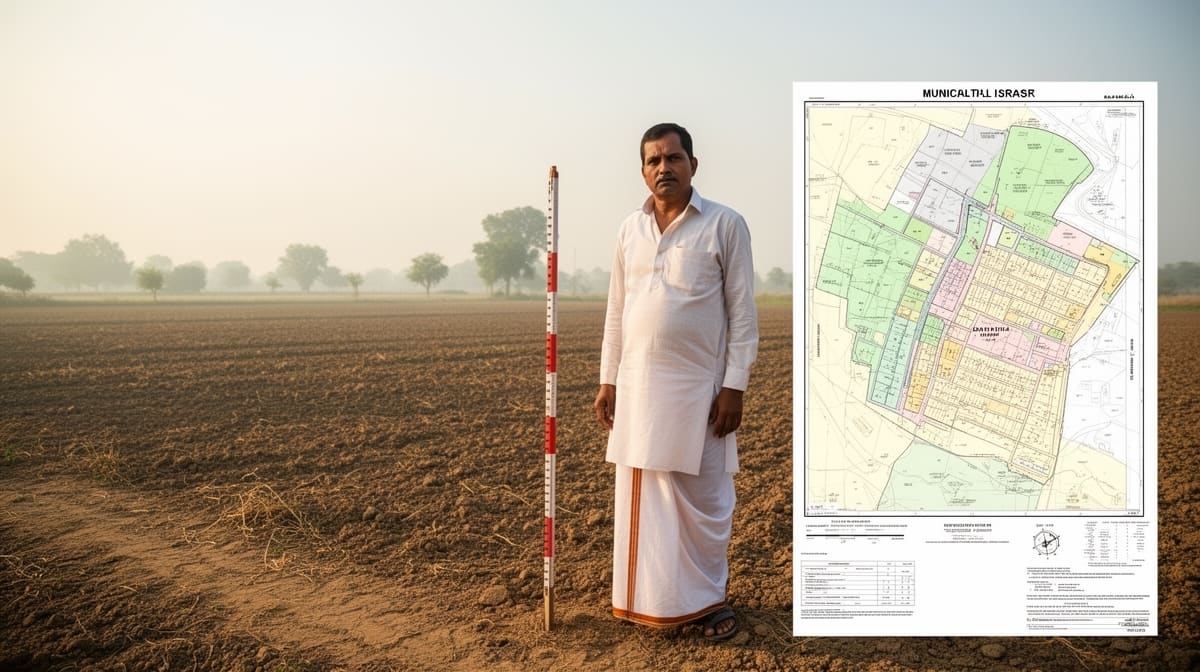
The Bombay High Court has affirmed that landowners cannot be compelled to accept Floor Space Index (FSI) or Transferable Development Rights (TDR) as compensation in land acquisition proceedings. The judgment reinforces the primacy of monetary compensation under the Right to Fair Compensation and Transparency in Land Acquisition, Rehabilitation and Resettlement Act, 2013, and upholds the landowner’s autonomy in choosing the form of compensation.
Background & Facts
The Dispute
The petitioners, Arjun Rambhau Parkhe and another, are landowners in Pune whose property is slated for acquisition as part of a road widening project by the Pune Municipal Corporation. On 05.03.2026, the Deputy Engineer, Estate and Administration Department of the Pune Municipal Corporation (Respondent No.5), issued a communication (Exhibit K) directing the petitioners to cooperate by surrendering a portion of their land in exchange for enhanced FSI or TDR, without offering any monetary compensation.
The petitioners objected to this demand, asserting that under the Right to Fair Compensation and Transparency in Land Acquisition, Rehabilitation and Resettlement Act, 2013 (Act of 2013), they are entitled to monetary compensation as the primary and default mode of recompense. They further contended that the Municipal Corporation’s directive violated the binding precedent set by the Full Bench of this Court in Shree Vinayak Builders and Developers, Nagpur v. State of Maharashtra and others, 2022 (4) Mh.L.J. 739.
Key Facts
- The proposed road widening project involves acquisition of a portion of the petitioners’ land in Pune
- The Pune Municipal Corporation issued the impugned communication on 05.03.2026
- The communication offered only FSI/TDR as compensation, with no option for monetary payment
- The petitioners have consistently refused FSI/TDR and demanded monetary compensation under the Act of 2013
- No formal notification under Section 4 or Section 6 of the Act of 2013 has been issued as of the date of the petition
- The petitioners are not opposed to acquisition but insist on statutory compliance
Procedural History
- 05.03.2026: Impugned communication issued by Deputy Engineer, Pune Municipal Corporation
- 15.03.2026: Writ Petition No. 4373 of 2026 filed before the Bombay High Court
- 09.04.2026: Hearing conducted before Justices Manish Pitale and Shreeram V. Shirsat
Relief Sought
The petitioners sought:
- Quashing of the communication dated 05.03.2026
- A direction to the Municipal Corporation to provide monetary compensation under the Act of 2013
- An interim stay on any attempt to take possession of the land
- A direction to conduct a formal measurement of the land to be acquired before any possession is taken
The Legal Issue
The central question was whether the acquiring authority, in this case the Pune Municipal Corporation, can unilaterally impose FSI/TDR as the sole form of compensation under the Act of 2013, or whether the landowner retains the absolute right to choose monetary compensation.
Arguments Presented
For the Petitioner
The petitioners relied on the Full Bench decision in Shree Vinayak Builders and Developers, which held that FSI/TDR cannot be imposed as compulsory compensation. Counsel argued that Section 30 of the Act of 2013 mandates that compensation shall be determined in accordance with the provisions of the Act, which prioritize monetary payment. The petitioners emphasized that the Act is a welfare legislation designed to protect landowners from coercive and undervalued compensation mechanisms. They further contended that the impugned communication violated Article 300A of the Constitution, which protects the right to property.
For the Respondent
The Advocate General for the State of Maharashtra waived notice and did not oppose the petitioners’ prayer. No substantive counter-arguments were presented by the State or the Municipal Corporation.
The Court's Analysis
The Court examined the Full Bench ruling in Shree Vinayak Builders and Developers and reaffirmed its holding that the choice between monetary compensation and FSI/TDR rests exclusively with the landowner. The Court observed that the Act of 2013 was enacted to ensure fairness, transparency, and dignity in land acquisition, and that forcing FSI/TDR upon unwilling landowners defeats the very purpose of the statute.
"The landowner cannot be compelled to accept FSI/TDR as compensation. The option must be offered, but the decision must rest with the owner."
The Court noted that the impugned communication was issued without any formal acquisition process under the Act of 2013, and that the Municipal Corporation had not initiated the prescribed procedures for determining market value, solatium, or rehabilitation entitlements. The Court further held that any taking of possession without a proper measurement of the land to be acquired would violate procedural fairness and the principle of natural justice.
The Court rejected the notion that FSI/TDR could serve as a substitute for statutory compensation, emphasizing that such mechanisms are supplementary and cannot override the landowner’s right to monetary recompense.
The Verdict
The petitioners succeeded. The Court issued the following ad-interim directions:
- The Pune Municipal Corporation shall not insist on compensation solely through FSI/TDR
- The petitioners’ demand for monetary compensation under the Act of 2013 shall be respected
- The Municipal Corporation shall not take possession of the subject land until a formal measurement of the portion to be acquired is completed
- The measurement report, if completed before the next hearing, must be filed on record by the returnable date of 15.06.2026
- The impugned communication dated 05.03.2026 remains suspended pending final adjudication
What This Means For Similar Cases
Monetary Compensation Is the Default Right
- Practitioners representing landowners in urban acquisition cases must immediately assert the right to monetary compensation under the Act of 2013
- Any offer of FSI/TDR must be voluntary and documented as an option, not a condition
- Municipal corporations and development authorities cannot bypass valuation procedures by offering non-monetary alternatives
Measurement Is a Precondition to Possession
- Before any physical possession is taken, a certified survey and measurement of the land to be acquired must be conducted and recorded
- Failure to do so renders any possession illegal and subject to quashing
- Landowners may now file applications for injunctions based on non-compliance with this procedural safeguard
Precedent Binding on All Acquisition Authorities
- The Shree Vinayak Builders precedent is now reaffirmed as binding across Maharashtra
- All acquisition authorities must revise their standard operating procedures to reflect this ruling
- Legal notices issued under Section 11 of the Act of 2013 must explicitly state the landowner’s right to choose compensation mode