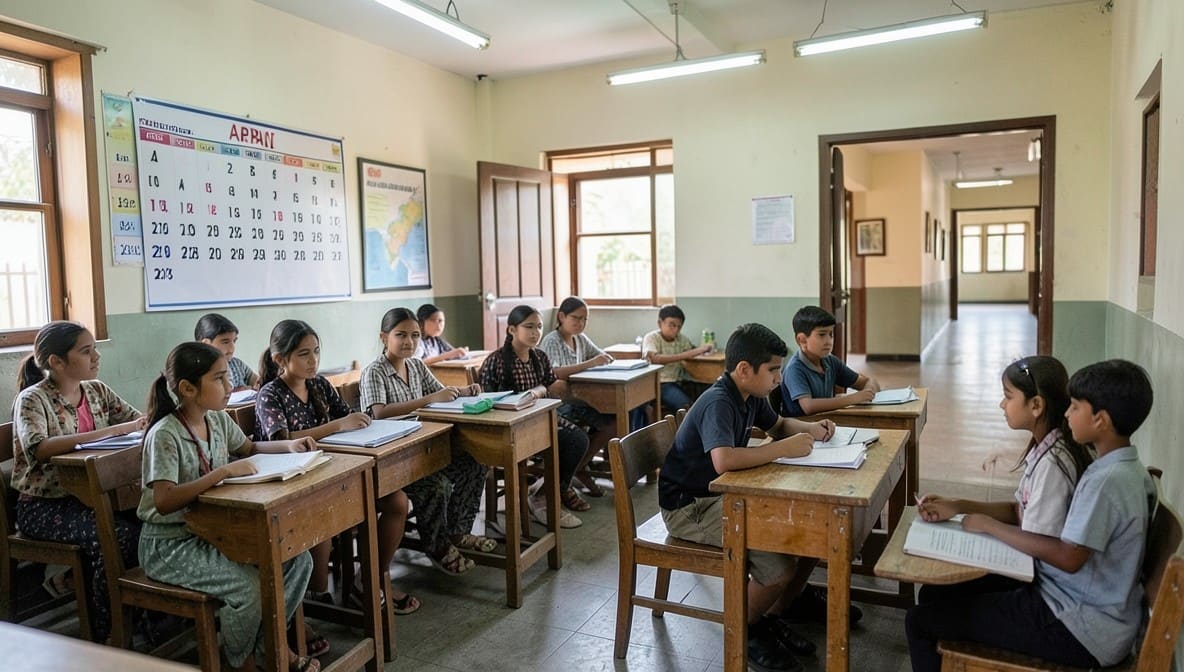
In a rare exercise of judicial compassion grounded in public interest, the Allahabad High Court has held that the right of students to sit for examinations cannot be compromised even when a property is subject to enforcement under the SARFAESI Act. The Court prioritized the educational continuity of over a hundred children over the procedural rights of a secured creditor, setting a significant precedent for balancing economic enforcement with fundamental social rights.
Background & Facts
The Dispute
The petitioner, S.M. Transport, acting through its authorized officer, is a secured creditor seeking enforcement of a security interest over Plot No. 13/29, Indira Nagar, Lucknow, under the Securitisation and Reconstruction of Financial Assets and Enforcement of Security Interest Act, 2002. The property was originally mortgaged by the borrowers, Mohd. Mehdi and Saiyeda Nigar Mehdi, who have since operated the Grace Montessori School on the premises since 1996.
Key Facts
- The school operates from Class Nursery to Class V with approximately 118 enrolled students and 12 teaching staff
- The academic session for 2025-2026 is currently underway
- First-quarter examinations are scheduled between 24.04.2026 and 22.05.2026
- The property was seized and possession taken by the Additional District Magistrate on 23.01.2026 under Section 14 of the SARFAESI Act
- The Securitization Application No. 727 of 2025 remains pending before the Debts Recovery Tribunal, Lucknow
- An Interim Relief Application (IA No. 2215 of 2026) is also pending before the Tribunal seeking stay of enforcement
Procedural History
- 23.01.2026: Additional District Magistrate took possession of the property under Section 14 of the SARFAESI Act
- 24.04.2026: Petition filed under Article 227 of the Constitution seeking stay of sale and restoration of possession for examination purposes
- 24.04.2026: Hearing conducted and interim directions issued on the same day
The Parties' Positions
Petitioners (S.M. Transport & Others): Argued that they are lawful secured creditors entitled to enforce their security interest under the SARFAESI Act. They contended that the petition is an abuse of process since an appeal lies under Section 18 of the Act.
Respondents (Mohd. Mehdi, Saiyeda Nigar Mehdi & Grace Montessori School): Emphasized that the property is not merely an asset but the operational base of a school serving 118 children. They submitted that disruption of examinations would cause irreparable harm to the students’ academic future.
Relief Sought
The petitioners sought:
- Stay of issuance of sale certificate for the property
- Restoration of possession to conduct examinations
- Direction to the Debts Recovery Tribunal to decide the pending Securitization Application and Interim Application expeditiously
The Legal Issue
Can the enforcement of a secured creditor’s rights under the SARFAESI Act be temporarily suspended to protect the right of children to sit for examinations, even in the absence of a statutory provision granting such relief?
Arguments Presented
For the Petitioner
Learned counsel for the petitioners emphasized that the school is a legitimate occupant of the property and that the students are innocent third parties. They argued that the Court’s inherent jurisdiction under Article 227 permits intervention to prevent manifest injustice. The prayer was narrowly confined to permitting examinations to proceed without disturbance, not to challenging the legality of possession or sale.
For the Respondent
The respondent bank’s counsel contended that the petitioners have an alternative remedy under Section 18 of the SARFAESI Act and that the High Court should not interfere in the statutory enforcement process. They argued that allowing temporary access would set a precedent undermining the efficacy of asset recovery by financial institutions.
The Court's Analysis
Justice Chandra Dhari Singh explicitly declined to adjudicate the merits of the underlying debt or the legality of the possession order dated 23.01.2026. Instead, the Court focused on the immediate humanitarian concern: the disruption of education for 118 children.
"My concern is solely about the future of the students, who are studying at the school in question, particularly stated in paragraph no. 4 of the affidavit filed in support of the petition and the limited prayer made by learned counsel for the petitioner to allow the examinations scheduled between 24.04.2026 and 22.05.2026 to proceed peacefully."
The Court recognized that while the SARFAESI Act empowers secured creditors to enforce security interests, it does not contemplate the collateral damage to public welfare, particularly education. The Court invoked its extraordinary jurisdiction under Article 227 to prevent a manifest injustice that would affect minors beyond repair.
The Court further noted that the property was already under the custody of the Additional District Magistrate, meaning physical control was not with the school. Therefore, the relief sought was not to reverse possession but to permit temporary, supervised access for a strictly defined purpose.
The Court rejected the argument that Section 18 of the SARFAESI Act provided an adequate remedy, observing that appellate remedies are not designed to address urgent, time-sensitive humanitarian crises.
The Verdict
The petition was disposed of with the following directions:
- The Additional District Magistrate shall ensure the examinations scheduled between 24.04.2026 and 22.05.2026 are conducted peacefully without interference
- The effect of the possession order dated 23.01.2026 shall be kept in abeyance until 25.05.2026
- The property shall be desealed for the sole purpose of conducting examinations
- Upon conclusion of examinations on 25.05.2026, possession shall be handed over to Respondent No. 2 (the secured creditor)
- The Debts Recovery Tribunal, Lucknow, shall decide Securitization Application No. 727 of 2025 without granting unnecessary adjournments
What This Means For Similar Cases
Education Cannot Be Held Hostage to Financial Enforcement
- Practitioners representing schools or educational institutions facing SARFAESI enforcement must immediately file applications highlighting student enrollment numbers, examination schedules, and potential disruption
- Courts may now consider humanitarian impact as a valid ground for interim relief, even in statutory enforcement proceedings
- The burden shifts to the secured creditor to demonstrate why immediate enforcement outweighs the right to education
Judicial Discretion Under Article 227 Extends to Non-Statutory Relief
-
The judgment affirms that High Courts may exercise supervisory jurisdiction under Article 227 to prevent manifest injustice, even where statutory remedies exist
-
This does not invalidate the SARFAESI Act but creates a narrow, time-bound exception for urgent public welfare concerns
-
Future petitions must be narrowly framed - seeking only temporary access, not permanent stay or reversal of possession
-
Always include exact dates of examinations or academic deadlines in applications
-
Attach school registration certificates, student lists, and examination timetables as annexures
-
Cite this judgment to argue that statutory enforcement must yield to fundamental rights of children in exigent circumstances