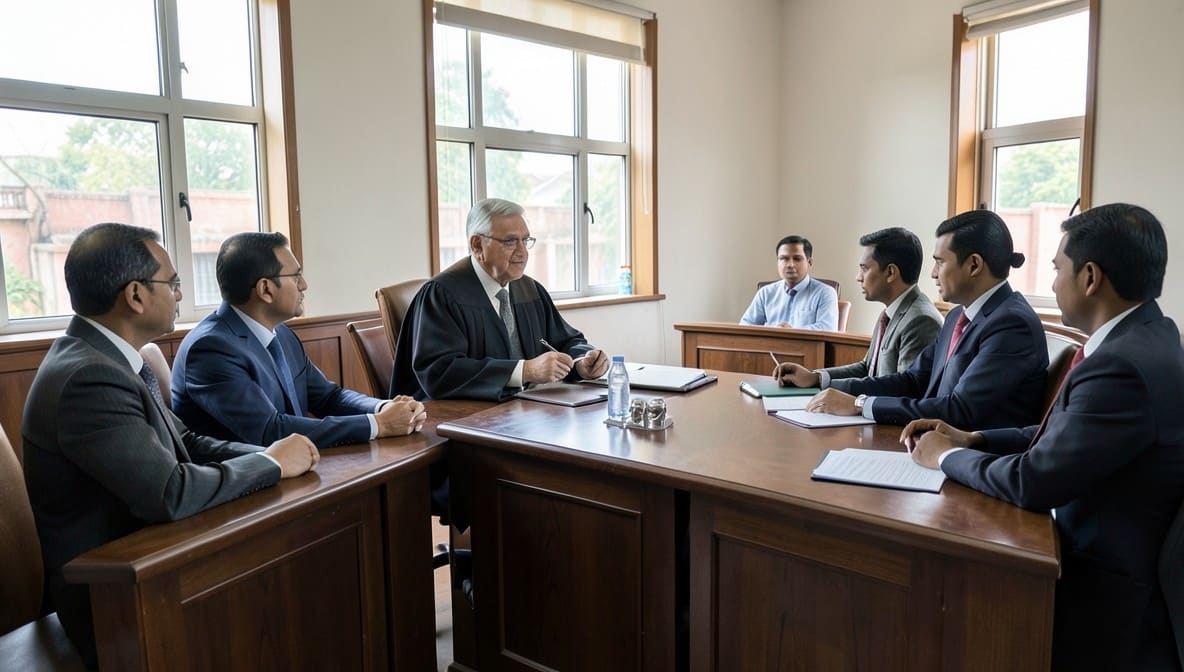
The Jharkhand High Court has reaffirmed that judicial intervention for violation of natural justice does not automatically entitle a party to restitution. In a significant clarification, the Court held that restoration of rights or revival of terminated benefits requires a specific prayer and cannot be inferred merely because a procedural flaw is established.
Background & Facts
The Dispute
The petitioner, Anand Kumar Singh, held a mining lease under the Jharkhand Mineral Concession Rules. The lease was terminated by the respondents - State of Jharkhand, Deputy Commissioner, and District Mining Officer - without affording him a reasonable opportunity of hearing. The petitioner challenged the termination through a writ petition, arguing that the order violated the principles of natural justice.
Procedural History
- 2024: Writ Petition (C) No. 3852 of 2024 filed before the Jharkhand High Court
- 06.02.2025: Division Bench quashed the termination order on grounds of denial of natural justice
- 23.05.2025: Supreme Court dismissed the State’s Special Leave Petition against the above order
- 2025: Petitioner filed a Review Petition seeking consequential relief in the form of reinstatement of the lease
Relief Sought
The petitioner sought restoration of his lease and consequential relief, relying on Beg Raj Singh v. State of U.P. and Dhanbad Wines v. State of Jharkhand, which he claimed mandated restitution upon finding procedural illegality.
The Legal Issue
The central question was whether restitution, such as reinstatement of a terminated mining lease, is an automatic consequence when a termination order is quashed for violation of natural justice, even in the absence of a specific prayer for such relief.
Arguments Presented
For the Petitioner
The petitioner’s counsel, Mr. Sumeet Gadodia, argued that the principle of restitution under Beg Raj Singh and Dhanbad Wines required the Court to restore the petitioner to the position he would have occupied had the illegal termination not occurred. He emphasized that the Supreme Court’s dismissal of the State’s SLP validated the High Court’s original order and reinforced the obligation to grant full relief.
For the Respondent
The State’s counsel, Mr. Sanjay Kumar Tiwari, contended that the original writ petition only challenged the legality of termination, not the non-renewal or non-reinstatement of the lease. He argued that since no specific prayer for restitution was made, the Court was not obligated to grant it. He further noted that the State retained the right to reissue the lease after complying with natural justice.
The Court's Analysis
The Court examined whether the failure to grant reinstatement constituted an error apparent on the face of the record warranting review. It noted that while the original order had correctly set aside the termination for breach of natural justice, it had explicitly left open the petitioner’s right to claim damages in a civil court.
"In paragraph 11 of the order dated 06.02.2025, this Court has, in clear terms, observed that since the termination of the lease in favour of the petitioner was held as illegal, it was left open to the petitioner to approach the Civil Court to claim damages against the respondents."
The Court distinguished Beg Raj Singh and Dhanbad Wines, noting that both cases involved specific prayers for reinstatement and factual contexts where restoration was feasible and equitable. In contrast, the present case lacked any such prayer, and the nature of mining leases - subject to statutory conditions, environmental clearances, and competitive bidding - made automatic reinstatement impractical.
The Court emphasized that review jurisdiction is limited and cannot be invoked to re-appreciate evidence or grant new reliefs not sought originally. It held that damages, not restitution, were the appropriate remedy in the absence of a specific claim for restoration.
The Verdict
The review petition was dismissed. The Court held that restitution is not automatic upon quashing an order for violation of natural justice, and that damages remain the proper consequential relief where no specific prayer for reinstatement is made.
What This Means For Similar Cases
Restitution Requires Specific Prayer
- Practitioners must explicitly plead for reinstatement or restoration in writ petitions challenging administrative actions
- Vague prayers for "appropriate relief" will not suffice to trigger restitutionary remedies
- Courts will not infer relief beyond what is specifically claimed, even if procedural illegality is established
Damages as Default Consequence
- When a termination is quashed for procedural flaws but reinstatement is impractical, courts may direct claim for damages
- Petitioners should be advised to include alternative prayers for compensation in the event restitution is denied
- This approach aligns with the principle that writ courts are not forums for adjudicating civil disputes unless specifically invoked
Review Jurisdiction Is Narrow
- A dismissed SLP does not validate or expand the scope of the original order
- Review petitions cannot be used to seek new reliefs or reargue merits
- Courts will not entertain review on grounds of "omission" unless an error is apparent on the face of the record