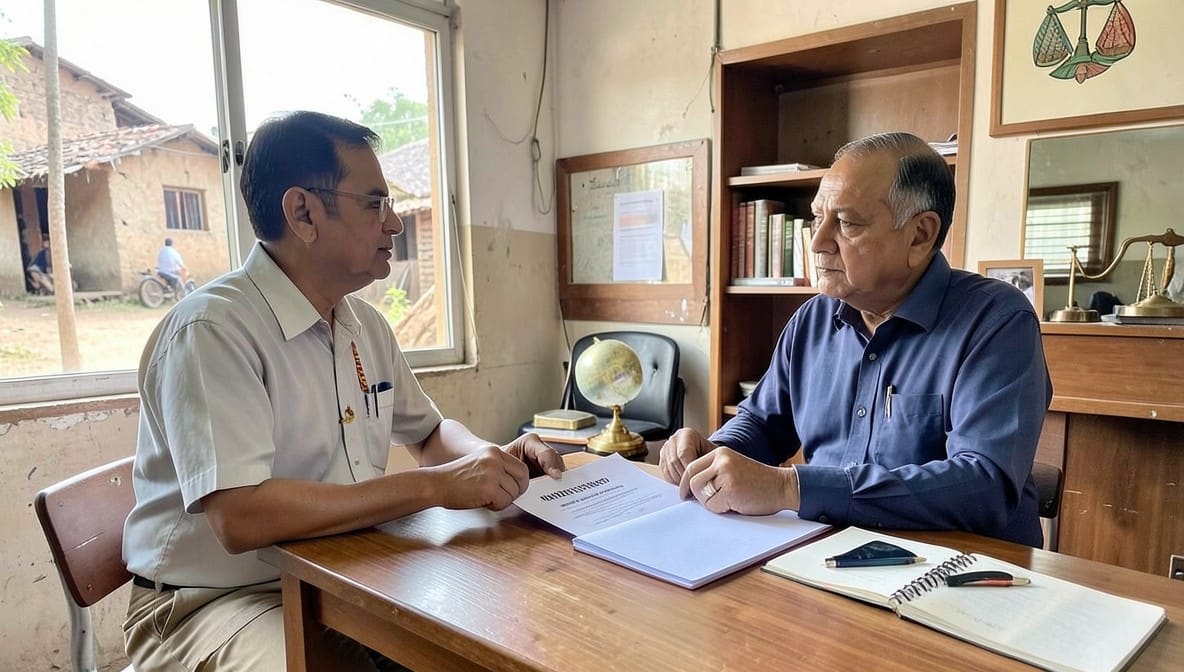
The Calcutta High Court has clarified that the non-renewal of a contractual employment does not constitute termination requiring adherence to principles of natural justice, provided no stigmatic imputation is made. However, the Court strongly condemned the illegal re-engagement of a contractual employee by a Minister outside statutory procedures, labeling it a gross violation of public accountability and rule of law.
Background & Facts
The Dispute
The writ petitioner, Tithi Adhikary, was appointed on a one-year contractual basis as a Group-C staff member under the Sarba Shikkha Mission, Howrah, effective May 2, 2007. Her contract was extendable annually, and she received extensions through 2008 and 2009. In November 2008, she was transferred to Bally West Circle. On December 7, 2009, she received a show cause notice for alleged dereliction of duty in updating UDISE data. She submitted a reply, which the authorities found unsatisfactory. Her contract expired on March 15, 2010, and was not renewed.
Procedural History
- April 5, 2010: A letter was issued by the Additional District Magistrate, Howrah, informing the Circle Project Coordinator that the petitioner’s contract would not be renewed beyond March 15, 2010.
- October 5, 2010: Despite the non-renewal, the petitioner was engaged as a departmental assistant in the secretariat of the Minister in Charge, School Education, West Bengal, without a sanctioned post or formal appointment process.
- August 21, 2012: She was verbally terminated from the Minister’s office with retrospective effect from August 16, 2012. No written order was issued.
- November 1, 2012: A new incumbent was appointed to her post.
- 2013: The petitioner filed this writ petition seeking reinstatement.
Relief Sought
The petitioner sought reinstatement in her original Group-C position, arguing that her non-renewal was arbitrary, discriminatory, and violative of natural justice. She also contended that her subsequent service in the Minister’s office constituted continuation of employment, entitling her to benefits under a 2010 government memorandum.
The Legal Issue
The central question was whether the non-renewal of a contractual employment, without punitive imputation, requires compliance with principles of natural justice, and whether re-engagement by a Minister without a sanctioned post or procedural compliance can validate a prior illegal termination.
Arguments Presented
For the Petitioner
The petitioner’s counsel, Mr. Dibyayan Banerji, argued that the non-renewal of her contract after a show cause notice amounted to punitive termination requiring a fair hearing under Swati Priyadarshini v. State of Madhya Pradesh and Firoz Ahmad Sheikh v. UT of J&K. He contended that the April 5, 2010 letter was fabricated and served after contract expiry, rendering it invalid. He further argued that her subsequent service in the Minister’s office, with salary and emoluments for over two years, established a de facto continuation of employment, entitling her to benefits under the April 23, 2010 memorandum.
For the Respondent/State
The State and Sarba Shikkha Mission contended that contractual appointments do not create vested rights beyond the contract period. The non-renewal was a mere exercise of contractual right, not a dismissal, and thus did not trigger natural justice obligations under Parshotam Lal Dhingra v. Union of India. They emphasized that her engagement in the Minister’s office was illegal - no sanctioned post existed, funds were misused, and the appointment was made solely due to ministerial favoritism, violating Smt. Kanika Das v. State of West Bengal.
The Court's Analysis
The Court examined the distinction between termination and non-renewal of contract. It held that non-renewal of a contractual service is not termination but a natural conclusion of tenure, and does not attract the procedural safeguards of Article 311 unless it carries a stigmatic imputation. The April 5, 2010 letter was not a termination order but a communication of a decision already made, devoid of any charge or censure. Therefore, no violation of natural justice occurred.
"Termination of service of the petitioner for non-renewal of contract is therefore not a dismissal in accordance with the law, which would have required compliance of the legal formalities like an enquiry or disciplinary proceeding before such termination."
However, the Court turned sharply to the petitioner’s subsequent engagement in the Minister’s secretariat. It found this to be a blatant violation of constitutional governance. The Minister, not being the appointing authority, had no power to create a post or appoint someone without statutory sanction. The salary was drawn from public funds meant for education, not personal patronage. The Court cited Smt. Kanika Das to affirm that appointments influenced by extraneous considerations, especially by Ministers, are illegal and void.
"What else can be a greater example of lawlessness in the State than the manner in which the petitioner was engaged again in the secretariat of the Minister, without compliance with any legal and procedural obligations?"
The Court rejected the petitioner’s reliance on the April 23, 2010 memorandum, noting it applied only to those still in service on its effective date - June 1, 2010. Since her contract had lapsed on March 15, 2010, she was ineligible. Her service in the Minister’s office, however long, could not cure the initial illegality or create a legal right.
The Verdict
The writ petition was dismissed. The Court held that non-renewal of a contractual service without stigmatic imputation does not violate natural justice, but re-engagement by a Minister without sanctioned posts or procedural compliance is illegal and void. The petitioner’s claim for reinstatement was denied.
What This Means For Similar Cases
Non-Renewal Is Not Termination
- Practitioners must distinguish between non-renewal and punitive termination when advising clients on contractual employment disputes.
- Absent allegations of misconduct or stigma, non-renewal does not trigger Article 311 or natural justice obligations.
- Show cause notices issued before contract expiry do not automatically convert non-renewal into disciplinary action.
Ministerial Appointments Are Ultra Vires
- Any appointment made by a Minister without statutory authority, sanctioned posts, or competitive process is void ab initio.
- Public funds used for such appointments may be subject to recovery proceedings.
- Courts will strike down appointments based on personal favoritism, even if the employee performed duties for years.
Contractual Tenure Cannot Be Extended by De Facto Service
- Continuous service without formal renewal does not create a legal right to permanency or benefits under subsequent notifications.
- Employees must rely on written contracts and formal extensions; de facto continuation is legally irrelevant.
- Notifications issued after contract expiry cannot be applied retrospectively to benefit former employees.