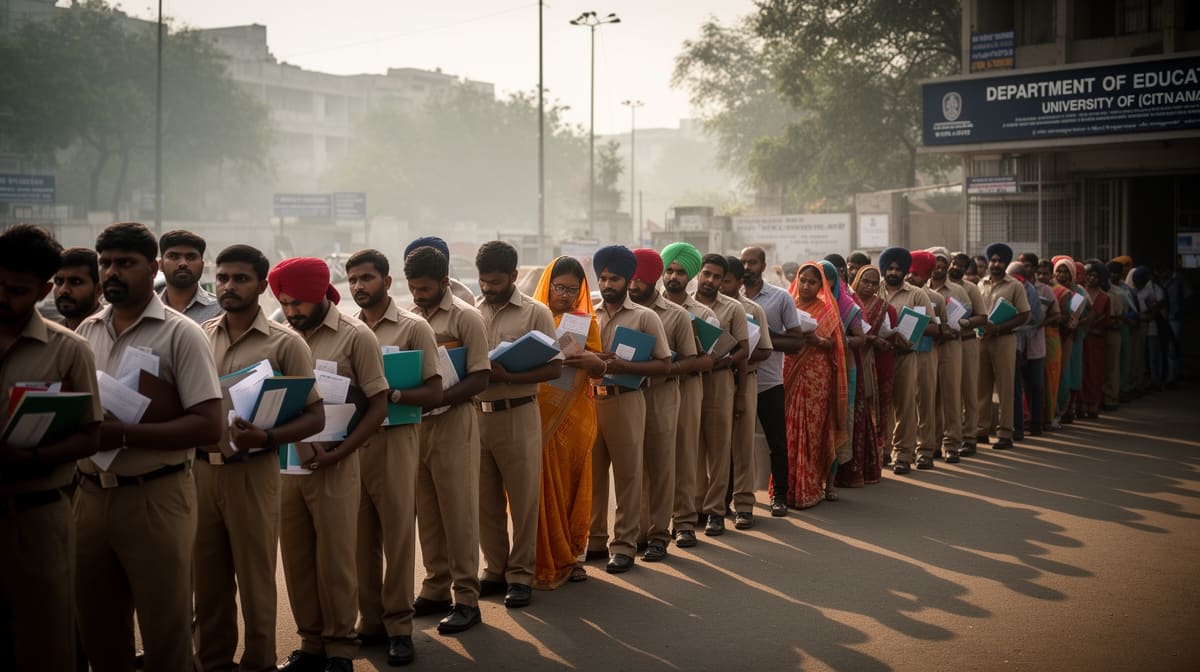
The Central Administrative Tribunal has affirmed that successor corporatized entities like BSNL cannot evade the regularization obligations of their predecessor government departments toward long-serving casual workers, even after decades of service. This ruling reinforces the constitutional mandate of equality and the binding nature of Supreme Court judgments in rem on all similarly situated employees.
Background & Facts
The Dispute
Rama Chandra Behera, a casual labourer engaged by the Department of Telecommunications (DoT) in 1994, continued working without interruption after BSNL was corporatized on 01.10.2000. Despite hundreds of similarly placed casual workers being regularized by BSNL following judicial directives, his repeated representations for regularization were rejected in 2019. He contends that his prolonged, uninterrupted service entitles him to parity with others who received regularization, and that the refusal violates Article 14 of the Constitution.
Procedural History
- 1994: Applicant engaged as casual labourer under DoT
- 01.10.2000: BSNL corporatized; applicant continued in same role under BSNL
- 2019: First OA (No. 154/2019) filed; Tribunal directed respondents to consider representation
- 25.06.2019: Representation rejected by BSNL
- 2019: Present OA (No. 260/00875/2019) filed challenging rejection
- 10.02.2026: Full Bench of CAT, in OA No. 654/2015, held that BSNL must regularize pre-2000 casual workers
Relief Sought
The applicant seeks quashing of the 25.06.2019 rejection order and a direction to BSNL to grant him temporary status followed by regularization, with service benefits computed from the date of initial engagement.
The Legal Issue
The central question was whether BSNL, as a successor entity to the DoT, is legally bound to regularize casual workers engaged prior to corporatization, and whether the doctrine of laches or delay can bar such claims when similar employees have been regularized pursuant to binding Supreme Court judgments.
Arguments Presented
For the Petitioner
The petitioner relied on multiple Supreme Court judgments - Dharam Singh v. State of U.P., Jaggo v. Union of India, and Bhola Nath v. State of Jharkhand - to argue that: (1) successor corporations inherit liabilities of predecessor departments; (2) long-term casual service creates a legitimate expectation of regularization; (3) denial of parity to similarly placed workers violates Article 14; and (4) delay cannot be invoked where the state has been engaged in internal deliberations and has already regularized others.
For the Respondent
The respondents contended that: (1) the applicant’s claim is barred by limitation under the Administrative Tribunals Act, 1985; (2) the Umadevi judgment bars regularization of casual workers absent formal recruitment; (3) the applicant’s engagement was through contractors, disqualifying him from regularization; and (4) the applicant’s delay in approaching the Tribunal reflects acquiescence and laches, rendering his claim inequitable.
The Court's Analysis
The Tribunal conducted a comprehensive review of Supreme Court jurisprudence on regularization, emphasizing the distinction between judgments in rem and in personam. It held that the Apex Court’s rulings in Dharam Singh, Jaggo, and Bhola Nath were not confined to the parties before them but established principles of public law applicable to all similarly situated employees.
"The State and its instrumentalities are expected in such category of cases to themselves, extend the benefit of judicial pronouncements to all similarly placed employees without forcing each person to individually knock the doors of Courts."
The Court rejected the argument that Umadevi categorically barred regularization, noting that the Supreme Court in Pawan Kumar v. Union of India (2026 INSC 156) had clarified that Umadevi does not preclude regularization where service is not illegal but merely procedurally irregular. The Tribunal further held that delay cannot be a ground for denial when the state itself has been deliberating on regularization policies and has already extended benefits to others.
The principle of non-discrimination under Article 14 was central. The Court observed that BSNL had regularized 455 other casual workers under similar circumstances. Denying the applicant the same benefit constituted arbitrary classification, violating the constitutional guarantee of equal treatment. The Court also affirmed that judgments in rem, particularly those concerning policy-driven regularization schemes, impose a positive duty on the state to extend benefits proactively, not reactively.
The Tribunal emphasized that Article 141 makes Supreme Court pronouncements binding law from the date of the original enactment, not merely from the date of judgment. Thus, the applicant’s claim, though pending, was governed by the latest and most authoritative interpretation of the law.
The Verdict
The applicant won. The Tribunal held that BSNL is legally bound to regularize casual workers engaged prior to its corporatization, and that delay or laches cannot defeat a claim when the state has already extended benefits to similarly placed employees. The 25.06.2019 rejection order was quashed, and BSNL was directed to regularize the applicant within 90 days, with service benefits computed from the date of initial engagement.
What This Means For Similar Cases
Regularization Is Not Discretionary When Parity Exists
- Practitioners must now argue that denial of regularization to one worker while granting it to others is a clear Article 14 violation, regardless of procedural delays
- The burden shifts to the employer to justify differential treatment - mere administrative convenience is insufficient
- Cases involving long-term casual service (10+ years) in public sector undertakings should be framed as constitutional claims, not mere service disputes
Successor Entities Cannot Evade Predecessor Obligations
- Corporatized entities like BSNL, Air India, or ONGC inherit liabilities from their government predecessors
- The doctrine of successor liability applies even if the new entity was not in existence during the original engagement
- Legal arguments must cite Dharam Singh and Bhola Nath to establish that structural change does not extinguish accrued rights
Judicial Pronouncements in Rem Bind All Similarly Situated Persons
- When the Supreme Court issues a judgment on a policy matter like regularization, it operates in rem and binds all affected employees
- Employees need not file individual petitions if a class-wide judgment exists
- Authorities must proactively implement such judgments - waiting for individual applications is a violation of constitutional duty
- Practitioners should cite State of UP v. Arvind Kumar Srivastava and Chairman/MD, UPPCL v. Ram Gopal to reinforce this principle