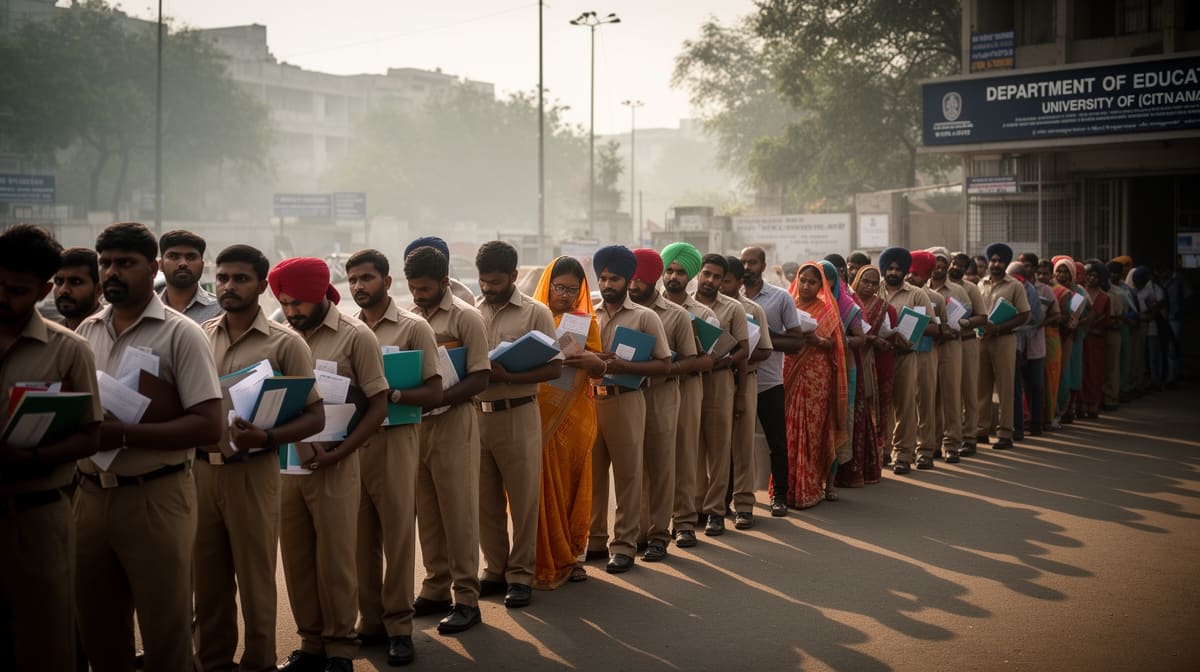
The Chhattisgarh High Court has reinforced the constitutional imperative of fair employment by directing state authorities to expeditiously decide on regularization claims of daily wage workers with over eight years of continuous service. This judgment crystallizes the legal expectation that prolonged temporary employment, particularly in integral roles, cannot be perpetuated without recourse to permanent absorption.
Background & Facts
The Dispute
The petitioners, nine individuals engaged as daily wage employees in various Class-III and Class-IV posts - including Data Entry Operators, Drivers, Peons, and Assistants - at Hemchand Yadav Vishwavidyalaya and other state institutions, have served continuously for periods ranging from eight to ten years. Despite performing duties essential to institutional functioning, they were never absorbed into regular service. Their repeated applications for regularization remained unaddressed, prompting this writ petition.
Procedural History
- 2015 - 2025: Petitioners employed on daily wage basis across multiple departments
- 17.10.2025: Petitioners submitted formal representation for regularization (Annexure P-9)
- 2026: Writ petition filed before Chhattisgarh High Court seeking regularization, parity with Legislative Assembly Secretariat employees, and absorption against sanctioned vacancies
- 23.02.2026: Court heard arguments and issued final order
Relief Sought
The petitioners sought: (i) regularization from the date of completing 3 or 10 years of service; (ii) amendment of university regulations to ensure parity with regularized employees of the Legislative Assembly; (iii) absorption against existing vacant sanctioned posts; (iv) exemplary costs for mental agony and financial hardship; and (v) any other relief deemed just.
The Legal Issue
The central question was whether long-term daily wage employees with over eight to ten years of continuous service are entitled to regularization under constitutional and statutory principles, and whether administrative inaction on their representations constitutes a violation of Article 14 and Article 21.
Arguments Presented
For the Petitioner
Counsel relied on Narendra Kumar Tiwari v. State of Jharkhand and Jaggo v. Union of India to argue that prolonged temporary employment in core functions violates the right to fair and stable employment under Article 21. They contended that the state’s failure to act on representations for over six months amounted to arbitrariness and denial of equal opportunity. The petitioners also invoked the principle of reasonable classification to demand parity with employees of the Chhattisgarh Legislative Assembly Secretariat, who were regularized in 2021.
For the Respondent
The Advocate for Respondent No. 3 conceded that the petitioners’ representation was pending and expressed no objection to the court directing a decision on it. The State did not contest the factual duration of service or the integral nature of the roles. No substantive legal defense was advanced against the claim for regularization.
The Court's Analysis
The Court examined the evolving jurisprudence on regularization of temporary employees, particularly the Supreme Court’s observation in Jaggo v. Union of India that "engaging workers on a temporary basis for extended periods... not only contravenes international labour standards but also exposes the organization to legal challenges and undermines employee morale." The Court emphasized that administrative delay in deciding regularization claims is not a permissible excuse for violating the dignity of labor.
"The government departments to lead by example in providing fair and stable employment."
The Court noted that while there is no absolute right to regularization, continuous service exceeding eight to ten years, especially in roles that are permanent in nature, creates a legitimate expectation of absorption. The state’s failure to fill sanctioned vacancies while retaining workers on daily wages constitutes a violation of principles of natural justice and non-arbitrariness under Article 14. The Court rejected the notion that regularization must await policy formulation, holding that due process requires timely adjudication of individual claims.
The Court further held that the petitioners’ representation dated 17.10.2025 must be decided within four months, and that the university, as a state instrumentality, is bound by the same constitutional obligations as any other public authority.
The Verdict
The petitioners succeeded. The Court held that long-term daily wage employees with over eight years of service are entitled to a reasoned decision on regularization within four months. The university was directed to consider the representation expeditiously, in accordance with law, and to avoid further administrative inaction.
What This Means For Similar Cases
Regularization Is Not Discretionary After 8 - 10 Years
- Practitioners must now argue that continuous service beyond eight years in integral roles creates a legitimate expectation of regularization
- Administrative delay beyond six months on pending representations is prima facie arbitrary and challengeable under Article 14
- State institutions cannot justify non-absorption by citing "policy pending" - individual claims must be adjudicated
Parity Claims Are Legally Viable
- Where similar categories of employees (e.g., Legislative Assembly staff) have been regularized, non-regularization of comparable workers invites violation of equal protection under Article 14
- Petitioners may now cite Jaggo and this judgment to demand parity in pay, seniority, and benefits
Procedural Compliance Is Non-Negotiable
- Public employers must establish time-bound timelines for deciding regularization applications
- Failure to decide within four months, as directed here, opens the door to contempt proceedings or further writs
- Practitioners should file follow-up writs if decisions are delayed beyond the stipulated period