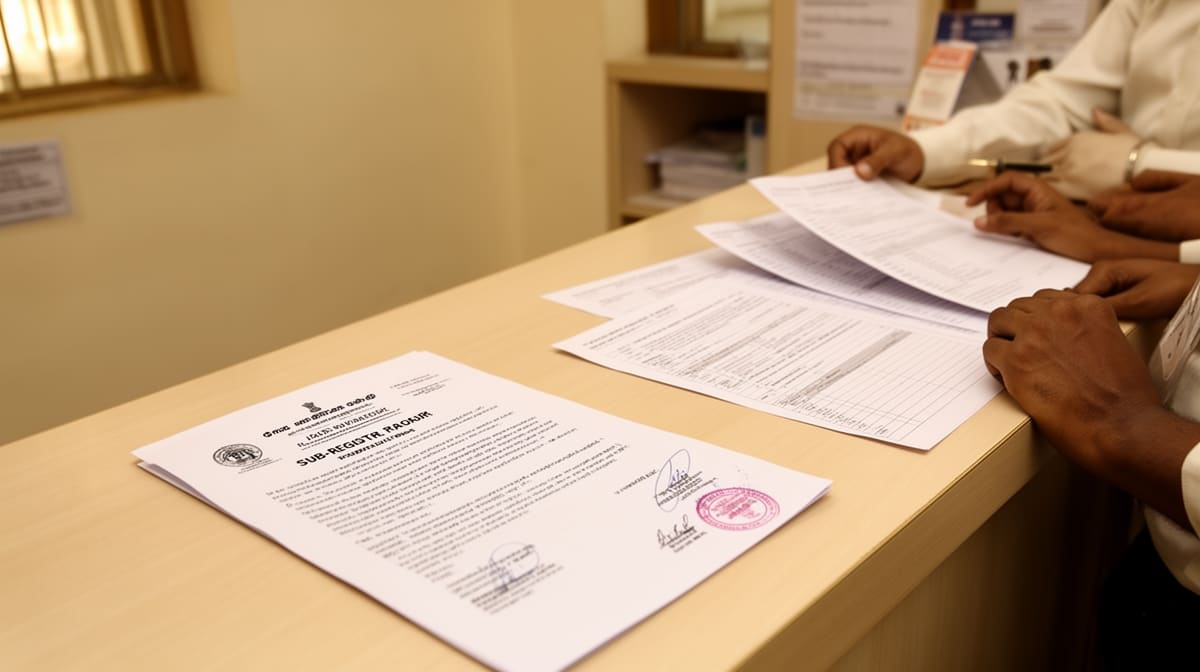
The Madras High Court has clarified that Sub-Registrars must consider all relevant documents, including prior registered wills, before refusing registration of a sale deed under Section 71 of the Registration Act, 1908. The judgment underscores the necessity of a speaking order when registration is denied, ensuring procedural fairness in property transactions.
Background & Facts
The Dispute
The petitioner, D. Thamaraiselvan, claimed title to a property through his mother, Subbammal, who was the legatee under a registered will dated 04.10.1996 executed by Muthusamy Gounder. The will took effect upon the testator’s death on 21.02.2005, and the petitioner inherited the property as the sole legal heir. When he presented an agreement of sale for registration, the Sub-Registrar, Nallur-Tiruppur, refused registration under Refusal Check Slip No. RFL/Nallur-Tiruppur/33/2025 dated 04.07.2025, citing a conflicting partition deed (Document No. 1634/2005).
Procedural History
The petitioner approached the Madras High Court under Article 226 of the Constitution of India, seeking:
- Quashing of the refusal check slip as illegal
- Directions to the Sub-Registrar to register the sale deed
- A timeframe for compliance
Relief Sought
The petitioner argued that the Sub-Registrar failed to consider the registered will (Document No. 257/1996), which formed the basis of his title. The refusal was thus arbitrary and contrary to the principles of natural justice.
The Legal Issue
The central question was whether a Sub-Registrar can refuse registration of a document under Section 71 of the Registration Act, 1908 without considering all relevant documents, including prior registered wills, and whether such refusal must be accompanied by a speaking order.
Arguments Presented
For the Petitioner
The petitioner’s counsel contended that:
- The Sub-Registrar ignored the registered will (Document No. 257/1996), which was the foundation of the petitioner’s title.
- The refusal was arbitrary and violated the principles of natural justice, as no opportunity was provided to address the conflicting partition deed.
- The Refusal Check Slip was non-speaking and did not comply with Section 71 of the Registration Act, 1908, which mandates a reasoned order.
For the Respondents
The Special Government Pleader argued that:
- The refusal was justified due to the existence of the partition deed (Document No. 1634/2005), which created a competing claim over the property.
- Reliance was placed on the Division Bench judgment in S. Amalraj v. C. Sivakumar and another (W.A.(MD) No. 8 of 2026), which held that a subsequent document conflicting with an earlier registered document could be construed as forged.
- Without prejudice, the respondents sought remand for reconsideration after issuing notice to all interested parties.
The Court's Analysis
The Court examined the Refusal Check Slip and observed that it made no reference to the registered will (Document No. 257/1996), which was the petitioner’s primary title document. The Court held that:
-
Section 71 of the Registration Act, 1908 imposes a duty on the Sub-Registrar to consider all documents presented before refusing registration. Failure to do so renders the refusal arbitrary and illegal.
-
The Refusal Check Slip was non-speaking and did not provide reasons for ignoring the registered will. The Court emphasized that any refusal must be accompanied by a speaking order, detailing the grounds for rejection and the documents considered.
"The refusal check slip does not refer to the registered will dated 04.10.1996. Therefore, reconsideration is warranted. The refusal check slip is set aside, and the petitioner is permitted to re-present the agreement of sale for registration."
-
The Court distinguished the reliance on S. Amalraj v. C. Sivakumar by noting that the Sub-Registrar had not conducted a thorough examination of all documents. The judgment in Amalraj was inapplicable where the registering authority had failed to consider material evidence.
-
The Court directed that upon re-presentation of the sale deed, the Sub-Registrar must issue notice to all parties to the partition deed (Document No. 1634/2005) and the petitioner. Within 30 days, the Sub-Registrar must either register the document or issue a speaking order under Section 71 of the Registration Act, 1908.
The Verdict
The writ petition was disposed of with the following directions:
- The Refusal Check Slip No. RFL/Nallur-Tiruppur/33/2025 was quashed.
- The petitioner was permitted to re-present the agreement of sale for registration.
- The Sub-Registrar was directed to either register the document or issue a speaking order within 30 days of re-presentation, after issuing notice to all interested parties.
What This Means For Similar Cases
Sub-Registrar Must Consider All Documents
- Sub-Registrars cannot refuse registration based on a single document without examining all relevant title documents, including prior registered wills or deeds.
- Practitioners should ensure that refusal orders explicitly address all documents presented, failing which they may be challenged as arbitrary.
Speaking Order Mandatory Under Section 71
- Any refusal to register a document must be accompanied by a speaking order detailing the reasons for rejection and the documents considered.
- Non-speaking refusal slips are liable to be quashed, as they violate the principles of natural justice and Section 71 of the Registration Act, 1908.
Opportunity for Re-Presentation
- Parties aggrieved by refusal orders should seek re-presentation of documents, ensuring that all relevant evidence is brought to the Sub-Registrar’s attention.
- The Court’s direction to issue notice to all interested parties ensures that competing claims are adjudicated fairly before registration is refused.