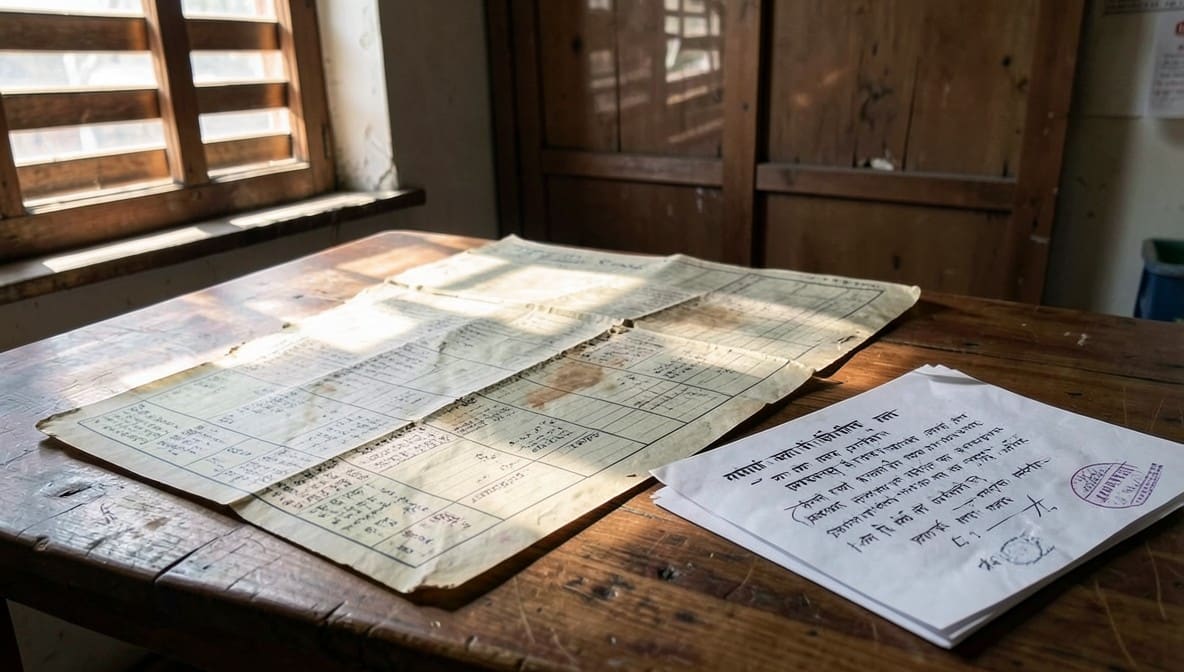
The Allahabad High Court delivered a significant judgment on the primacy of valid title deeds over historical revenue records, holding that a municipal corporation cannot deny a no-objection certificate (NOC) for construction based solely on century-old revenue entries when the land has been continuously recorded as abadi and developed under registered sale deeds since 1913.
Background & Facts
The Dispute
The petitioner, M/s Knots India Carpets Private Limited, sought an NOC from Nagar Nigam Varanasi for constructing a hotel on a property measuring 22,571.84 sq ft (2097.75 sq mtr) in Misir Pokhra, Varanasi. The Municipal Corporation refused the NOC by letter dated 24.01.2026, citing that Arazi No. 2404 was recorded as a pond in the Fasli year 1291 (1884 CE) in revenue records. The petitioner challenged this refusal, arguing that the land had been lawfully transferred, developed, and recorded as abadi (settled) land for over a century.
Key Facts
- 19.11.1913: Erstwhile Municipal Board, Benaras, executed a registered sale deed for 2 Bighas and 7 Biswas of land (Arazi No. 2404) in favor of Maharaja Mahindra Chandra Nandy, admitting the land was open with structures. The sale was sanctioned by the Commissioner (letter dated 31.05.1913) and Municipal Board resolution (27.09.1913).
- 12.11.1920: Another registered sale deed transferred 5 Biswas of land to Maharaja Mahindra Chandra Nandy.
- 25.09.1957: Successors of Maharaja Nandy transferred 19,099 sq ft of land to Godrej Dhunjishaw Gandhi and Shavak Dhunjishaw Gandhi.
- 11.02.1958: Godrej Gandhi purchased an additional 7,808 sq ft from Raja Ram Sahu.
- 21.09.1959: Godrej Gandhi transferred 3,605.5 sq ft to Sri Shiv Dayal Khemka Charitable Trust.
- 08.11.2011: The petitioner acquired the property via registered sale deed, which was recorded in municipal records.
- 09.02.2018: Petitioner entered into a MoU with the State of U.P. for constructing a Star Hotel (investment: Rs. 100 crores).
- 24.01.2026: Nagar Nigam Varanasi denied the NOC, relying on the 1884 revenue entry.
Procedural History
- 20.03.2026: Court directed respondents to obtain instructions.
- 01.04.2026: Respondents stated Arazi No. 2404 was recorded as a pond in 1884 but now as abadi. They cited Hinch Lal Tiwari v. State of U.P. (2001) 6 SCC 496 to justify pond restoration.
- 29.04.2026: Principal Secretary, Urban Development, filed an affidavit relying on an IIT-BHU report (15.04.2026), prepared at the respondents' instance.
- 10.04.2026: Sub-Divisional Magistrate initiated proceedings under Sections 59/61 of the UP Tenancy Act, 1939 (erroneously cited; should be UP Revenue Code, 2006).
- 30.04.2026: Court noted respondents' lack of action prior to the writ petition and directed personal affidavits from Principal Secretary and Municipal Commissioner.
- 11.05.2026 & 15.05.2026: Matter adjourned at respondents' request.
- 27.05.2026: Court proceeded to decide the petition with parties' consent.
The Parties' Positions
Petitioner's Contention:
- The 1913 sale deed admitted the land was open with structures, estopping respondents from alleging it was a pond.
- Revenue records show the land as abadi since 1954 (Fasli year 1361) till date.
- The property is in a densely populated area, and no pond exists as per IIT-BHU report.
- UP Zamindari Abolition & Land Reforms Act, 1950 and UP Revenue Code, 2006 are inapplicable as the land was included in municipal limits before 01.07.1952.
- Doctrine of estoppel bars respondents from denying the 1913 sale deed's validity.
Respondents' Contention:
- Arazi No. 2404 was recorded as a pond in 1884, and the IIT-BHU report supports pond redevelopment.
- Reliance on Hinch Lal Tiwari and Jagpal Singh v. State of Punjab (2011) 11 SCC 396 to argue for pond restoration.
Relief Sought
The petitioner sought:
- Quashing of the impugned letter dated 24.01.2026.
- A writ of mandamus directing Nagar Nigam Varanasi to reconsider the NOC application.
The Legal Issue
The central question was whether historical revenue records (1884) showing land as a pond can override:
- Valid registered sale deeds executed in 1913 and subsequent transfers.
- Continuous recording of the land as abadi in revenue records since 1954.
- Doctrine of estoppel against the municipal corporation, which admitted the land's character in 1913.
Arguments Presented
For the Petitioner
- Title Validity: The 1913 sale deed carried a presumption of validity under Section 54 of the Transfer of Property Act, 1882, and Registration Act, 1908. The burden to disprove its genuineness lay on the respondents, who failed to discharge it.
- Revenue Records: The land was recorded as abadi since 1954 (Fasli year 1361), and no records showed it as a pond post-1952. The Khasra (record of possession) for Fasli year 1359 showed a partial pond entry, but the Khatauni (record of rights) consistently recorded it as abadi.
- Estoppel: The Municipal Board admitted in 1913 that the land was open with structures, estopping it from later alleging it was a pond. Reliance was placed on Manualsons Hotels Pvt Ltd v. State of Kerala (2016) for the principle that unconscionable departure from an assumption is barred.
- Inapplicability of Statutes: The UP Zamindari Abolition & Land Reforms Act, 1950 and UP Revenue Code, 2006 were inapplicable as the land was included in municipal limits before 01.07.1952. No demarcation under Section 5 or notification under Section 8 of the UP Urban Areas Zamindari Abolition & Land Reforms Act, 1956 was issued.
- Arbitrary Action: The respondents targeted only the petitioner's property (22,571.84 sq ft) out of 0.688 hectares of Arazi No. 2404, violating Article 14.
For the Respondents
- Pond Character: Arazi No. 2404 was recorded as a pond in 1884, and the IIT-BHU report supported its restoration.
- Precedents: Reliance on Hinch Lal Tiwari and Jagpal Singh to argue that pond land must be restored regardless of subsequent developments.
The Court's Analysis
The Court conducted a multi-pronged analysis of the legal and factual matrix:
-
Primacy of Registered Sale Deeds:
"A registered sale deed carries with it a formidable presumption of validity and genuineness. Registration is not a mere procedural formality but a solemn act that imparts a high degree of sanctity to the document." The Court relied on Prem Singh v. Birbal (2006) 5 SCC 353, Jamila Begum v. Shami Mohd. (2019) 2 SCC 727, and Ratan Singh v. Normal Gill (2021) 15 SCC 300 to hold that the burden to disprove a registered deed is heavy and requires cogent evidence. The respondents failed to challenge the 1913 sale deed's validity, estopping them from later alleging the land was a pond.
-
Revenue Records vs. Ground Reality:
- The Khasra (possession record) for Fasli year 1359 showed a partial pond entry, but the Khatauni (rights record) recorded the land as abadi since 1954.
- The 1913 sale deed explicitly mentioned "land with structures", corroborating the land's non-pond character.
- The IIT-BHU report (15.04.2026) found no pond at the site, recommending new pond development procedures. The report noted:
"The pond appears to have been filled with silt, earth, and debris over time... The surrounding areas are densely populated."
- The respondents failed to produce revenue records between 1884 and 1954, raising adverse inferences under Section 114 of the Evidence Act, 1872.
-
Inapplicability of Precedents: The Court distinguished Hinch Lal Tiwari and Jagpal Singh:
- In Hinch Lal Tiwari, the land was never developed, and pattas were wrongly granted over pond land.
- In Jagpal Singh, the appellants were trespassers who filled a village pond.
- In the present case, the petitioner's predecessors had valid title since 1913, and the land was developed and recorded as abadi for 72 years. The respondents took no action for pond restoration until the writ petition was filed.
-
Estoppel and Unconscionable Conduct: The Court applied Manualsons Hotels Pvt Ltd v. State of Kerala (2016) to hold that the Municipal Corporation was estopped from denying the 1913 sale deed's validity after 113 years. The doctrine of estoppel barred unconscionable departure from the assumption that the land was open with structures.
-
Arbitrary and Discriminatory Action: The respondents targeted only the petitioner's 22,571.84 sq ft property out of 0.688 hectares of Arazi No. 2404, violating Article 14 of the Constitution.
-
Statutory Inapplicability:
- UP Zamindari Abolition & Land Reforms Act, 1950: Inapplicable under Section 1(2) as the land was included in municipal limits before 07.07.1949.
- UP Revenue Code, 2006: Chapters VIII and IX (pertaining to pond management) were inapplicable as the land was not agricultural and no demarcation/notification was issued under the UP Urban Areas Zamindari Abolition & Land Reforms Act, 1956.
- UP Tenancy Act, 1939: Proceedings under Sections 59/61 were misconceived as there was no tenancy dispute.
The Verdict
The writ petition was allowed. The Court:
- Quashed the impugned letter dated 24.01.2026 issued by Nagar Nigam Varanasi.
- Issued a writ of mandamus directing Nagar Nigam Varanasi to reconsider the petitioner's NOC application for hotel construction, keeping in view the Court's findings.
- Directed that the reconsideration be completed expeditiously, preferably within four weeks from the production of the certified copy of the order.
- Made no order as to costs.
What This Means For Similar Cases
Revenue Records Are Not Conclusive Proof of Land Character
- Historical revenue entries (e.g., 1884) cannot override valid title deeds or continuous possession records.
- Courts will draw adverse inferences under Section 114 of the Evidence Act if revenue records are incomplete or dilapidated.
- Practitioners should argue:
- The burden of proof lies on the party relying on historical records to disprove valid title deeds.
- Estoppel applies where a party (e.g., municipal corporation) admitted the land's character in prior transactions.
Development and Public Use Trump Pond Restoration Claims
- Pond restoration directions (e.g., Hinch Lal Tiwari, Jagpal Singh) apply only where:
- The land retains its pond character.
- There are no valid title deeds or development.
- The land is not in a densely populated area.
- Practitioners should argue:
- Loss of utility: If a pond has been filled, developed, or recorded as abadi for decades, restoration is not automatic.
- Public interest: Construction for economic development (e.g., hotels) may outweigh ecological restoration if no pond exists.
Municipal Corporations Cannot Act Arbitrarily
- Targeted actions (e.g., denying NOC to one owner while ignoring others) violate Article 14.
- Procedural compliance is mandatory:
- Demarcation under Section 5 and notification under Section 8 of the UP Urban Areas Zamindari Abolition & Land Reforms Act, 1956 are prerequisites for vesting agricultural land.
- Misapplication of statutes (e.g., citing UP Tenancy Act, 1939 instead of UP Revenue Code, 2006) can vitiate proceedings.
- Practitioners should argue:
- Arbitrary action: Challenge selective enforcement of pond restoration.
- Jurisdictional errors: Seek quashing of proceedings initiated under wrong statutes.