The Allahabad High Court has clarified that recorded revenue entries, even if formally recognized under statutory provisions, cannot immunize landholders from judicial review when the validity of those entries is under active challenge. This ruling reinforces the principle that administrative records are not conclusive in the face of pending legal proceedings seeking their cancellation.
Background & Facts
The Dispute
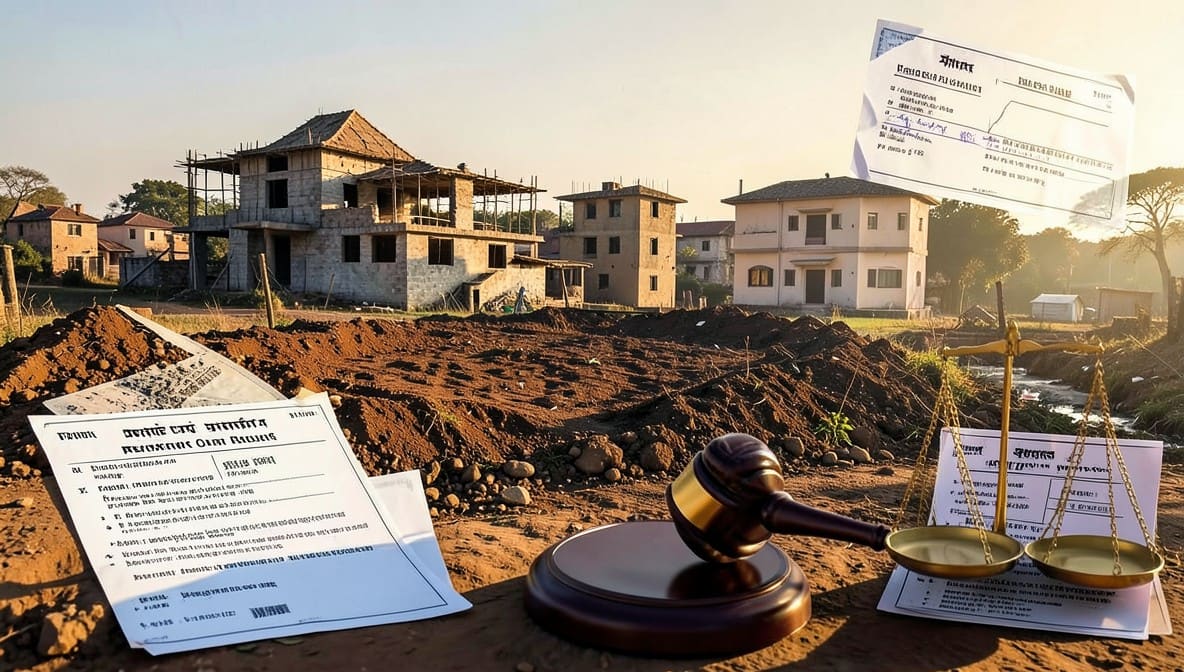
The petitioner filed a Public Interest Litigation seeking direction to the State of Uttar Pradesh and other respondents to remove illegal encroachments over Plot No.1M, recorded as Banjar in the revenue records of Village Rampur J. Sarroi, Tehsil and District Bhadohi. The encroachment allegedly involved unauthorized occupation and use of land by respondents 4 to 7, who were recorded as Bhumidhars with non-transferable rights.
Key Facts
- Plot No.1M covers an area of 1.138 hectares and is recorded in Khata No.205
- Respondents 4 to 7 (Amritlal, Nandlal, Brijlal, and Heeralal) are recorded as Bhumidhars with non-transferable rights in Khatauni 1426-1431 Fasli
- Their recording as Bhumidhars was effected pursuant to an order passed under Section 122-B(4)(f) of the U.P. Z.A. & L.R. Act, 1950
- The State Government has initiated proceedings for cancellation of the order granting rights to respondents 4 to 7
- Case No. T202316670505045 is pending before the Deputy District Magistrate, Bhadohi, challenging the legality of the settlement order
- No evidence was presented to the Court that the encroachment had been rectified or that the pending cancellation case had been concluded
Procedural History
- 2025: Public Interest Litigation No. 3197 of 2025 filed before the Allahabad High Court
- 12.11.2025: Tehsildar, Bhadohi, issued instructions regarding the revenue status of Plot No.1M, submitted to the Court
- 12.05.2026: Hearing concluded before Hon’ble Justice Arun Kumar
The Parties' Positions
The petitioner contended that the respondents’ possession constituted illegal encroachment on government land, despite the revenue entries, and sought immediate removal. The State, through its Standing Counsel, acknowledged the pendency of Case No. T202316670505045 and submitted that the matter was already under adjudication by the Deputy District Magistrate.
Relief Sought
The petitioner sought a direction to the State and revenue authorities to remove the illegal encroachment, cancel the impugned settlement orders, and restore the land to its original status as Banjar.
The Legal Issue
The central question was whether the mere recording of respondents as Bhumidhars under Section 122-B(4)(f) of the U.P. Z.A. & L.R. Act, 1950 precludes the High Court from directing removal of encroachment, when a statutory challenge to the very validity of that recording is already pending before a competent authority.
Arguments Presented
For the Petitioner
The petitioner argued that revenue records are not title documents and cannot override the legal status of land as government property. He relied on the principle that recorded entries are prima facie evidence only and are subject to challenge. He contended that the pendency of a cancellation proceeding does not validate the encroachment and that the State has a duty to protect public land.
For the Respondent
The State, through its Standing Counsel, accepted that the settlement order was under challenge but submitted that the matter was already sub judice before the Deputy District Magistrate. It argued that the High Court should not interfere in an ongoing administrative proceeding and that the petitioner’s remedy lay in awaiting the outcome of Case No. T202316670505045.
The Court's Analysis
The Court examined the nature of the proceedings pending before the Deputy District Magistrate and noted that the State itself had initiated Case No. T202316670505045 for cancellation of the settlement order. The Court observed that the respondents’ rights, though recorded in revenue records, were not final or immune from judicial review.
"The recording of names in the Khatauni does not confer absolute or indefeasible title, particularly when the very basis of such recording is under statutory challenge."
The Court emphasized that the High Court’s role in a PIL is not to act as a land tribunal but to ensure that statutory authorities discharge their duties expeditiously. Since the competent authority - the Deputy District Magistrate - was already seized of the matter, further intervention by the High Court was unnecessary. The Court held that directing removal of encroachment at this stage would amount to prejudging the outcome of a pending proceeding.
The Court also noted that the State had not disputed the pendency of the cancellation case, nor had it sought to defend the legality of the settlement order. This indicated that the administrative machinery was already engaged in correcting the error.
The Verdict
The writ petition was disposed of with the direction that the Deputy District Magistrate, Tehsil and District Bhadohi, decide Case No. T202316670505045 expeditiously, preferably within three months from the date of presentation of a certified copy of this order. The Court directed that the decision be rendered after affording a fair hearing to all parties concerned. No other relief was granted.
What This Means For Similar Cases
Revenue Records Are Not Final in the Face of Pending Challenges
- Practitioners must not assume that recorded Bhumidhari rights under the U.P. Z.A. & L.R. Act are immune from cancellation
- In PILs or writ petitions challenging encroachment, the pendency of a statutory cancellation proceeding is a decisive factor
- Courts will defer to the competent authority where a valid challenge is already pending
Judicial Restraint in PILs Involving Administrative Remedies
- The High Court will not substitute its opinion for that of a statutorily designated authority when proceedings are active
- Petitioners must exhaust or await the outcome of pending administrative or quasi-judicial proceedings before seeking extraordinary remedies
- This judgment reinforces the doctrine of sub judice in land disputes involving statutory settlement orders
Duty to Act Expeditiously on Pending Land Cancellation Cases
- Authorities must conclude pending cancellation proceedings within reasonable timelines
- Courts may impose deadlines (e.g., three months) to prevent undue delay in resolving land title disputes
- Failure to comply may invite further judicial intervention or contempt proceedings