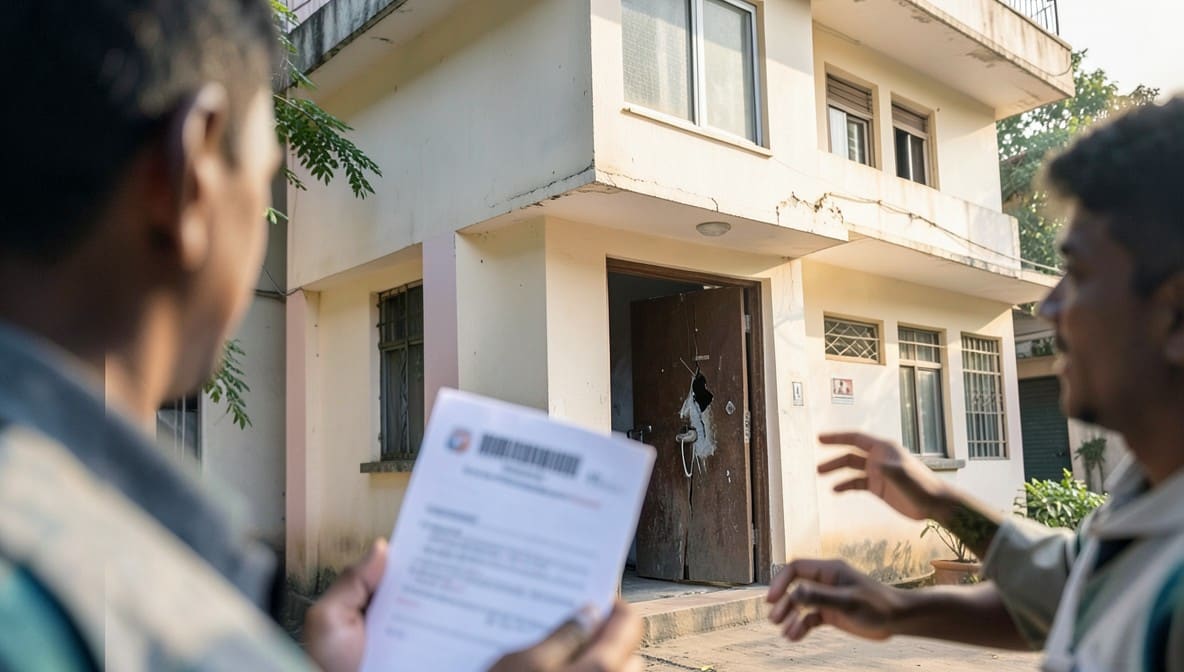
The Madhya Pradesh High Court recently dismissed an appeal challenging a trial court's decree in a property title dispute, reinforcing the principle that a registered sale deed prevails over claims of adverse possession when supported by documentary evidence. The judgment underscores the onerous burden on parties asserting adverse possession and the limited scope for belated amendments under the Code of Civil Procedure (CPC).
Background & Facts
The Dispute
The respondent/plaintiff, Smt. Mamta, filed a civil suit for declaration of title and restoration of possession over municipal house No. 534 (old No. 515), Vinoba Nagar, Indore. She claimed ownership via a registered sale deed dated 12.06.1996 from one Sitabai, describing the property as a 40x10 ft (400 sq.ft) three-storeyed house. The appellants/defendants, Sohanlal and others, allegedly encroached upon the property on 15.07.2006 by breaking the lock, prompting the plaintiff to lodge a police complaint on 18.01.2007.
Key Facts
- Property Details: House No. 534 (old No. 515), Vinoba Nagar, Indore, measuring 400 sq.ft.
- Ownership Chain:
- 05.01.1965: Ramchandra sold the property (1600 sq.ft) to Kamlabai via registered sale deed (Exhibit P/21).
- 19.07.1971: Kamlabai sold the entire property to Sitabai (Exhibit P/22).
- 12.06.1996: Sitabai sold 400 sq.ft of the property to the plaintiff (Exhibit P/23).
- Encroachment: Appellants allegedly took possession on 15.07.2006 by breaking the lock.
- Police Complaint: Filed on 18.01.2007 at Police Station, Palasia.
- Suit Filing: Plaintiff filed the suit on 29.06.2007.
The Appellants' Claims
The appellants denied the plaintiff's ownership, asserting:
- They resided in the property since 1974-75 with their father, late Pannalalji Tiwari.
- Pannalalji was the original owner, and the plaintiff's husband, Mohanlal, fraudulently obtained a patta (Exhibit D/1) in his name instead of Pannalalji.
- They claimed adverse possession over the property, having constructed the house with self-earned money.
- A separate suit (Civil Suit No. 94A/2006) was filed by the appellants for title declaration, pending adjudication.
Procedural History
- 29.06.2007: Plaintiff filed Civil Suit No. 17A/2014 before the Vth Additional District Judge, Indore.
- 28.08.2015: Trial court decreed the suit, declaring the plaintiff as owner and directing the appellants to vacate the property within 30 days. Damages at Rs. 800/month from 01.06.2007 were also awarded.
- 10.12.2015: Appellants filed the present First Appeal (FA No. 907/2015).
- 30.08.2022: Appellants filed applications under Order 41 Rule 27, Order 6 Rule 17, and Order 7 Rule 11 CPC, arguing the property was in a gandi basti (slum area) and required permission under the Madhya Pradesh Gandi Basti Kshetra (Sudhar Tatha Nirmulan) Adhiniyam, 1976 for eviction.
Relief Sought
The appellants sought:
- Setting aside the trial court's decree dated 28.08.2015.
- Dismissal of the plaintiff's suit on grounds of lack of title and belated amendments.
- Alternatively, remand of the case for fresh evidence.
The Legal Issue
The appeal raised three key questions:
- Whether the trial court correctly recorded findings on the plaintiff's title based on the registered sale deed.
- Whether the appellants illegally encroached upon the property and if damages were rightly awarded.
- Whether the appellants' applications under Order 41 Rule 27 and Order 6 Rule 17 CPC for belated amendments were tenable.
Arguments Presented
For the Appellants
- Title Dispute: Argued the plaintiff's sale deed was void ab initio as Mohanlal fraudulently obtained the patta in his name instead of Pannalalji.
- Adverse Possession: Claimed continuous possession since 1974-75 and construction of the house with self-earned money.
- Procedural Objections: Contended the suit was barred under Section 20 of the Madhya Pradesh Gandi Basti Adhiniyam, 1976, requiring permission for eviction suits in slum areas. Sought belated amendments to raise this defense.
For the Respondent
- Title Proof: Relied on the registered sale deed (Exhibit P/23) and admissions of the appellant (DW-1) acknowledging Sitabai's ownership and tenancy.
- Encroachment: Highlighted the appellants' illegal possession since 15.07.2006 and the police complaint lodged on 18.01.2007.
- Procedural Compliance: Opposed the belated applications, arguing lack of due diligence and delay in raising objections.
The Court's Analysis
Title Dispute
The Court examined the chain of sale deeds (Exhibits P/21, P/22, P/23) and the patta (Exhibit D/1):
- Exhibit P/21 (1965): Ramchandra sold 1600 sq.ft to Kamlabai.
- Exhibit P/22 (1971): Kamlabai sold the entire property to Sitabai.
- Exhibit P/23 (1996): Sitabai sold 400 sq.ft to the plaintiff.
- Exhibit D/1: Patta issued to Mohanlal (plaintiff's husband) as a tenant of Sitabai, paying Rs. 60/month.
The appellant's admission (DW-1) corroborated the plaintiff's title:
"यह कहना सह है क दा वया मकान नगर िनगम म पहले सीताबाई के नाम से दज थी। वतः कहा क पहले हम सीताबाई के मकान म करायेदार थे।" (Translation: "It is correct that the house was earlier registered in the name of Sitabai. Thus, we were tenants of Sitabai.")
The Court held that the sale deed (Exhibit P/23) and the appellant's admissions established the plaintiff's title beyond doubt. The patta (Exhibit D/1) did not confer ownership but merely recognized Mohanlal as a tenant.
Encroachment and Damages
The trial court's findings on illegal encroachment were upheld:
- The appellants failed to prove continuous possession since 1974-75.
- Documents (Exhibits P/38, P/39) showed inconsistent addresses, undermining their claim.
- Witnesses (DW-4 to DW-7) admitted Pannalalji resided near MY Hospital, not the suit property.
- The trial court rightly relied on the plaintiff's documents, prepared by public officers, over the appellants' self-serving statements.
Belated Amendments
The Court dismissed the applications under Order 41 Rule 27 and Order 6 Rule 17 CPC:
- Order 6 Rule 17: Requires showing due diligence to raise new matters post-trial commencement. The appellants failed to demonstrate this.
- Order 41 Rule 27: Requires proving the evidence was not within their knowledge despite due diligence. The appellants' casual statement in para 4 of the applications was insufficient.
- Section 20 of the Gandi Basti Adhiniyam: The provision applies only to eviction suits against tenants, not owners. The appellants' claim of ownership negated their reliance on this provision.
Adverse Possession
The Court reiterated the onerous burden on parties claiming adverse possession:
- The plea must be specific, continuous, open, and hostile to the true owner.
- The appellants failed to establish the date of commencement of adverse possession or its continuity.
- By asserting adverse possession, they implicitly admitted the plaintiff's title, undermining their own claim.
"It is a settled position of law that in a plea of adverse possession there is no equity at all. The burden is onerous on the person asserting adverse possession in which the appellants miserably failed."
The Verdict
The appeal was dismissed, upholding the trial court's decree:
- The plaintiff was declared the owner of the suit property.
- The appellants were directed to vacate the property within 30 days of the judgment.
- Damages of Rs. 800/month from 01.06.2007 until possession was restored were confirmed.
What This Means For Similar Cases
Registered Sale Deed Trumps Adverse Possession
- Documentary Evidence: Courts prioritize registered sale deeds and public records over oral claims of adverse possession.
- Burden of Proof: Parties asserting adverse possession must prove specific dates, continuity, and hostility to the true owner. Vague pleadings are insufficient.
Procedural Compliance Is Non-Negotiable
- Belated Amendments: Applications under Order 41 Rule 27 and Order 6 Rule 17 CPC require due diligence. Casual or delayed submissions are liable to be rejected.
- Statutory Exceptions: Provisions like Section 20 of the Gandi Basti Adhiniyam apply only to tenants, not owners. Misapplication of such provisions can be fatal to the case.
Tenancy vs. Ownership
- Tenancy Admissions: Acknowledging tenancy (as DW-1 did) corroborates the landlord's title and undermines claims of ownership.
- Fraudulent Patta: A patta obtained through misrepresentation (e.g., in a tenant's name instead of the owner) is void ab initio and does not confer title.