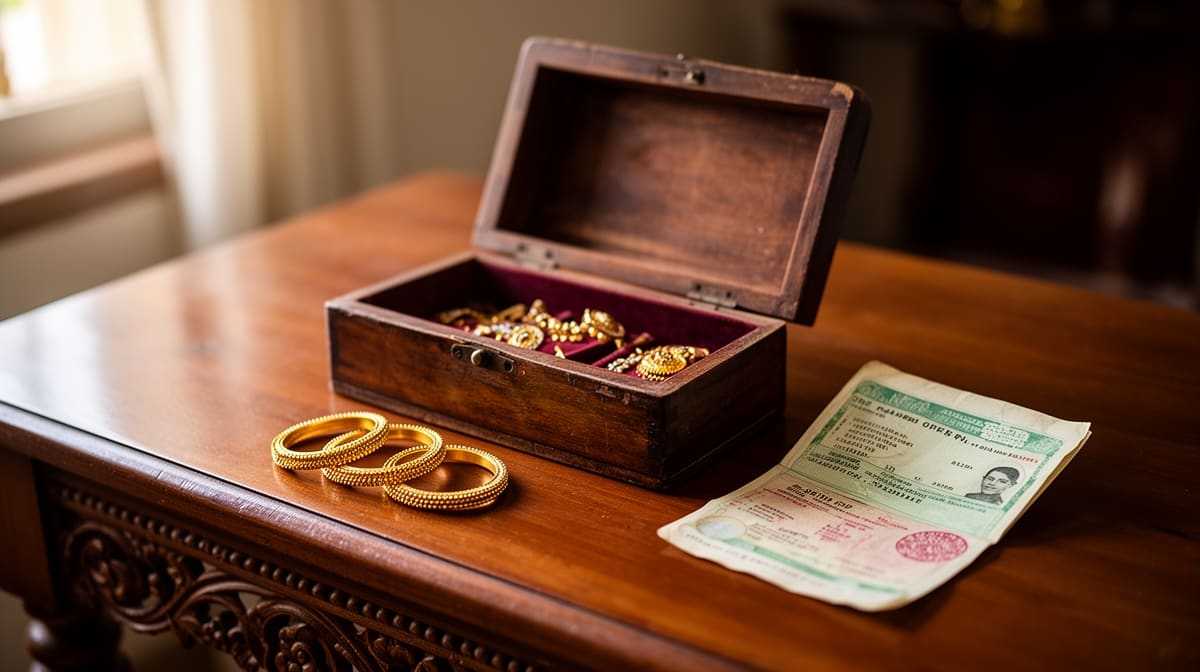
A landmark ruling by the Kerala High Court has clarified that a woman’s right to recover gold ornaments and household articles entrusted during cohabitation does not hinge on the legal validity of the marriage. The judgment establishes that such transactions are governed by the law of trust, irrespective of whether the union is void under personal law. This doctrinal shift has profound implications for women seeking restitution in non-registered or interfaith relationships.
Background & Facts
The Dispute
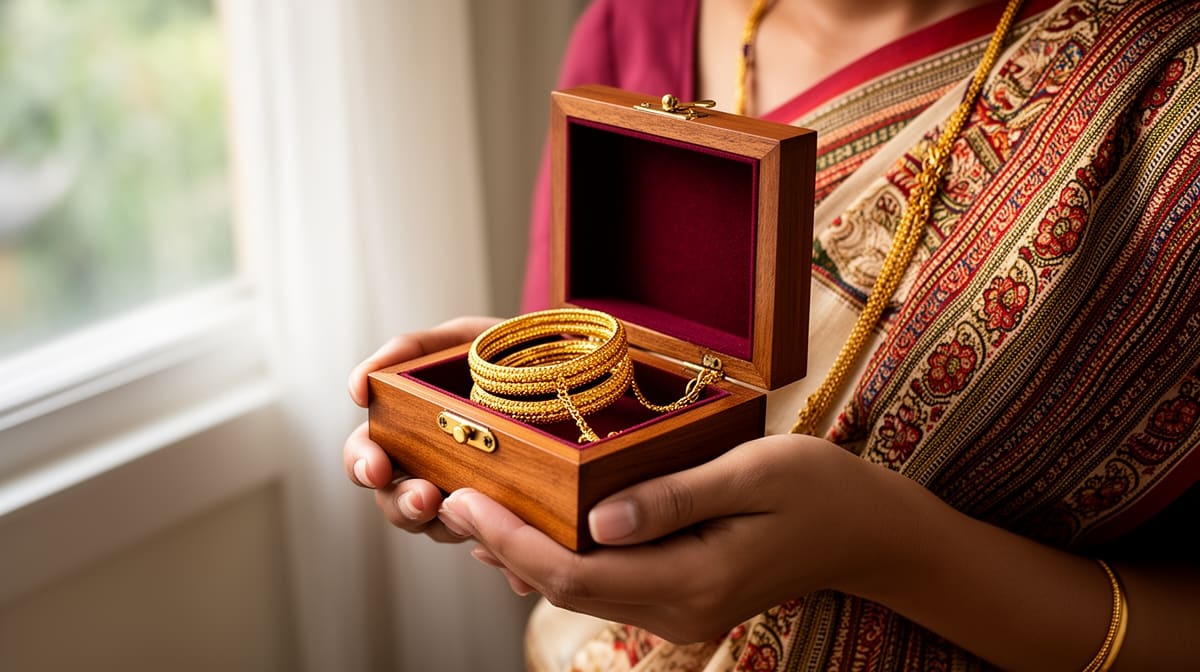
The appellant, a Christian woman, claimed she entered into a marriage with the respondent, a Hindu man, on 23 October 2008 at the Perumkadavila Sub-Registrar’s Office. She alleged that the marriage was solemnized according to Hindu rites at her residence, with both families present. Her parents gifted her 75 sovereigns of gold ornaments and household articles worth ₹1,00,000. She alleged that the respondent misappropriated 70 sovereigns and retained the household items after abandoning her in January 2009.
Procedural History
- 2012: Appellant filed Original Petition No.395/2012 in Family Court, Thiruvananthapuram, seeking recovery of ornaments, household articles, and maintenance.
- 2017: Family Court dismissed the petition, holding that no valid marriage existed under the Hindu Marriage Act, 1955, as the appellant was Christian and had not converted.
- 2017: Appellant filed this matrimonial appeal before the Kerala High Court.
Relief Sought
The appellant sought recovery of 70 sovereigns of gold ornaments, household articles, and arrears of maintenance from January 2009 onwards.
The Legal Issue
The central question was whether a woman can claim recovery of gold ornaments and household articles entrusted during a cohabitation relationship, even if the marriage is legally invalid under personal law.
Arguments Presented
For the Appellant
Counsel argued that Ext.A1, the marriage registration document, though not sufficient to establish a valid Hindu marriage, evidenced the parties’ mutual intent to wed. The photographs in Ext.A2 series, unchallenged in genuineness, corroborated the ceremonial exchange of ornaments. Reliance was placed on Section 14 of the Family Courts Act, which permits courts to act on any relevant material, including photographs, without requiring original negatives. The appellant contended that the transaction of ornaments was akin to a trust, and the respondent’s retention constituted unjust enrichment.
For the Respondent
The respondent’s counsel contended that the marriage was void ab initio under the Hindu Marriage Act, 1955, as the appellant was not a Hindu and had not converted. He argued that no legal relationship existed to support claims for recovery of property. He further challenged the authenticity of the photographs and claimed there was no proof of entrustment. The respondent maintained that maintenance and property claims are inseparable from marital status and cannot be sustained in the absence of a valid marriage.
The Court's Analysis
The Court affirmed that the marriage between the appellant and respondent was invalid under the Hindu Marriage Act, 1955, as the appellant, a Christian, had not converted to Hinduism, and no marriage was solemnized under the Special Marriage Act, 1954. The Court agreed with the Family Court that Ext.A1 was merely a contract and did not confer marital status.
However, the Court departed sharply from the trial court’s reasoning on the recovery of ornaments. It held that the validity of the marriage is irrelevant to claims arising from the entrustment of valuables during cohabitation. The Court observed:
"If the evidence establishes that a woman, while entering into a relationship of the above nature with a man and in contemplation of starting a shared life, had entrusted or the man had obtained her gold ornaments or other valuables, she would be entitled to recover the same from him, as the transaction is in the nature of trust."
The Court emphasized that Section 14 of the Family Courts Act empowers courts to rely on circumstantial evidence, including photographs, without demanding original negatives. The respondent’s allegation of morphing was speculative and unsupported. The Court further noted that the trial court’s rejection of the claim was predicated entirely on the invalidity of marriage, thereby failing to independently assess the trust-based claim.
The Court concluded that the trial court’s approach was legally flawed. The law of trust, not marital status, governs the recovery of property voluntarily transferred in contemplation of a shared life.
The Verdict
The appellant prevailed on the issue of property recovery. The Kerala High Court set aside the Family Court’s judgment and remanded the matter for fresh adjudication on the claim for return of gold ornaments and household articles. The Court held that the validity of the marriage is immaterial to such claims, and the trial court must now evaluate the evidence under the doctrine of trust.
What This Means For Similar Cases
Trust Claims Are Independent of Marriage Validity
- Practitioners must now separate the issue of marital validity from claims for recovery of dowry or gifted property
- Even in void or unregistered unions, if valuables were transferred in contemplation of cohabitation, a trust may be inferred
- The burden shifts to the recipient to prove the transfer was absolute, not conditional
Photographs and Circumstantial Evidence Are Admissible
- Family Courts may rely on digital photographs as substantive evidence under Section 14 of the Family Courts Act
- No requirement exists to produce original negatives or forensic verification unless specifically contested with credible evidence
- Courts must evaluate the plausibility of oral testimony in light of visual and contextual evidence
Maintenance Claims Still Tied to Marital Status
- While property recovery is now decoupled from marriage validity, maintenance claims under Section 24 of the Hindu Marriage Act or Section 125 CrPC still require proof of a legally recognized relationship
- Practitioners should file parallel claims under Section 125 CrPC where cohabitation is established, even if marriage is void
- This judgment does not extend to alimony or spousal support - only to restitution of property